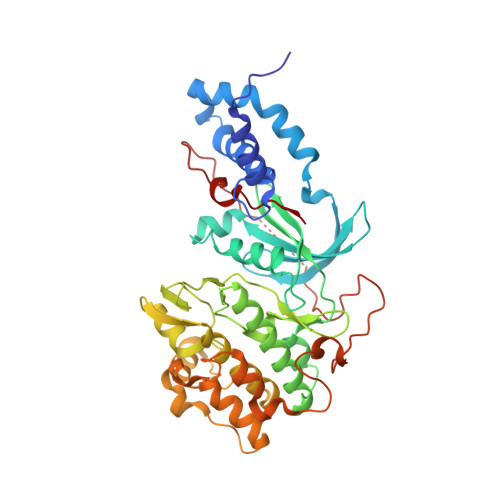
6P5M | pdb_00006p5m

Discovery of a Novel, Highly Potent, and Selective Thieno[3,2-d]pyrimidinone-Based Cdc7 inhibitor with a Quinuclidine Moiety (TAK-931) as an Orally Active Investigational Anti-Tumor Agent


Experimental Data Snapshot

  • Method: X-RAY DIFFRACTION
  • Resolution: 2.65 Å
  • R-Value Free: 
    0.225 (Depositor), 0.223 (DCC) 
  • R-Value Work: 
    0.193 (Depositor), 0.194 (DCC) 
  • R-Value Observed: 
    0.195 (Depositor) 

Starting Model: experimental
View more details

wwPDB Validation 3D Report Full Report

Validation slider image for 6P5M

Ligand Structure Quality Assessment 


This is version 1.2 of the entry. See complete history

Literature

Discovery of a Novel, Highly Potent, and Selective Thieno[3,2-d]pyrimidinone-Based Cdc7 Inhibitor with a Quinuclidine Moiety (TAK-931) as an Orally Active Investigational Antitumor Agent.

Kurasawa, O.Miyazaki, T.Homma, M.Oguro, Y.Imada, T.Uchiyama, N.Iwai, K.Yamamoto, Y.Ohori, M.Hara, H.Sugimoto, H.Iwata, K.Skene, R.Hoffman, I.Ohashi, A.Nomura, T.Cho, N.

(2020) J Med Chem 63: 1084-1104

  • DOI: https://doi.org/10.1021/acs.jmedchem.9b01427
  • Primary Citation Related Structures: 
    6P5M, 6P5P

  • PubMed Abstract: 

    In our pursuit of developing a novel, potent, and selective cell division cycle 7 (Cdc7) inhibitor, we optimized the previously reported thieno[3,2- d ]pyrimidinone analogue I showing time-dependent Cdc7 kinase inhibition and slow dissociation kinetics. These medicinal chemistry efforts led to the identification of compound 3d , which exhibited potent cellular activity, excellent kinase selectivity, and antitumor efficacy in a COLO205 xenograft mouse model. However, the issue of formaldehyde adduct formation emerged during a detailed study of 3d , which was deemed an obstacle to further development. A structure-based approach to circumvent the adduct formation culminated in the discovery of compound 11b ( TAK-931 ) possessing a quinuclidine moiety as a preclinical candidate. In this paper, the design, synthesis, and biological evaluation of this series of compounds will be presented.


  • Organizational Affiliation
    • Pharmaceutical Research Division , Takeda Pharmaceutical Company, Ltd. , 26-1, Muraoka-Higashi 2-chome , Fujisawa , Kanagawa 251-8555 , Japan.

Macromolecule Content 

  • Total Structure Weight: 185.5 kDa 
  • Atom Count: 12,788 
  • Modeled Residue Count: 1,574 
  • Deposited Residue Count: 1,620 
  • Unique protein chains: 1

Macromolecules

Find similar proteins by:|  3D Structure
Entity ID: 1
MoleculeChains  Sequence LengthOrganismDetailsImage
Rho-associated protein kinase 2
A, B, C, D
405Homo sapiensMutation(s): 1 
Gene Names: ROCK2KIAA0619
EC: 2.7.11.1 (PDB Primary Data), 2.7.11.39 (UniProt)
UniProt & NIH Common Fund Data Resources
Find proteins for O75116 (Homo sapiens)
Explore O75116 
Go to UniProtKB:  O75116
PHAROS:  O75116
GTEx:  ENSG00000134318 
Entity Groups
Sequence Clusters30% Identity50% Identity70% Identity90% Identity95% Identity100% Identity
UniProt GroupO75116
Sequence Annotations
Expand
Reference Sequence

Small Molecules

Ligands 1 Unique
IDChains Name / Formula / InChI Key2D Diagram3D Interactions
O1S

Query on O1S


Download:Ideal Coordinates CCD File
E [auth A],
F [auth B]
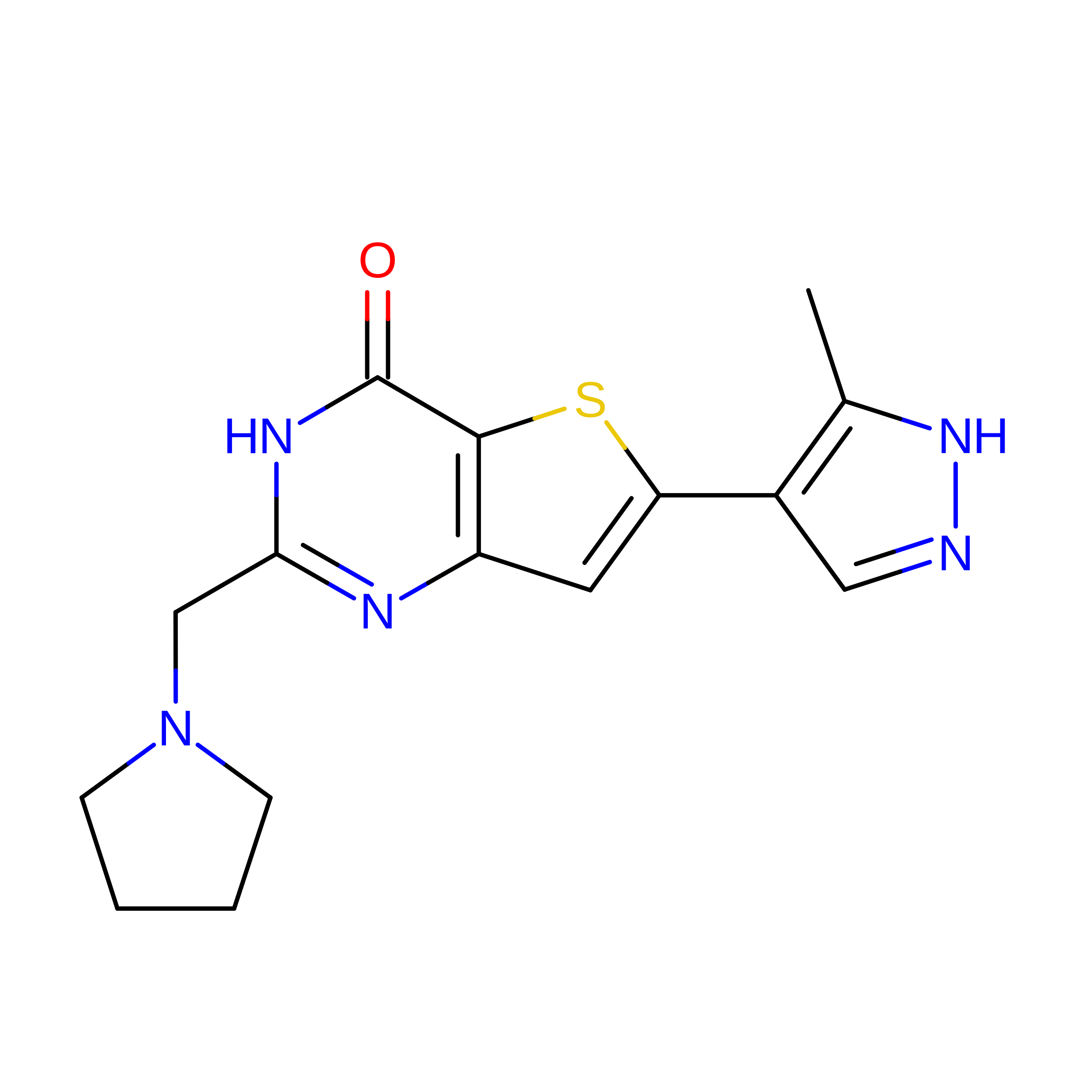
6-(5-methyl-1H-pyrazol-4-yl)-2-[(pyrrolidin-1-yl)methyl]thieno[3,2-d]pyrimidin-4(3H)-one
C15 H17 N5 O S
MUYIKPWUBQUQAV-UHFFFAOYSA-N

Experimental Data & Validation

Experimental Data

  • Method: X-RAY DIFFRACTION
  • Resolution: 2.65 Å
  • R-Value Free:  0.225 (Depositor), 0.223 (DCC) 
  • R-Value Work:  0.193 (Depositor), 0.194 (DCC) 
  • R-Value Observed: 0.195 (Depositor) 
Space Group: P 1 21 1
Unit Cell:
Length ( Å )Angle ( ˚ )
a = 89.456α = 90
b = 146.416β = 97.12
c = 111.876γ = 90
Software Package:
Software NamePurpose
HKL-2000data scaling
REFMACrefinement
PDB_EXTRACTdata extraction
HKL-2000data reduction
PHASERphasing

Structure Validation

View Full Validation Report


Ligand Structure Quality Assessment 


Entry History 

Deposition Data

Revision History  (Full details and data files)

  • Version 1.0: 2020-01-15
    Type: Initial release
  • Version 1.1: 2020-02-26
    Changes: Database references
  • Version 1.2: 2023-10-11
    Changes: Data collection, Database references, Refinement description