Download Mendeley
A surrogate structural platform informed by ancestral reconstruction and resurrection of a putative carbohydrate binding module hybrid illuminates the neofunctionalization of a pectate lyase.
Jones, D.R., McLean, R., Hobbs, J.K., Abbott, D.W.(2019) J Struct Biol 207: 279-286
- PubMed: 31200020 Search on PubMed
- DOI: https://doi.org/10.1016/j.jsb.2019.06.003
- Primary Citation Related Structures:
6OJK, 6OJL - PubMed Abstract:
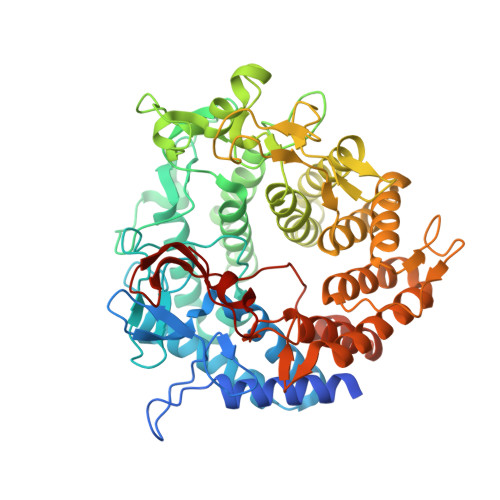
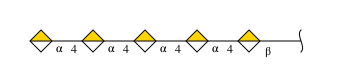
Yersinia enterocolitica is a pectinolytic zoonotic foodborne pathogen, the genome of which contains pectin-binding proteins and several different classes of pectinases, including polysaccharide lyases (PLs) and an exopolygalacturonase. These proteins operate within a coordinated pathway to completely saccharify homogalacturonan (HG). Polysaccharide lyase family 2 (PL2) is divided into two major subfamilies that are broadly-associated with contrasting 'endolytic' (PL2A) or 'exolytic' (PL2B) activities on HG. In the Y. enterocolitica genome, the PL2A gene is adjacent to an independent carbohydrate binding module from family 32 (YeCBM32), which possesses a N-terminal secretion tag and is known to specifically bind HG. Independent CBMs are rare in nature and, most commonly, are fused to enzymes in order to potentiate catalysis. The unconventional gene architecture of YePL2A and YeCBM32, therefore, may represent an ancestral relic of a fission event that decoupled PL2A from its cognate CBM. To provide further insight into the evolution of this pectinolytic locus and the molecular basis of HG depolymerisation within Y. enterocolitica, we have resurrected a YePL2A-YeCBM32 chimera and demonstrated that the extant PL2A digests HG more efficiently. In addition, we have engineered a tryptophan from the active site of the exolytic YePL2B into YePL2A (YePL2A-K291W) and demonstrated, using X-ray crystallography of substrate complexes, that it is a structural determinant of exo-activity within the PL2 family. In this manner, surrogate structural platforms may assist in the study of phylogenetic relationships informed by extant and resurrected sequences, and can be used to overcome challenging structural problems within carbohydrate active enzyme families.
- Agriculture and Agri-Food Canada, Lethbridge Research and Development Centre, Lethbridge, Alberta T1J 4B1, Canada.
Organizational Affiliation: