6OC9 | pdb_00006oc9

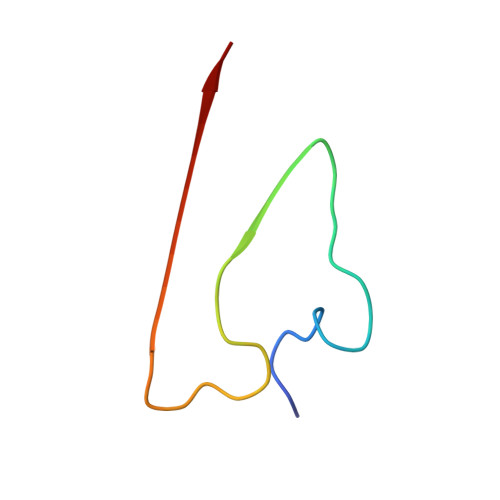
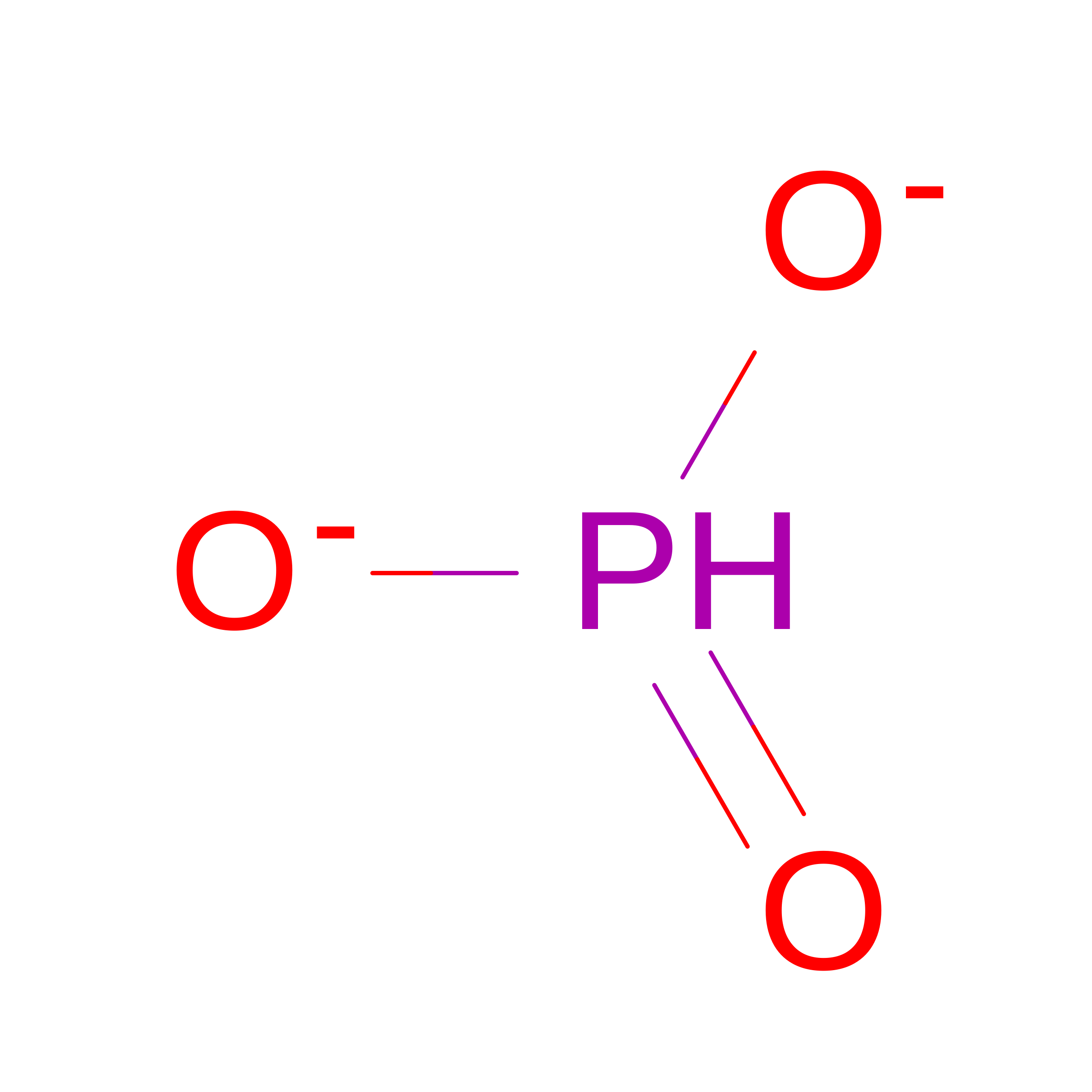
S8 phosphorylated beta amyloid 40 fibrils

  • Classification: SIGNALING PROTEIN
  • Organism(s): Homo sapiens
  • Mutation(s): No 

  • Deposited: 2019-03-22 Released: 2019-06-05 
  • Deposition Author(s): Qiang, W., Hu, Z.W.
  • Funding Organization(s): National Institutes of Health/National Institute of General Medical Sciences (NIH/NIGMS)

Experimental Data Snapshot

  • Method: SOLID-STATE NMR
  • Conformers Calculated: 40 
  • Conformers Submitted: 10 
  • Selection Criteria: structures with the lowest energy 

wwPDB Validation 3D Report Full Report

Currently 6OC9 does not have a validation slider image.


This is version 1.3 of the entry. See complete history

Literature

Molecular structure of an N-terminal phosphorylated beta-amyloid fibril.

Hu, Z.W.Vugmeyster, L.Au, D.F.Ostrovsky, D.Sun, Y.Qiang, W.

(2019) Proc Natl Acad Sci U S A 116: 11253-11258

  • DOI: https://doi.org/10.1073/pnas.1818530116
  • Primary Citation Related Structures: 
    6OC9

  • PubMed Abstract: 

    The structural polymorphism in β-amyloid (Aβ) plaques from Alzheimer disease (AD) has been recognized as an important pathological factor. Plaques from sporadic AD patients contain fibrillar deposits of various amyloid proteins/peptides, including posttranslational modified Aβ (PTM-Aβ) subtypes. Although many PTM-Aβs were shown to accelerate the fibrillation process, increase neuronal cytotoxicity of aggregates, or enhance the stability of fibrils, the contribution of PTM-Aβs to structural polymorphisms and their pathological roles remains unclear. We report here the NMR-based structure for the Ser-8-phosphorylated 40-residue Aβ (pS8-Aβ 40 ) fibrils, which shows significant difference to the wild-type fibrils, with higher cross-seeding efficiency and thermodynamic stability. Given these physicochemical properties, the structures originated from pS8-Aβ 40 fibrils may potentially dominate the polymorphisms in the mixture of wild-type and phosphorylated Aβ deposits. Our results imply that Aβ subtypes with "seeding-prone" properties may influence the polymorphisms of amyloid plaques through the cross-seeding process.


  • Organizational Affiliation
    • Department of Chemistry, Binghamton University, Binghamton, NY 13902.

Macromolecule Content 

  • Total Structure Weight: 44.16 kDa 
  • Atom Count: 3,100 
  • Modeled Residue Count: 400 
  • Deposited Residue Count: 400 
  • Unique protein chains: 1

Macromolecules

Find similar proteins by:|  3D Structure
Entity ID: 1
MoleculeChains  Sequence LengthOrganismDetailsImage
Amyloid-beta precursor protein
A, B, C, D, E
A, B, C, D, E, F, G, H, I, J
40Homo sapiensMutation(s): 0 
UniProt & NIH Common Fund Data Resources
Find proteins for P05067 (Homo sapiens)
Explore P05067 
Go to UniProtKB:  P05067
PHAROS:  P05067
GTEx:  ENSG00000142192 
Entity Groups
Sequence Clusters30% Identity50% Identity70% Identity90% Identity95% Identity100% Identity
UniProt GroupP05067
Sequence Annotations
Expand
Reference Sequence

Experimental Data & Validation

Experimental Data

  • Method: SOLID-STATE NMR
  • Conformers Calculated: 40 
  • Conformers Submitted: 10 
  • Selection Criteria: structures with the lowest energy 

Structure Validation

View Full Validation Report

Currently 6OC9 does not have a validation slider image.


Entry History 

& Funding Information

Deposition Data


Funding OrganizationLocationGrant Number
National Institutes of Health/National Institute of General Medical Sciences (NIH/NIGMS)United StatesGM125853

Revision History  (Full details and data files)

  • Version 1.0: 2019-06-05
    Type: Initial release
  • Version 1.1: 2019-06-12
    Changes: Data collection, Database references
  • Version 1.2: 2020-01-01
    Changes: Author supporting evidence
  • Version 1.3: 2024-05-01
    Changes: Data collection, Database references