6NVO | pdb_00006nvo

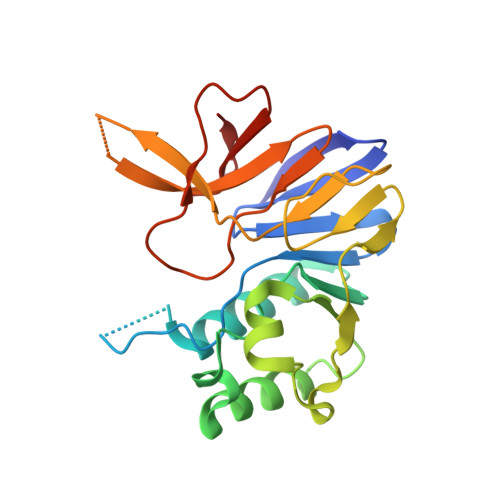
Crystal structure of Pseudomonas putida nuclease MPE


Experimental Data Snapshot

  • Method: X-RAY DIFFRACTION
  • Resolution: 2.20 Å
  • R-Value Free: 
    0.263 (Depositor), 0.264 (DCC) 
  • R-Value Work: 
    0.202 (Depositor), 0.204 (DCC) 
  • R-Value Observed: 
    0.208 (Depositor) 

Starting Model: experimental
View more details

wwPDB Validation 3D Report Full Report

Validation slider image for 6NVO

This is version 1.4 of the entry. See complete history

Literature

Activity and structure ofPseudomonas putidaMPE, a manganese-dependent single-strand DNA endonuclease encoded in a nucleic acid repair gene cluster.

Ejaz, A.Goldgur, Y.Shuman, S.

(2019) J Biological Chem 294: 7931-7941

  • DOI: https://doi.org/10.1074/jbc.RA119.008049
  • Primary Citation Related Structures: 
    6NVO, 6NVP

  • PubMed Abstract: 

    A recently identified and widely prevalent prokaryal gene cluster encodes a suite of enzymes with imputed roles in nucleic acid repair. The enzymes are as follows: MPE, a DNA endonuclease; Lhr-Core, a 3'-5' DNA helicase; LIG, an ATP-dependent DNA ligase; and Exo, a metallo-β-lactamase-family nuclease. Bacterial and archaeal MPE proteins belong to the binuclear metallophosphoesterase superfamily that includes the well-studied DNA repair nucleases Mre11 and SbcD. Here, we report that the Pseudomonas putida MPE protein is a manganese-dependent DNA endonuclease that incises either linear single strands or the single-strand loops of stem-loop DNA structures. MPE has feeble activity on duplex DNA. A crystal structure of MPE at 2.2 Å resolution revealed that the active site includes two octahedrally coordinated manganese ions. Seven signature amino acids of the binuclear metallophosphoesterase superfamily serve as the enzymic metal ligands in MPE: Asp 33 , His 35 , Asp 78 , Asn 112 , His 124 , His 146 , and His 158 A swath of positive surface potential on either side of the active site pocket suggests a binding site for the single-strand DNA substrate. The structure of MPE differs from Mre11 and SbcD in several key respects: (i) MPE is a monomer, whereas Mre11 and SbcD are homodimers; (ii) MPE lacks the capping domain present in Mre11 and SbcD; and (iii) the topology of the β sandwich that comprises the core of the metallophosphoesterase fold differs in MPE vis-à-vis Mre11 and SbcD. We surmise that MPE exemplifies a novel clade of DNA endonuclease within the binuclear metallophosphoesterase superfamily.


  • Organizational Affiliation
    • From the Molecular Biology and.

Macromolecule Content 

  • Total Structure Weight: 24.42 kDa 
  • Atom Count: 1,639 
  • Modeled Residue Count: 200 
  • Deposited Residue Count: 216 
  • Unique protein chains: 1

Macromolecules

Find similar proteins by:|  3D Structure
Entity ID: 1
MoleculeChains  Sequence LengthOrganismDetailsImage
Nuclease MPE216Pseudomonas putida KT2440Mutation(s): 0 
Gene Names: PP_1102
UniProt
Find proteins for Q88NV2 (Pseudomonas putida (strain ATCC 47054 / DSM 6125 / CFBP 8728 / NCIMB 11950 / KT2440))
Explore Q88NV2 
Go to UniProtKB:  Q88NV2
Entity Groups
Sequence Clusters30% Identity50% Identity70% Identity90% Identity95% Identity100% Identity
UniProt GroupQ88NV2
Sequence Annotations
Expand
Reference Sequence

Experimental Data & Validation

Experimental Data

  • Method: X-RAY DIFFRACTION
  • Resolution: 2.20 Å
  • R-Value Free:  0.263 (Depositor), 0.264 (DCC) 
  • R-Value Work:  0.202 (Depositor), 0.204 (DCC) 
  • R-Value Observed: 0.208 (Depositor) 
Space Group: P 21 21 2
Unit Cell:
Length ( Å )Angle ( ˚ )
a = 58.224α = 90
b = 72.995β = 90
c = 41.748γ = 90
Software Package:
Software NamePurpose
PHENIXrefinement
HKL-2000data reduction
HKL-2000data scaling
SHELXCDphasing

Structure Validation

View Full Validation Report


Entry History 

& Funding Information

Deposition Data


Funding OrganizationLocationGrant Number
National Institutes of Health/National Institute of Environmental Health Sciences (NIH/NIEHS)United StatesR35 GM126945

Revision History  (Full details and data files)

  • Version 1.0: 2019-03-27
    Type: Initial release
  • Version 1.1: 2019-04-17
    Changes: Data collection, Database references
  • Version 1.2: 2019-05-29
    Changes: Data collection, Database references
  • Version 1.3: 2019-12-18
    Changes: Author supporting evidence
  • Version 1.4: 2023-10-11
    Changes: Data collection, Database references, Derived calculations, Refinement description