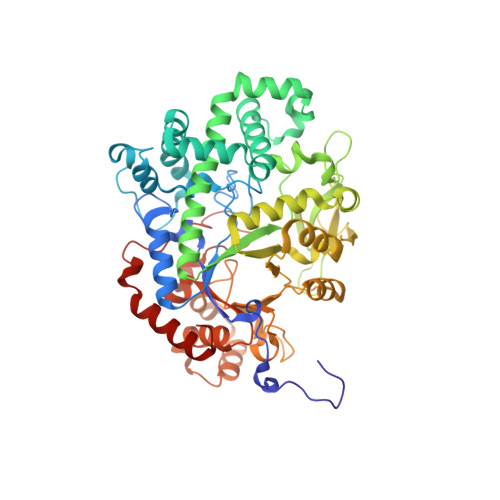
6LX2 | pdb_00006lx2

Potato D-enzyme complexed with CA26


Experimental Data Snapshot

  • Method: X-RAY DIFFRACTION
  • Resolution: 2.05 Å
  • R-Value Free: 
    0.196 (Depositor), 0.204 (DCC) 
  • R-Value Work: 
    0.166 (Depositor), 0.175 (DCC) 
  • R-Value Observed: 
    0.168 (Depositor) 

Starting Model: experimental
View more details

wwPDB Validation 3D Report Full Report

Validation slider image for 6LX2

This is version 1.3 of the entry. See complete history

Literature

Structural analysis and reaction mechanism of the disproportionating enzyme (D-enzyme) from potato.

Imamura, K.Matsuura, T.Nakagawa, A.Kitamura, S.Kusunoki, M.Takaha, T.Unno, H.

(2020) Protein Sci 29: 2085-2100

  • DOI: https://doi.org/10.1002/pro.3932
  • Primary Citation Related Structures: 
    6LX1, 6LX2, 7COV

  • PubMed Abstract: 

    Starch produced by plants is a stored form of energy and is an important dietary source of calories for humans and domestic animals. Disproportionating enzyme (D-enzyme) catalyzes intramolecular and intermolecular transglycosylation reactions of α-1, 4-glucan. D-enzyme is essential in starch metabolism in the potato. We present the crystal structures of potato D-enzyme, including two different types of complex structures: a primary Michaelis complex (substrate binding mode) for 26-meric cycloamylose (CA26) and a covalent intermediate for acarbose. Our study revealed that the acarbose and CA26 reactions catalyzed by potato D-enzyme involve the formation of a covalent intermediate with the donor substrate. HPAEC of reaction substrates and products revealed the activity of the potato D-enzyme on acarbose and CA26 as donor substrates. The structural and chromatography analyses provide insight into the mechanism of the coupling reaction of CA and glucose catalyzed by the potato D-enzyme. The enzymatic reaction mechanism does not involve residual hydrolysis. This could be particularly useful in preventing unnecessary starch degradation leading to reduced crop productivity. Optimization of this mechanism would be important for improvements of starch storage and productivity in crops.


  • Organizational Affiliation
    • Laboratory of Enzyme Chemistry, Graduate School of Agriculture and Biological Science, Osaka Prefecture University, Osaka, Japan.

Macromolecule Content 

  • Total Structure Weight: 60.89 kDa 
  • Atom Count: 4,601 
  • Modeled Residue Count: 523 
  • Deposited Residue Count: 524 
  • Unique protein chains: 1

Macromolecules

Find similar proteins by:|  3D Structure
Entity ID: 1
MoleculeChains  Sequence LengthOrganismDetailsImage
4-alpha-glucanotransferase, chloroplastic/amyloplastic524Solanum tuberosumMutation(s): 0 
Gene Names: DPEP
EC: 2.4.1.25
UniProt
Find proteins for Q06801 (Solanum tuberosum)
Explore Q06801 
Go to UniProtKB:  Q06801
Entity Groups
Sequence Clusters30% Identity50% Identity70% Identity90% Identity95% Identity100% Identity
UniProt GroupQ06801
Sequence Annotations
Expand
Reference Sequence

Oligosaccharides

Help  
Entity ID: 2
MoleculeChains Length2D Diagram GlycosylationD Interactions
4-deoxy-alpha-D-glucopyranose-(1-4)-4-deoxy-alpha-D-glucopyranose-(1-4)-4-deoxy-alpha-D-glucopyranose-(1-4)-4-deoxy-alpha-D-glucopyranose-(1-4)-4-deoxy-alpha-D-glucopyranose-(1-4)-4-deoxy-alpha-D-glucopyranose-(1-4)-4-deoxy-alpha-D-glucopyranose-(1-4)-4-deoxy-alpha-D-glucopyranose-(1-4)-4-deoxy-alpha-D-glucopyranose-(1-4)-4-deoxy-alpha-D-glucopyranose-(1-4)-4-deoxy-alpha-D-glucopyranose
B
11N/A
Glycosylation Resources
GlyTouCan: G24848RE
GlyCosmos: G24848RE

Small Molecules

Experimental Data & Validation

Experimental Data

  • Method: X-RAY DIFFRACTION
  • Resolution: 2.05 Å
  • R-Value Free:  0.196 (Depositor), 0.204 (DCC) 
  • R-Value Work:  0.166 (Depositor), 0.175 (DCC) 
  • R-Value Observed: 0.168 (Depositor) 
Space Group: C 2 2 21
Unit Cell:
Length ( Å )Angle ( ˚ )
a = 70.841α = 90
b = 120.413β = 90
c = 174.552γ = 90
Software Package:
Software NamePurpose
REFMACrefinement
SCALAdata scaling
MOLREPphasing
PDB_EXTRACTdata extraction
MOSFLMdata reduction

Structure Validation

View Full Validation Report


Entry History 

Deposition Data

Revision History  (Full details and data files)

  • Version 1.0: 2020-08-26
    Type: Initial release
  • Version 1.1: 2020-09-23
    Changes: Database references
  • Version 1.2: 2020-10-07
    Changes: Database references
  • Version 1.3: 2023-11-29
    Changes: Data collection, Database references, Refinement description