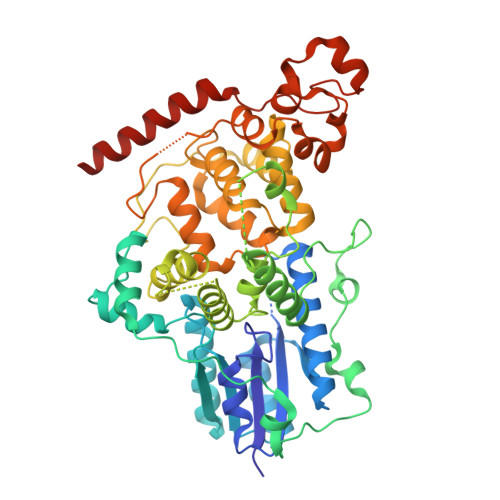
6LUE | pdb_00006lue

Crystal structure of mouse Cryptochrome 1 in complex with compound KL201


Experimental Data Snapshot

  • Method: X-RAY DIFFRACTION
  • Resolution: 2.10 Å
  • R-Value Free: 
    0.256 (Depositor), 0.263 (DCC) 
  • R-Value Work: 
    0.218 (Depositor), 0.227 (DCC) 
  • R-Value Observed: 
    0.220 (Depositor) 

Starting Model: experimental
View more details

wwPDB Validation 3D Report Full Report

Validation slider image for 6LUE

Ligand Structure Quality Assessment 


This is version 1.3 of the entry. See complete history

Literature

An Isoform-Selective Modulator of Cryptochrome 1 Regulates Circadian Rhythms in Mammals.

Miller, S.Aikawa, Y.Sugiyama, A.Nagai, Y.Hara, A.Oshima, T.Amaike, K.Kay, S.A.Itami, K.Hirota, T.

(2020) Cell Chem Biol 27: 1192-1198.e5

  • DOI: https://doi.org/10.1016/j.chembiol.2020.05.008
  • Primary Citation Related Structures: 
    6LUE

  • PubMed Abstract: 

    Cryptochrome 1 (CRY1) and CRY2 are core regulators of the circadian clock, and the development of isoform-selective modulators is important for the elucidation of their redundant and distinct functions. Here, we report the identification and functional characterization of a small-molecule modulator of the mammalian circadian clock that selectively controls CRY1. Cell-based circadian chemical screening identified a thienopyrimidine derivative KL201 that lengthened the period of circadian rhythms in cells and tissues. Functional assays revealed stabilization of CRY1 but not CRY2 by KL201. A structure-activity relationship study of KL201 derivatives in combination with X-ray crystallography of the CRY1-KL201 complex uncovered critical sites and interactions required for CRY1 regulation. KL201 bound to CRY1 in overlap with FBXL3, a subunit of ubiquitin ligase complex, and the effect of KL201 was blunted by knockdown of FBXL3. KL201 will facilitate isoform-selective regulation of CRY1 to accelerate chronobiology research and therapeutics against clock-related diseases.


  • Organizational Affiliation
    • Institute of Transformative Bio-Molecules, Nagoya University, Nagoya 464-8601, Japan.

Macromolecule Content 

  • Total Structure Weight: 115.52 kDa 
  • Atom Count: 7,784 
  • Modeled Residue Count: 941 
  • Deposited Residue Count: 996 
  • Unique protein chains: 1

Macromolecules

Find similar proteins by:|  3D Structure
Entity ID: 1
MoleculeChains  Sequence LengthOrganismDetailsImage
Cryptochrome-1
A, B
498Mus musculusMutation(s): 0 
Gene Names: Cry1
UniProt & NIH Common Fund Data Resources
Find proteins for P97784 (Mus musculus)
Explore P97784 
Go to UniProtKB:  P97784
IMPC:  MGI:1270841
Entity Groups
Sequence Clusters30% Identity50% Identity70% Identity90% Identity95% Identity100% Identity
UniProt GroupP97784
Sequence Annotations
Expand
Reference Sequence

Small Molecules

Ligands 1 Unique
IDChains Name / Formula / InChI Key2D Diagram3D Interactions
EUL
(Subject of Investigation/LOI)

Query on EUL


Download:Ideal Coordinates CCD File
C [auth A],
D [auth B]
2-bromanyl-N-(5,6,7,8-tetrahydro-[1]benzothiolo[2,3-d]pyrimidin-4-yl)benzamide
C17 H14 Br N3 O S
KFSLRFWIPVMBNT-UHFFFAOYSA-N

Experimental Data & Validation

Experimental Data

  • Method: X-RAY DIFFRACTION
  • Resolution: 2.10 Å
  • R-Value Free:  0.256 (Depositor), 0.263 (DCC) 
  • R-Value Work:  0.218 (Depositor), 0.227 (DCC) 
  • R-Value Observed: 0.220 (Depositor) 
Space Group: C 1 2 1
Unit Cell:
Length ( Å )Angle ( ˚ )
a = 130.551α = 90
b = 143.26β = 118.65
c = 76.73γ = 90
Software Package:
Software NamePurpose
REFMACrefinement
PHENIXrefinement
MOSFLMdata reduction
SCALAdata scaling
PHASERphasing

Structure Validation

View Full Validation Report


Ligand Structure Quality Assessment 


Entry History 

& Funding Information

Deposition Data


Funding OrganizationLocationGrant Number
Japan Science and TechnologyJapanJPMJPR14LA
Japan Society for the Promotion of Science (JSPS)Japan15H05590
Japan Society for the Promotion of Science (JSPS)Japan18H02402

Revision History  (Full details and data files)

  • Version 1.0: 2020-06-10
    Type: Initial release
  • Version 1.1: 2020-06-24
    Changes: Database references
  • Version 1.2: 2020-09-30
    Changes: Database references
  • Version 1.3: 2023-11-29
    Changes: Data collection, Database references, Refinement description