Download Mendeley
A Plug-and-Latch Mechanism for Gating the Mechanosensitive Piezo Channel.
Geng, J., Liu, W., Zhou, H., Zhang, T., Wang, L., Zhang, M., Li, Y., Shen, B., Li, X., Xiao, B.(2020) Neuron 106: 438
- PubMed: 32142647 Search on PubMed
- DOI: https://doi.org/10.1016/j.neuron.2020.02.010
- Primary Citation Related Structures:
6LQI - PubMed Abstract:
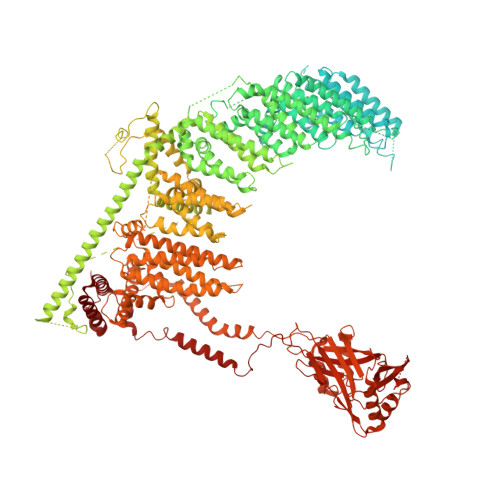
The mechanosensitive Piezo1 and Piezo2 channels convert mechanical force into cation permeation. However, their precise mechanogating and regulatory mechanisms remain elusive. Here, we report that Piezo1 utilizes three lateral ion-conducting portals equipped with physical gates for cooperative gating and splicing regulation. Mutating residues lining the portal converts Piezo1 into an anion-selective channel, demonstrating the portal-based cation-permeating pathway. Intriguingly, the portal is physically blocked with a plug domain, which undergoes alternative splicing in both Piezo1 and Piezo2. The Piezo1 isoform has local openings of the portals, enlarged single-channel conductance and sensitized mechanosensitivity. Remarkably, the three plugs are strategically latched onto the central axis for coordinated gating of the three portals. Disrupting the latching induces three quantal sub-conductance states in Piezo1, but not in the isoform. Together, we propose that Piezo utilizes an elegant plug-and-latch mechanism to physically and coordinately gate the lateral portals through the spliceable plug gates.
- State Key Laboratory of Membrane Biology, Tsinghua-Peking Joint Center for Life Sciences, Beijing Advanced Innovation Center for Structural Biology, IDG/McGovern Institute for Brain Research, School of Pharmaceutical Sciences, Tsinghua University, Beijing 100084, China.
Organizational Affiliation: