6LEH | pdb_00006leh

Crystal structure of Autotaxin in complex with an inhibitor


Experimental Data Snapshot

  • Method: X-RAY DIFFRACTION
  • Resolution: 2.00 Å
  • R-Value Free: 
    0.237 (Depositor), 0.238 (DCC) 
  • R-Value Work: 
    0.189 (Depositor), 0.190 (DCC) 
  • R-Value Observed: 
    0.192 (Depositor) 

Starting Model: experimental
View more details

wwPDB Validation 3D Report Full Report

Validation slider image for 6LEH

Ligand Structure Quality Assessment 


This is version 3.2 of the entry. See complete history

Literature

Identification of PotentIn VivoAutotaxin Inhibitors that Bind to Both Hydrophobic Pockets and Channels in the Catalytic Domain.

Kawaguchi, M.Okabe, T.Okudaira, S.Hama, K.Kano, K.Nishimasu, H.Nakagawa, H.Ishitani, R.Kojima, H.Nureki, O.Aoki, J.Nagano, T.

(2020) J Med Chem 63: 3188-3204

  • DOI: https://doi.org/10.1021/acs.jmedchem.9b01967
  • Primary Citation Related Structures: 
    6LEH

  • PubMed Abstract: 

    Autotaxin (ATX, also known as ENPP2) is a predominant lysophosphatidic acid (LPA)-producing enzyme in the body, and LPA regulates various physiological functions, such as angiogenesis and wound healing, as well as pathological functions, including proliferation, metastasis, and fibrosis, via specific LPA receptors. Therefore, the ATX-LPA axis is a promising therapeutic target for dozens of diseases, including cancers, pulmonary and liver fibroses, and neuropathic pain. Previous structural studies revealed that the catalytic domain of ATX has a hydrophobic pocket and a hydrophobic channel; these serve to recognize the substrate, lysophosphatidylcholine (LPC), and deliver generated LPA to LPA receptors on the plasma membrane. Most reported ATX inhibitors bind to either the hydrophobic pocket or the hydrophobic channel. Herein, we present a unique ATX inhibitor that binds mainly to the hydrophobic pocket and also partly to the hydrophobic channel, inhibiting ATX activity with high potency and selectivity in vitro and in vivo . Notably, our inhibitor can rescue the cardia bifida (two hearts) phenotype in ATX-overexpressing zebrafish embryos.


  • Organizational Affiliation
    • Graduate School of Pharmaceutical Sciences, The University of Tokyo, 7-3-1 Hongo, Bunkyo-ku, Tokyo 113-0033, Japan.

Macromolecule Content 

  • Total Structure Weight: 99.67 kDa 
  • Atom Count: 6,712 
  • Modeled Residue Count: 783 
  • Deposited Residue Count: 835 
  • Unique protein chains: 1

Macromolecules

Find similar proteins by:|  3D Structure
Entity ID: 1
MoleculeChains  Sequence LengthOrganismDetailsImage
Ectonucleotide pyrophosphatase/phosphodiesterase family member 2835Mus musculusMutation(s): 0 
Gene Names: Enpp2Npps2Pdnp2
EC: 3.1.4.39 (PDB Primary Data), 3.1.4.4 (UniProt)
UniProt
Find proteins for Q9R1E6 (Mus musculus)
Explore Q9R1E6 
Go to UniProtKB:  Q9R1E6
Entity Groups
Sequence Clusters30% Identity50% Identity70% Identity90% Identity95% Identity100% Identity
UniProt GroupQ9R1E6
Glycosylation
Glycosylation Sites: 2Go to GlyGen: Q9R1E6-1
Sequence Annotations
Expand
Reference Sequence

Oligosaccharides

Help  
Entity ID: 2
MoleculeChains Length2D Diagram GlycosylationD Interactions
alpha-D-mannopyranose-(1-2)-alpha-D-mannopyranose-(1-3)-alpha-D-mannopyranose-(1-6)-alpha-D-mannopyranose-(1-4)-2-acetamido-2-deoxy-beta-D-glucopyranose-(1-4)-2-acetamido-2-deoxy-beta-D-glucopyranose
B
6N-Glycosylation
Glycosylation Resources
GlyTouCan: G40296AW
GlyCosmos: G40296AW
GlyGen: G40296AW
Entity ID: 3
MoleculeChains Length2D Diagram GlycosylationD Interactions
alpha-D-mannopyranose-(1-4)-2-acetamido-2-deoxy-beta-D-glucopyranose-(1-4)-2-acetamido-2-deoxy-beta-D-glucopyranose
C
3N-Glycosylation
Glycosylation Resources
GlyTouCan: G62182OO
GlyCosmos: G62182OO
GlyGen: G62182OO

Small Molecules

Ligands 8 Unique
IDChains Name / Formula / InChI Key2D Diagram3D Interactions
EAR
(Subject of Investigation/LOI)

Query on EAR


Download:Ideal Coordinates CCD File
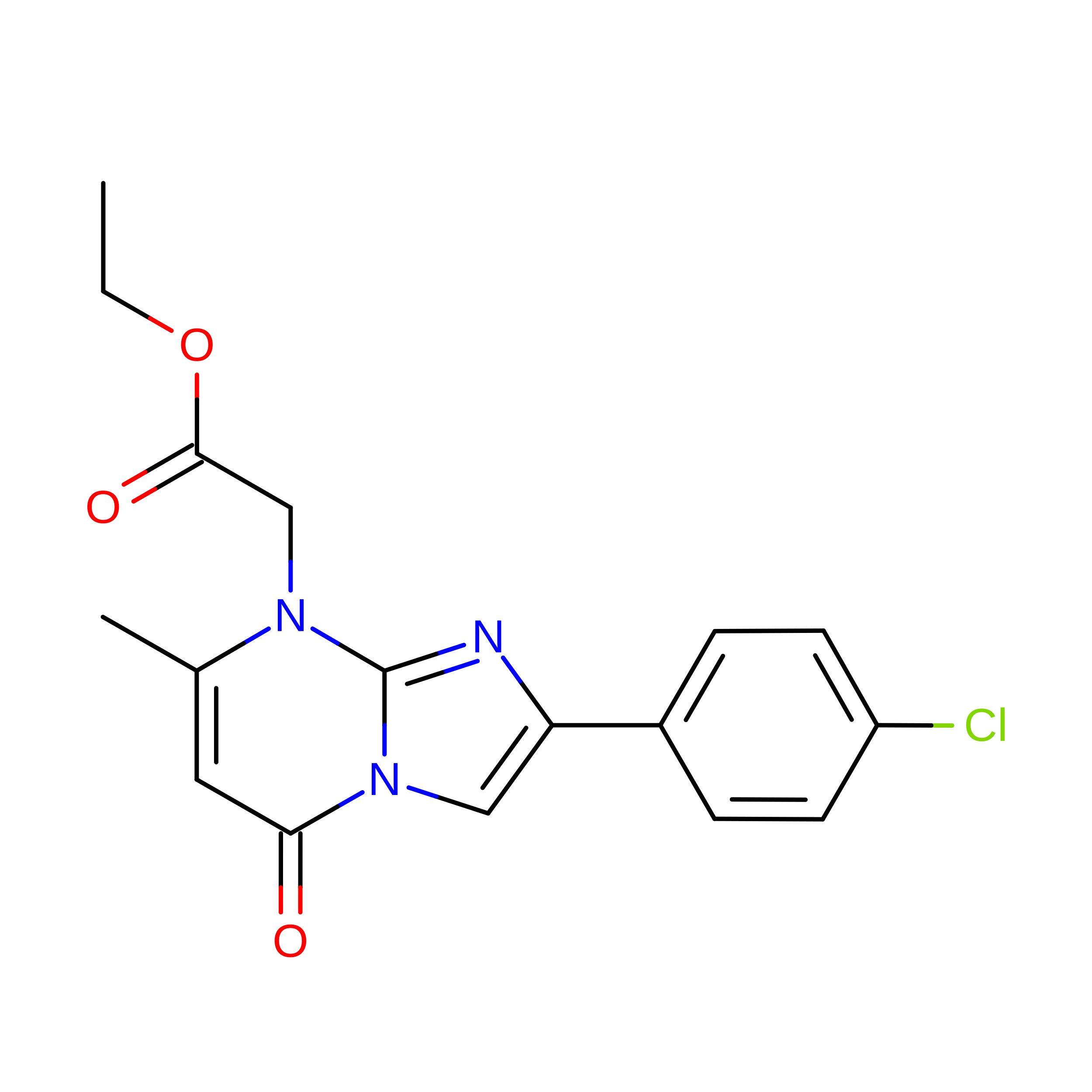
CA [auth A]ethyl 2-[2-(4-chlorophenyl)-7-methyl-5-oxidanylidene-imidazo[1,2-a]pyrimidin-8-yl]ethanoate
C17 H16 Cl N3 O3
RLGJDVZNHWILQI-UHFFFAOYSA-N
SO4

Query on SO4


Download:Ideal Coordinates CCD File
I [auth A]SULFATE ION
O4 S
QAOWNCQODCNURD-UHFFFAOYSA-L
ZN

Query on ZN


Download:Ideal Coordinates CCD File
D [auth A],
E [auth A]
ZINC ION
Zn
PTFCDOFLOPIGGS-UHFFFAOYSA-N
EDO

Query on EDO


Download:Ideal Coordinates CCD File
AA [auth A]
BA [auth A]
L [auth A]
M [auth A]
N [auth A]
AA [auth A],
BA [auth A],
L [auth A],
M [auth A],
N [auth A],
O [auth A],
P [auth A],
Q [auth A],
R [auth A],
S [auth A],
T [auth A],
U [auth A],
V [auth A],
W [auth A],
X [auth A],
Y [auth A],
Z [auth A]
1,2-ETHANEDIOL
C2 H6 O2
LYCAIKOWRPUZTN-UHFFFAOYSA-N
CA

Query on CA


Download:Ideal Coordinates CCD File
F [auth A]CALCIUM ION
Ca
BHPQYMZQTOCNFJ-UHFFFAOYSA-N
K

Query on K


Download:Ideal Coordinates CCD File
H [auth A]POTASSIUM ION
K
NPYPAHLBTDXSSS-UHFFFAOYSA-N
CL

Query on CL


Download:Ideal Coordinates CCD File
J [auth A],
K [auth A]
CHLORIDE ION
Cl
VEXZGXHMUGYJMC-UHFFFAOYSA-M
NA

Query on NA


Download:Ideal Coordinates CCD File
G [auth A]SODIUM ION
Na
FKNQFGJONOIPTF-UHFFFAOYSA-N

Experimental Data & Validation

Experimental Data

  • Method: X-RAY DIFFRACTION
  • Resolution: 2.00 Å
  • R-Value Free:  0.237 (Depositor), 0.238 (DCC) 
  • R-Value Work:  0.189 (Depositor), 0.190 (DCC) 
  • R-Value Observed: 0.192 (Depositor) 
Space Group: P 1 21 1
Unit Cell:
Length ( Å )Angle ( ˚ )
a = 61.507α = 90
b = 94.145β = 93.92
c = 75.556γ = 90
Software Package:
Software NamePurpose
PHENIXrefinement
XDSdata reduction
Aimlessdata scaling
MOLREPphasing

Structure Validation

View Full Validation Report


Ligand Structure Quality Assessment 


Entry History 

Deposition Data

Revision History  (Full details and data files)

  • Version 1.0: 2020-03-18
    Type: Initial release
  • Version 2.0: 2020-04-08
    Changes: Advisory, Atomic model, Database references, Derived calculations, Polymer sequence, Source and taxonomy, Structure summary
  • Version 3.0: 2020-07-29
    Type: Remediation
    Reason: Carbohydrate remediation
    Changes: Atomic model, Data collection, Derived calculations, Structure summary
  • Version 3.1: 2023-11-22
    Changes: Data collection, Database references, Derived calculations, Refinement description, Structure summary
  • Version 3.2: 2024-11-20
    Changes: Structure summary