Find PDB structures and Computed Structure Models (CSM) by combining queries from tools in this suite: Attribute Search, Sequence Similarity, Sequence Motif, 3D Similarity, and 3D Motif with 'AND' logic.
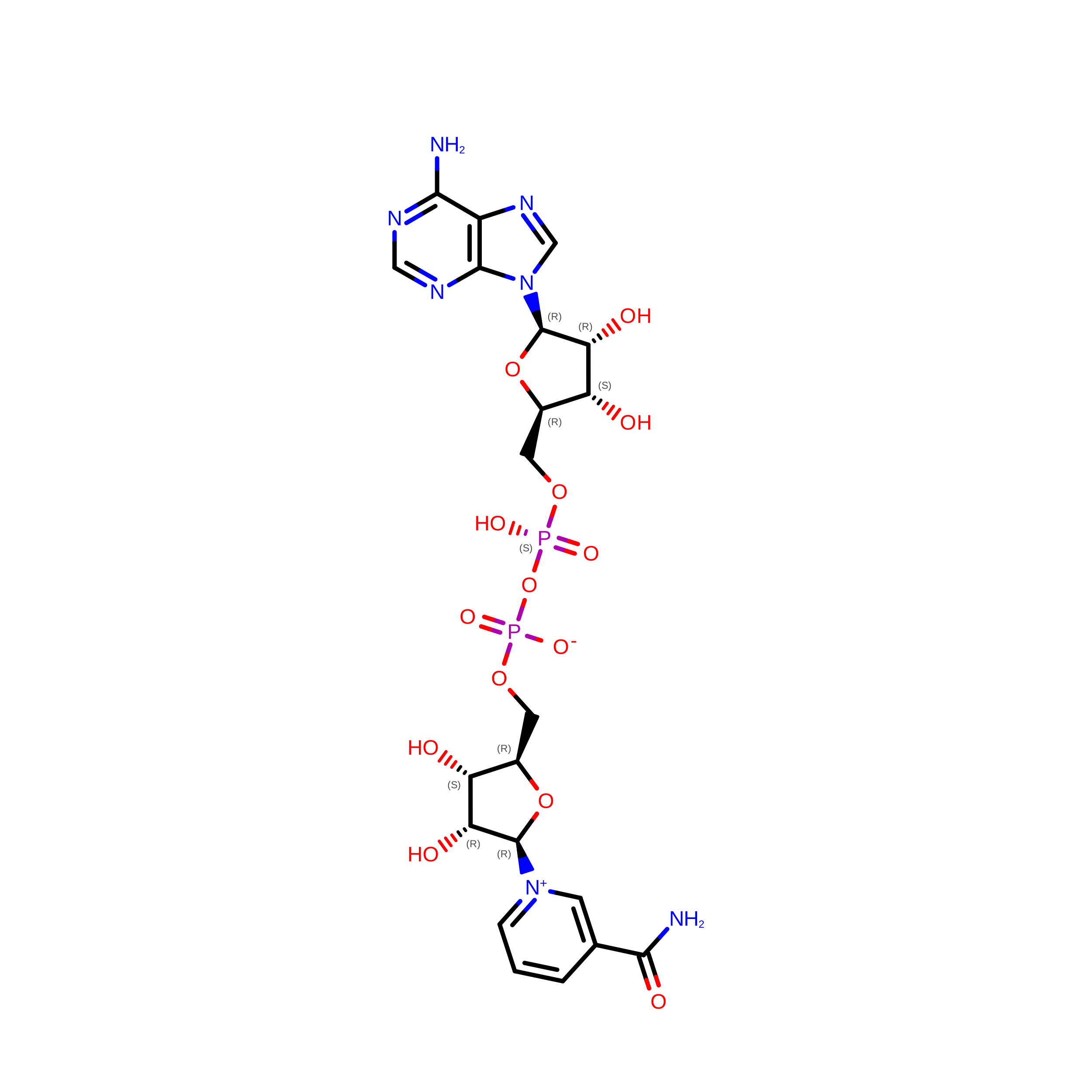
CRISPR-Cas systems are bacterial anti-viral systems, and phages use anti-CRISPR proteins (Acrs) to inactivate these systems. Here, we report a novel mechanism by which AcrIF11 inhibits the type I-F CRISPR system. Our structural and biochemical studies demonstrate that AcrIF11 functions as a novel mono-ADP-ribosyltransferase (mART) to modify N250 of the Cas8f subunit, a residue required for recognition of the protospacer-adjacent motif, within the crRNA-guided surveillance (Csy) complex from Pseudomonas aeruginosa. The AcrIF11-mediated ADP-ribosylation of the Csy complex results in complete loss of its double-stranded DNA (dsDNA) binding activity. Biochemical studies show that AcrIF11 requires, besides Cas8f, the Cas7.6f subunit for binding to and modifying the Csy complex. Our study not only reveals an unprecedented mechanism of type I CRISPR-Cas inhibition and the evolutionary arms race between phages and bacteria but also suggests an approach for designing highly potent regulatory tools in the future applications of type I CRISPR-Cas systems.
Organizational Affiliation:
Beijing Advanced Innovation Center for Soft Matter Science and Engineering, Beijing Key Laboratory of Bioprocess, State Key Laboratory of Chemical Resource Engineering, College of Life Science and Technology, Beijing University of Chemical Technology, Beijing 100029, China.
Key Laboratory of Livestock Infectious Diseases in Northeast China, Ministry of Education, College of Animal Science and Veterinary Medicine, Shenyang Agricultural University, Liaoning Province, Shenyang 110866, China.
Institute of Analytical Chemistry, College of Chemistry and Molecular Engineering, Peking University, Beijing 100871, China.
Department of Molecular Mechanisms of Disease, University of Zurich, 8057 Zurich, Switzerland.
The Protein Preparation and Characterization Core Facility of Tsinghua University, The China National Center for Protein Sciences (Beijing) Tsinghua University Branch, Beijing 100084, China.
HIT Center for Life Sciences, School of Life Science and Technology, Harbin Institute of Technology, Harbin 150080, China.
Department of Microbiology, School of Basic Medical Sciences, Peking University Health Science Center, Beijing 100191, China.
MOE Key Laboratory of Bioinformatics, School of Life Sciences, Tsinghua University, Beijing 100084, China.
State Key Laboratory of Natural and Biomimetic Drugs, Peking University, 38 Xueyuan Road, Beijing 100191, China.
State Key Laboratory for Biology of Plant Diseases and Insect Pests/Key Laboratory of Control of Biological Hazard Factors (Plant Origin) for Agri-product Quality and Safety, Ministry of Agriculture, Institute of Plant Protection, Chinese Academy of Agricultural Sciences, Beijing 100081, China.
Beijing Advanced Innovation Center for Soft Matter Science and Engineering, Beijing Key Laboratory of Bioprocess, State Key Laboratory of Chemical Resource Engineering, College of Life Science and Technology, Beijing University of Chemical Technology, Beijing 100029, China; Key Laboratory of Livestock Infectious Diseases in Northeast China, Ministry of Education, College of Animal Science and Veterinary Medicine, Shenyang Agricultural University, Liaoning Province, Shenyang 110866, China. Electronic address: zeliangchen@yahoo.com.
Beijing Advanced Innovation Center for Soft Matter Science and Engineering, Beijing Key Laboratory of Bioprocess, State Key Laboratory of Chemical Resource Engineering, College of Life Science and Technology, Beijing University of Chemical Technology, Beijing 100029, China. Electronic address: zhangyishirly@hotmail.com.
Department of Microbiology, School of Basic Medical Sciences, Peking University Health Science Center, Beijing 100191, China. Electronic address: xiaoyun.liu@bjmu.edu.cn.
Beijing Advanced Innovation Center for Soft Matter Science and Engineering, Beijing Key Laboratory of Bioprocess, State Key Laboratory of Chemical Resource Engineering, College of Life Science and Technology, Beijing University of Chemical Technology, Beijing 100029, China. Electronic address: fengyue@mail.buct.edu.cn.

 Download Mendeley