Download Mendeley
Cleavage-Dependent Activation of ATP-Dependent Protease HslUV from Staphylococcus aureus .
Jeong, S., Ahn, J., Kwon, A.R., Ha, N.-C.(2020) Mol Cells 43: 694-704
- PubMed: 32694241 Search on PubMedSearch on PubMed Central
- DOI: https://doi.org/10.14348/molcells.2020.0074
- Primary Citation Related Structures:
6KR1, 6KUI, 6KWW - PubMed Abstract:
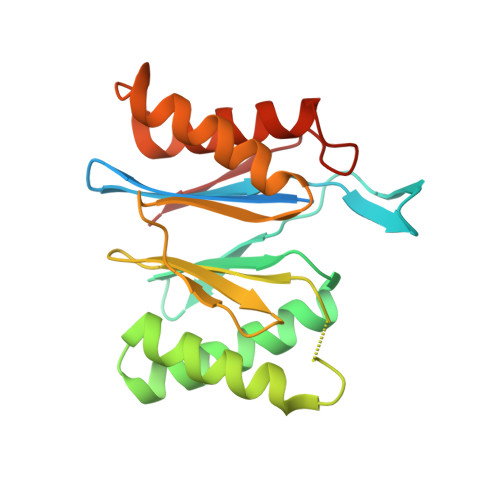
HslUV is a bacterial heat shock protein complex consisting of the AAA+ ATPase component HslU and the protease component HslV. HslV is a threonine (Thr) protease employing the N-terminal Thr residue in the mature protein as the catalytic residue. To date, HslUV from Gram-negative bacteria has been extensively studied. However, the mechanisms of action and activation of HslUV from Gram-positive bacteria, which have an additional N-terminal sequence before the catalytic Thr residue, remain to be revealed. In this study, we determined the crystal structures of HslV from the Gram-positive bacterium Staphylococcus aureus with and without HslU in the crystallization conditions. The structural comparison suggested that a structural transition to the symmetric form of HslV was triggered by ATP-bound HslU. More importantly, the additional N-terminal sequence was cleaved in the presence of HslU and ATP, exposing the Thr9 residue at the N-terminus and activating the ATP-dependent protease activity. Further biochemical studies demonstrated that the exposed N-terminal Thr residue is critical for catalysis with binding to the symmetric HslU hexamer. Since eukaryotic proteasomes have a similar additional N-terminal sequence, our results will improve our understanding of the common molecular mechanisms for the activation of proteasomes.
- Department of Agricultural Biotechnology, Center for Food Safety and Toxicology, Center for Food and Bioconvergence, and Research Institute for Agriculture and Life Sciences, CALS, Seoul National University, Seoul 08826, Korea.
Organizational Affiliation: