Download Mendeley
Specific interaction of zinc finger protein Com with RNA and the crystal structure of a self-complementary RNA duplex recognized by Com.
Nowacka, M., Fernandes, H., Kiliszek, A., Bernat, A., Lach, G., Bujnicki, J.M.(2019) PLoS One 14: e0214481-e0214481
- PubMed: 31022205 Search on PubMedSearch on PubMed Central
- DOI: https://doi.org/10.1371/journal.pone.0214481
- Primary Citation Related Structures:
6IA2 - PubMed Abstract:
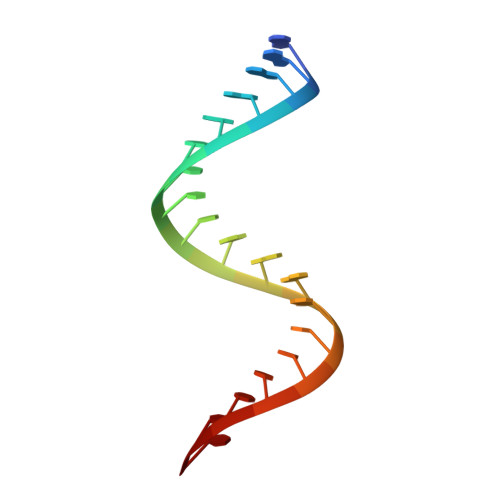
The bacteriophage Mu Com is a small zinc finger protein that binds to its cognate mom mRNA and activates its translation. The Mom protein, in turn, elicits a chemical modification (momification) of the bacteriophage genome, rendering the DNA resistant to cleavage by bacterial restriction endonucleases, and thereby protecting it from defense mechanisms of the host. We examined the basis of specificity in Com-RNA interactions by in vitro selection and probing of RNA structure. We demonstrated that Com recognizes a sequence motif within a hairpin-loop structure of its target RNA. Our data support the model of Com interaction with mom mRNA, in which Com binds to the short hairpin structure proximal to the so-called translation inhibition structure. We also observed that Com binds its target motif weakly if it is within an RNA duplex. These results suggest that the RNA structure, in addition to its sequence, is crucial for Com to recognize its target and that RNA conformational changes may constitute another level of Mom regulation. We determined a crystal structure of a Com binding site variant designed to form an RNA duplex preferentially. Our crystal model forms a 19-mer self-complementary double helix composed of the canonical and non-canonical base pairs. The helical parameters of crystalized RNA indicate why Com may bind it more weakly than a monomeric hairpin form.
- International Institute of Molecular and Cell Biology in Warsaw, Warsaw, Poland.
Organizational Affiliation: