Download Mendeley
Sequence-Selective Minor Groove Recognition of a DNA Duplex Containing Synthetic Genetic Components.
Padroni, G., Withers, J.M., Taladriz-Sender, A., Reichenbach, L.F., Parkinson, J.A., Burley, G.A.(2019) J Am Chem Soc 141: 9555-9563
- PubMed: 31117639 Search on PubMed
- DOI: https://doi.org/10.1021/jacs.8b12444
- Primary Citation Related Structures:
6I4N, 6I4O, 6RIO - PubMed Abstract:
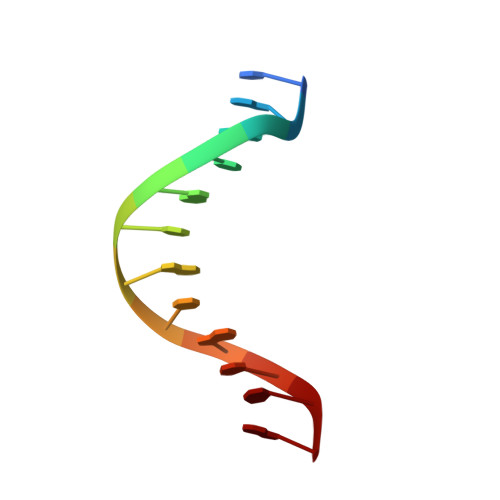
The structural basis of minor groove recognition of a DNA duplex containing synthetic genetic information by hairpin pyrrole-imidazole polyamides is described. Hairpin polyamides induce a higher melting stabilization of a DNA duplex containing the unnatural P·Z base-pair when an imidazole unit is aligned with a P nucleotide. An NMR structural study showed that the incorporation of two isolated P·Z pairs enlarges the minor groove and slightly narrows the major groove at the site of this synthetic genetic information, relative to a DNA duplex consisting entirely of Watson-Crick base-pairs. Pyrrole-imidazole polyamides bind to a P·Z-containing DNA duplex to form a stable complex, effectively mimicking a G·C pair. A structural hallmark of minor groove recognition of a P·Z pair by a polyamide is the reduced level of allosteric distortion induced by binding of a polyamide to a DNA duplex. Understanding the molecular determinants that influence minor groove recognition of DNA containing synthetic genetic components provides the basis to further develop unnatural base-pairs for synthetic biology applications.
- Department of Pure and Applied Chemistry , University of Strathclyde , Thomas Graham Building, 295 Cathedral Street , Glasgow G1 1XL , United Kingdom.
Organizational Affiliation: