6H48 | pdb_00006h48

A polyamorous repressor: deciphering the evolutionary strategy used by the phage-inducible chromosomal islands to spread in nature.


Experimental Data Snapshot

  • Method: X-RAY DIFFRACTION
  • Resolution: 2.20 Å
  • R-Value Free: 
    0.264 (Depositor), 0.265 (DCC) 
  • R-Value Work: 
    0.248 (Depositor), 0.244 (DCC) 
  • R-Value Observed: 
    0.249 (Depositor) 

wwPDB Validation 3D Report Full Report

Validation slider image for 6H48

This is version 1.1 of the entry. See complete history

Literature

The structure of a polygamous repressor reveals how phage-inducible chromosomal islands spread in nature.

Rafael Ciges-Tomas, J.Alite, C.Humphrey, S.Donderis, J.Bowring, J.Salvatella, X.Penades, J.R.Marina, A.

(2019) Nat Commun 10: 3676-3676

  • DOI: https://doi.org/10.1038/s41467-019-11504-2
  • Primary Citation Related Structures: 
    6H48, 6H49, 6H4B, 6H4C

  • PubMed Abstract: 

    Stl is a master repressor encoded by Staphylococcus aureus pathogenicity islands (SaPIs) that maintains integration of these elements in the bacterial chromosome. After infection or induction of a resident helper phage, SaPIs are de-repressed by specific interactions of phage proteins with Stl. SaPIs have evolved a fascinating mechanism to ensure their promiscuous transfer by targeting structurally unrelated proteins performing identically conserved functions for the phage. Here we decipher the molecular mechanism of this elegant strategy by determining the structure of SaPIbov1 Stl alone and in complex with two structurally unrelated dUTPases from different S. aureus phages. Remarkably, SaPIbov1 Stl has evolved different domains implicated in DNA and partner recognition specificity. This work presents the solved structure of a SaPI repressor protein and the discovery of a modular repressor that acquires multispecificity through domain recruiting. Our results establish the mechanism that allows widespread dissemination of SaPIs in nature.


  • Organizational Affiliation
    • Instituto de Biomedicina de Valencia (IBV-CSIC) and CIBER de Enfermedades Raras (CIBERER), Valencia, 46010, Spain.

Macromolecule Content 

  • Total Structure Weight: 11.58 kDa 
  • Atom Count: 684 
  • Modeled Residue Count: 77 
  • Deposited Residue Count: 96 
  • Unique protein chains: 1

Macromolecules

Find similar proteins by:|  3D Structure
Entity ID: 1
MoleculeChains  Sequence LengthOrganismDetailsImage
Orf2096Staphylococcus aureusMutation(s): 0 
UniProt
Find proteins for Q9F0J8 (Staphylococcus aureus)
Explore Q9F0J8 
Go to UniProtKB:  Q9F0J8
Entity Groups
Sequence Clusters30% Identity50% Identity70% Identity90% Identity95% Identity100% Identity
UniProt GroupQ9F0J8
Sequence Annotations
Expand
Reference Sequence

Small Molecules

Modified Residues  1 Unique
IDChains TypeFormula2D DiagramParent
MSE
Query on MSE
A
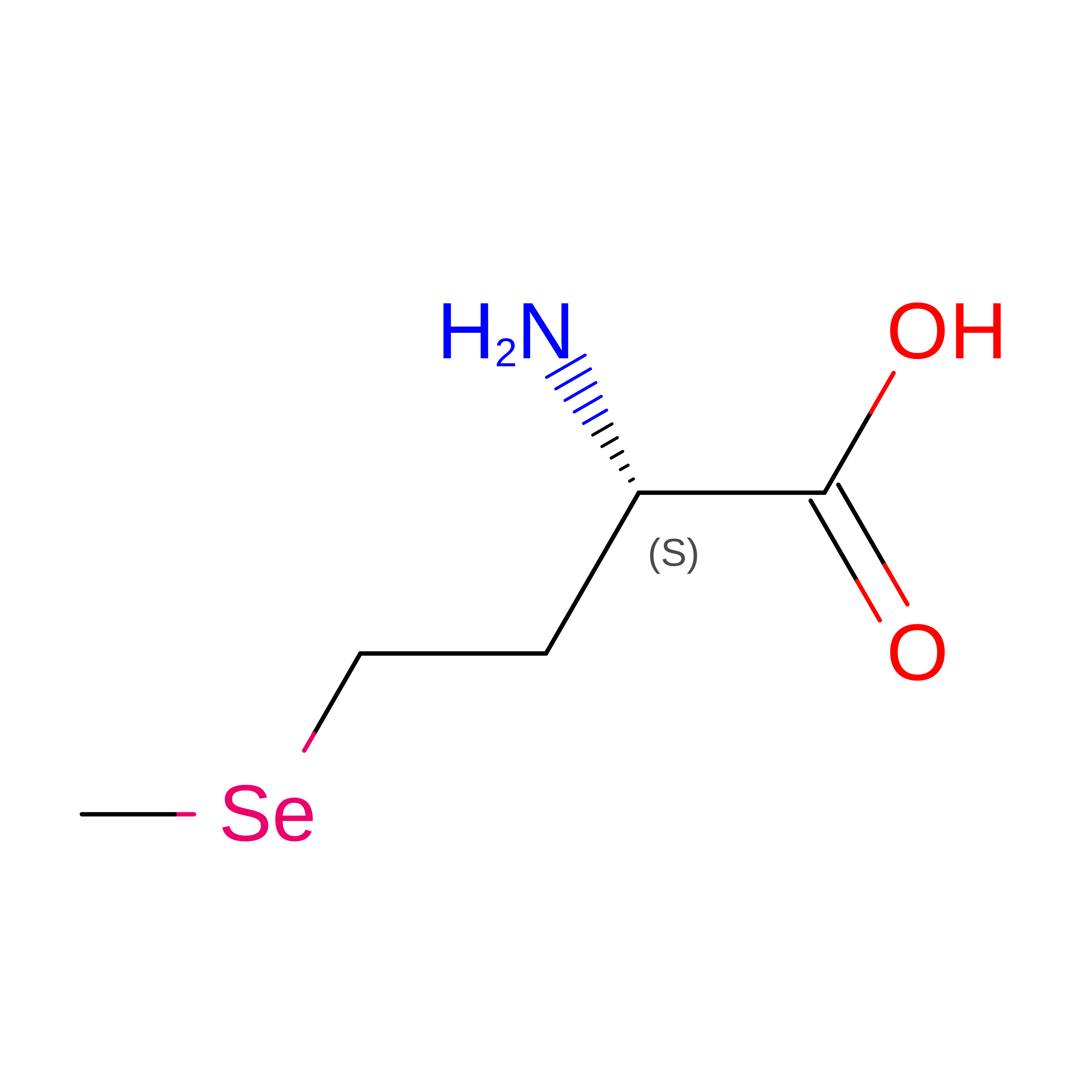
L-PEPTIDE LINKINGC5 H11 N O2 SeMET

Experimental Data & Validation

Experimental Data

  • Method: X-RAY DIFFRACTION
  • Resolution: 2.20 Å
  • R-Value Free:  0.264 (Depositor), 0.265 (DCC) 
  • R-Value Work:  0.248 (Depositor), 0.244 (DCC) 
  • R-Value Observed: 0.249 (Depositor) 
Space Group: P 3 2 1
Unit Cell:
Length ( Å )Angle ( ˚ )
a = 77.357α = 90
b = 77.357β = 90
c = 37.318γ = 120
Software Package:
Software NamePurpose
SCALAdata scaling
SOLVEphasing
REFMACrefinement
PDB_EXTRACTdata extraction
XDSdata reduction

Structure Validation

View Full Validation Report


Entry History 

& Funding Information

Deposition Data


Funding OrganizationLocationGrant Number
Spanish Ministry of Economy and CompetitivenessSpainBIO2016-78571-P
Spanish Ministry of Economy and CompetitivenessSpainFPU13/02880
Spanish Ministry of Economy and CompetitivenessSpainBES-2014-068617
Medical Research Council (United Kingdom)United KingdomMR/M003876/1
Biotechnology and Biological Sciences Research CouncilUnited KingdomBB/N002873/1
European Research CouncilUnited KingdomERC-ADG-2014 670932

Revision History  (Full details and data files)

  • Version 1.0: 2019-08-28
    Type: Initial release
  • Version 1.1: 2024-10-23
    Changes: Data collection, Database references, Structure summary