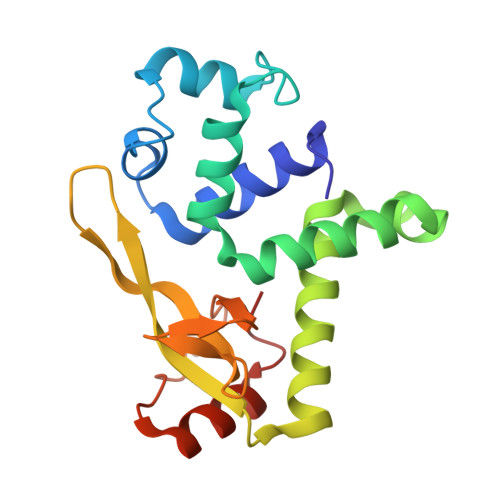
6EYX | pdb_00006eyx

Anti-CRISPR AcrIIa6 tetragonal form


Experimental Data Snapshot

  • Method: X-RAY DIFFRACTION
  • Resolution: 1.96 Å
  • R-Value Free: 
    0.226 (Depositor), 0.229 (DCC) 
  • R-Value Work: 
    0.209 (Depositor), 0.209 (DCC) 
  • R-Value Observed: 
    0.209 (Depositor) 

wwPDB Validation 3D Report Full Report

Validation slider image for 6EYX

This is version 1.2 of the entry. See complete history

Literature

Widespread anti-CRISPR proteins in virulent bacteriophages inhibit a range of Cas9 proteins.

Hynes, A.P.Rousseau, G.M.Agudelo, D.Goulet, A.Amigues, B.Loehr, J.Romero, D.A.Fremaux, C.Horvath, P.Doyon, Y.Cambillau, C.Moineau, S.

(2018) Nat Commun 9: 2919-2919

  • DOI: https://doi.org/10.1038/s41467-018-05092-w
  • Primary Citation Related Structures: 
    6EYX, 6EYY

  • PubMed Abstract: 

    CRISPR-Cas systems are bacterial anti-viral systems, and bacterial viruses (bacteriophages, phages) can carry anti-CRISPR (Acr) proteins to evade that immunity. Acrs can also fine-tune the activity of CRISPR-based genome-editing tools. While Acrs are prevalent in phages capable of lying dormant in a CRISPR-carrying host, their orthologs have been observed only infrequently in virulent phages. Here we identify AcrIIA6, an Acr encoded in 33% of virulent Streptococcus thermophilus phage genomes. The X-ray structure of AcrIIA6 displays some features unique to this Acr family. We compare the activity of AcrIIA6 to those of other Acrs, including AcrIIA5 (also from S. thermophilus phages), and characterize their effectiveness against a range of CRISPR-Cas systems. Finally, we demonstrate that both Acr families from S. thermophilus phages inhibit Cas9-mediated genome editing of human cells.


  • Organizational Affiliation
    • Département de biochimie, de microbiologie, et de bioinformatique, Faculté des sciences et de génie, Groupe de recherche en écologie buccale, Faculté de médecine dentaire, Université Laval, Québec City, QC, G1V 0A6, Canada.

Macromolecule Content 

  • Total Structure Weight: 43.41 kDa 
  • Atom Count: 3,306 
  • Modeled Residue Count: 360 
  • Deposited Residue Count: 370 
  • Unique protein chains: 1

Macromolecules

Find similar proteins by:|  3D Structure
Entity ID: 1
MoleculeChains  Sequence LengthOrganismDetailsImage
AcrIIa6
A, B
185Moineauvirus DT1Mutation(s): 0 
UniProt
Find proteins for Q9XJC1 (Streptococcus phage DT1)
Explore Q9XJC1 
Go to UniProtKB:  Q9XJC1
Entity Groups
Sequence Clusters30% Identity50% Identity70% Identity90% Identity95% Identity100% Identity
UniProt GroupQ9XJC1
Sequence Annotations
Expand
Reference Sequence

Experimental Data & Validation

Experimental Data

  • Method: X-RAY DIFFRACTION
  • Resolution: 1.96 Å
  • R-Value Free:  0.226 (Depositor), 0.229 (DCC) 
  • R-Value Work:  0.209 (Depositor), 0.209 (DCC) 
  • R-Value Observed: 0.209 (Depositor) 
Space Group: P 43 21 2
Unit Cell:
Length ( Å )Angle ( ˚ )
a = 71.37α = 90
b = 71.37β = 90
c = 177.7γ = 90
Software Package:
Software NamePurpose
BUSTERrefinement
XDSdata reduction
SCALAdata scaling
MOLREPphasing

Structure Validation

View Full Validation Report


Entry History 

Deposition Data

Revision History  (Full details and data files)

  • Version 1.0: 2018-06-06
    Type: Initial release
  • Version 1.1: 2018-08-08
    Changes: Data collection, Database references
  • Version 1.2: 2024-05-08
    Changes: Data collection, Database references