6DNE | pdb_00006dne

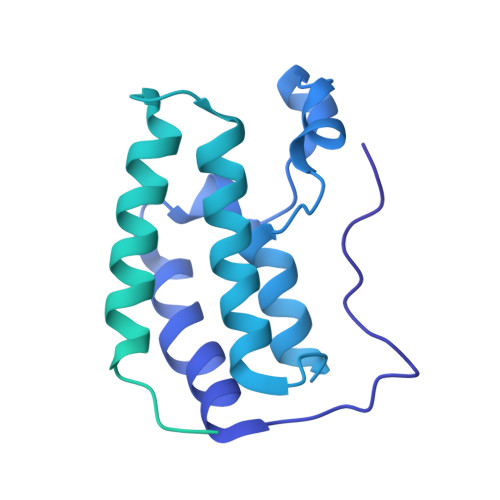
Crystal structure of human Bromodomain-containing protein 4 (BRD4) bromodomain with MS660


Experimental Data Snapshot

  • Method: X-RAY DIFFRACTION
  • Resolution: 2.96 Å
  • R-Value Free: 
    0.285 (Depositor), 0.288 (DCC) 
  • R-Value Work: 
    0.243 (Depositor), 0.247 (DCC) 
  • R-Value Observed: 
    0.245 (Depositor) 

Starting Model: experimental
View more details

wwPDB Validation 3D Report Full Report

Validation slider image for 6DNE

Ligand Structure Quality Assessment 


This is version 1.3 of the entry. See complete history

Literature

Spatially constrained tandem bromodomain inhibition bolsters sustained repression of BRD4 transcriptional activity for TNBC cell growth.

Ren, C.Zhang, G.Han, F.Fu, S.Cao, Y.Zhang, F.Zhang, Q.Meslamani, J.Xu, Y.Ji, D.Cao, L.Zhou, Q.Cheung, K.L.Sharma, R.Babault, N.Yi, Z.Zhang, W.Walsh, M.J.Zeng, L.Zhou, M.M.

(2018) Proc Natl Acad Sci U S A 115: 7949-7954

  • DOI: https://doi.org/10.1073/pnas.1720000115
  • Primary Citation Related Structures: 
    6DJC, 6DNE

  • PubMed Abstract: 

    The importance of BET protein BRD4 in gene transcription is well recognized through the study of chemical modulation of its characteristic tandem bromodomain (BrD) binding to lysine-acetylated histones and transcription factors. However, while monovalent inhibition of BRD4 by BET BrD inhibitors such as JQ1 blocks growth of hematopoietic cancers, it is much less effective generally in solid tumors. Here, we report a thienodiazepine-based bivalent BrD inhibitor, MS645, that affords spatially constrained tandem BrD inhibition and consequently sustained repression of BRD4 transcriptional activity in blocking proliferation of solid-tumor cells including a panel of triple-negative breast cancer (TNBC) cells. MS645 blocks BRD4 binding to transcription enhancer/mediator proteins MED1 and YY1 with potency superior to monovalent BET inhibitors, resulting in down-regulation of proinflammatory cytokines and genes for cell-cycle control and DNA damage repair that are largely unaffected by monovalent BrD inhibition. Our study suggests a therapeutic strategy to maximally control BRD4 activity for rapid growth of solid-tumor TNBC cells.


  • Organizational Affiliation
    • Department of Pharmacological Sciences, Icahn School of Medicine at Mount Sinai, New York, NY 10029.

Macromolecule Content 

  • Total Structure Weight: 98.4 kDa 
  • Atom Count: 2,139 
  • Modeled Residue Count: 247 
  • Deposited Residue Count: 868 
  • Unique protein chains: 1

Macromolecules

Find similar proteins by:|  3D Structure
Entity ID: 1
MoleculeChains  Sequence LengthOrganismDetailsImage
Bromodomain-containing protein 4
A, B
434Homo sapiensMutation(s): 0 
Gene Names: BRD4HUNK1
UniProt & NIH Common Fund Data Resources
Find proteins for O60885 (Homo sapiens)
Explore O60885 
Go to UniProtKB:  O60885
PHAROS:  O60885
GTEx:  ENSG00000141867 
Entity Groups
Sequence Clusters30% Identity50% Identity70% Identity90% Identity95% Identity100% Identity
UniProt GroupO60885
Sequence Annotations
Expand
Reference Sequence

Small Molecules

Ligands 1 Unique
IDChains Name / Formula / InChI Key2D Diagram3D Interactions
H1V

Query on H1V


Download:Ideal Coordinates CCD File
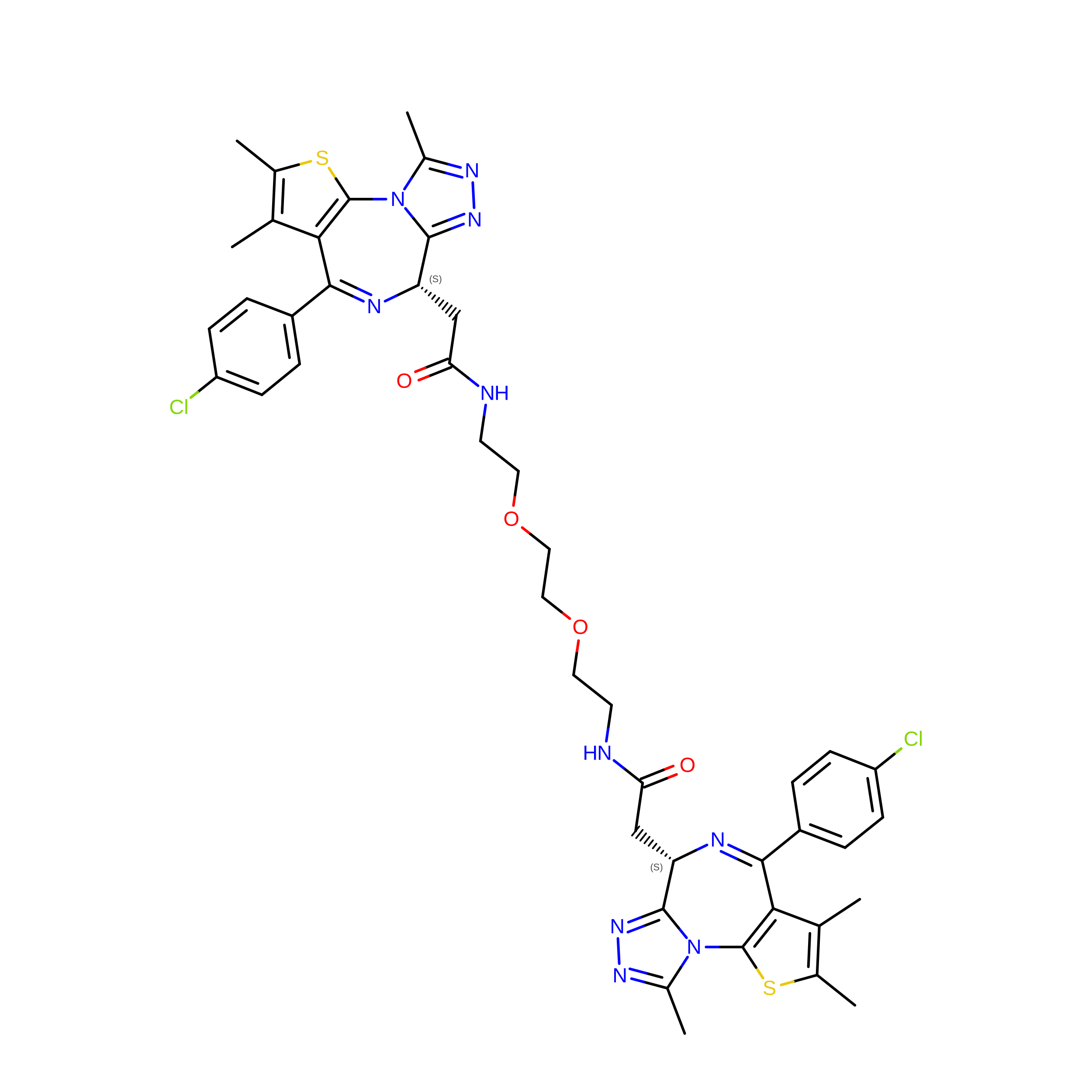
C [auth A]N,N'-[ethane-1,2-diylbis(oxyethane-2,1-diyl)]bis{2-[(6S)-4-(4-chlorophenyl)-2,3,9-trimethyl-6H-thieno[3,2-f][1,2,4]triazolo[4,3-a][1,4]diazepin-6-yl]acetamide}
C44 H46 Cl2 N10 O4 S2
ZKJQKCFLIQBELE-HEVIKAOCSA-N

Experimental Data & Validation

Experimental Data

  • Method: X-RAY DIFFRACTION
  • Resolution: 2.96 Å
  • R-Value Free:  0.285 (Depositor), 0.288 (DCC) 
  • R-Value Work:  0.243 (Depositor), 0.247 (DCC) 
  • R-Value Observed: 0.245 (Depositor) 
Space Group: P 65 2 2
Unit Cell:
Length ( Å )Angle ( ˚ )
a = 87.54α = 90
b = 87.54β = 90
c = 172.3γ = 120
Software Package:
Software NamePurpose
PHENIXrefinement
HKL-2000data reduction
SCALAdata scaling
BALBESphasing

Structure Validation

View Full Validation Report


Ligand Structure Quality Assessment 


Entry History 

Deposition Data

Revision History  (Full details and data files)

  • Version 1.0: 2018-07-18
    Type: Initial release
  • Version 1.1: 2018-08-01
    Changes: Data collection, Database references
  • Version 1.2: 2018-08-15
    Changes: Data collection, Database references
  • Version 1.3: 2023-10-11
    Changes: Data collection, Database references, Refinement description