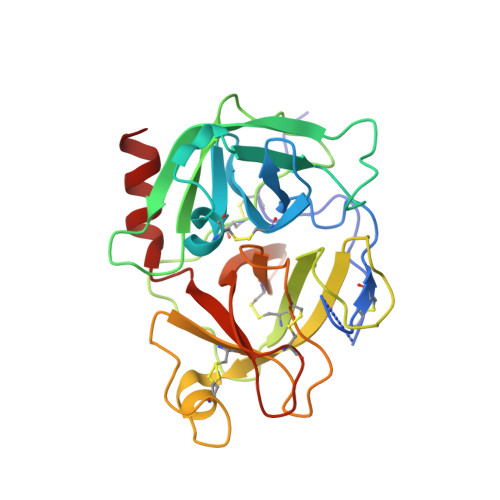
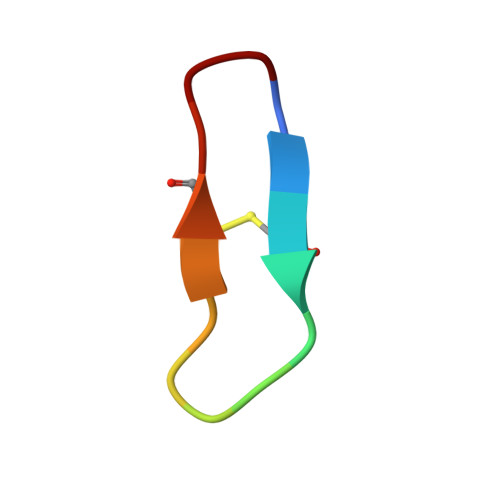
6D40 | pdb_00006d40

Highly Potent and Selective Plasmin Inhibitors Based on the Sunflower Trypsin Inhibitor-1 Scaffold Attenuate Fibrinolysis in Plasma


Experimental Data Snapshot

  • Method: X-RAY DIFFRACTION
  • Resolution: 1.43 Å
  • R-Value Free: 
    0.210 (Depositor), 0.211 (DCC) 
  • R-Value Work: 
    0.186 (Depositor), 0.187 (DCC) 
  • R-Value Observed: 
    0.187 (Depositor) 

Starting Models: experimental
View more details

wwPDB Validation 3D Report Full Report

Validation slider image for 6D40

This is version 1.3 of the entry. See complete history

Literature

Highly Potent and Selective Plasmin Inhibitors Based on the Sunflower Trypsin Inhibitor-1 Scaffold Attenuate Fibrinolysis in Plasma.

Swedberg, J.E.Wu, G.Mahatmanto, T.Durek, T.Caradoc-Davies, T.T.Whisstock, J.C.Law, R.H.P.Craik, D.J.

(2019) J Med Chem 62: 552-560

  • DOI: https://doi.org/10.1021/acs.jmedchem.8b01139
  • Primary Citation Related Structures: 
    6D3X, 6D3Y, 6D3Z, 6D40

  • PubMed Abstract: 

    Antifibrinolytic drugs provide important pharmacological interventions to reduce morbidity and mortality from excessive bleeding during surgery and after trauma. Current drugs used for inhibiting the dissolution of fibrin, the main structural component of blood clots, are associated with adverse events due to lack of potency, high doses, and nonselective inhibition mechanisms. These drawbacks warrant the development of a new generation of highly potent and selective fibrinolysis inhibitors. Here, we use the 14-amino acid backbone-cyclic sunflower trypsin inhibitor-1 scaffold to design a highly potent ( K i = 0.05 nM) inhibitor of the primary serine protease in fibrinolysis, plasmin. This compound displays a million-fold selectivity over other serine proteases in blood, inhibits fibrinolysis in plasma more effectively than the gold-standard therapeutic inhibitor aprotinin, and is a promising candidate for development of highly specific fibrinolysis inhibitors with reduced side effects.


  • Organizational Affiliation
    • Institute for Molecular Bioscience , The University of Queensland , Brisbane , QLD 4072 , Australia.

Macromolecule Content 

  • Total Structure Weight: 28.98 kDa 
  • Atom Count: 2,207 
  • Modeled Residue Count: 260 
  • Deposited Residue Count: 262 
  • Unique protein chains: 2

Macromolecules

Find similar proteins by:|  3D Structure
Entity ID: 1
MoleculeChains  Sequence LengthOrganismDetailsImage
Plasminogen248Homo sapiensMutation(s): 0 
Gene Names: PLG
EC: 3.4.21.7
UniProt & NIH Common Fund Data Resources
Find proteins for P00747 (Homo sapiens)
Explore P00747 
Go to UniProtKB:  P00747
PHAROS:  P00747
GTEx:  ENSG00000122194 
Entity Groups
Sequence Clusters30% Identity50% Identity70% Identity90% Identity95% Identity100% Identity
UniProt GroupP00747
Sequence Annotations
Expand
Reference Sequence
Find similar proteins by:  Sequence   |   3D Structure  
Entity ID: 2
MoleculeChains  Sequence LengthOrganismDetailsImage
Trypsin inhibitor 1B [auth C]14Helianthus annuusMutation(s): 1 
UniProt
Find proteins for Q4GWU5 (Helianthus annuus)
Explore Q4GWU5 
Go to UniProtKB:  Q4GWU5
Entity Groups
Sequence Clusters30% Identity50% Identity70% Identity90% Identity95% Identity100% Identity
UniProt GroupQ4GWU5
Sequence Annotations
Expand
Reference Sequence

Experimental Data & Validation

Experimental Data

  • Method: X-RAY DIFFRACTION
  • Resolution: 1.43 Å
  • R-Value Free:  0.210 (Depositor), 0.211 (DCC) 
  • R-Value Work:  0.186 (Depositor), 0.187 (DCC) 
  • R-Value Observed: 0.187 (Depositor) 
Space Group: C 1 2 1
Unit Cell:
Length ( Å )Angle ( ˚ )
a = 85.318α = 90
b = 41.754β = 109.57
c = 78.996γ = 90
Software Package:
Software NamePurpose
PHENIXrefinement
XDSdata reduction
SCALAdata scaling
PHASERphasing
PDB_EXTRACTdata extraction

Structure Validation

View Full Validation Report


Entry History 

Deposition Data

Revision History  (Full details and data files)

  • Version 1.0: 2019-01-23
    Type: Initial release
  • Version 1.1: 2019-05-01
    Changes: Data collection, Database references
  • Version 1.2: 2023-10-04
    Changes: Data collection, Database references, Refinement description
  • Version 1.3: 2024-11-06
    Changes: Structure summary