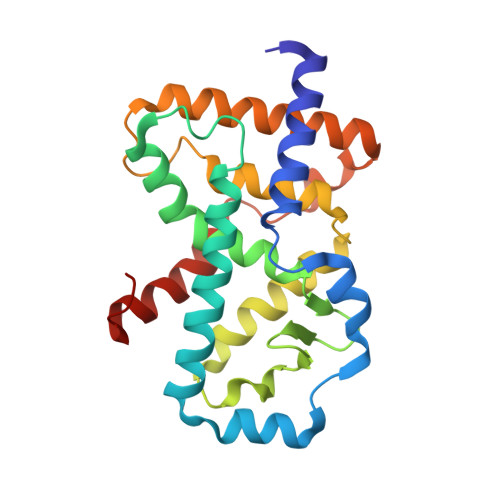
6CVH | pdb_00006cvh

Identification and biological evaluation of thiazole-based inverse agonists of RORgt


Experimental Data Snapshot

  • Method: X-RAY DIFFRACTION
  • Resolution: 3.50 Å
  • R-Value Free: 
    0.310 (Depositor), 0.314 (DCC) 
  • R-Value Work: 
    0.260 (Depositor), 0.265 (DCC) 
  • R-Value Observed: 
    0.265 (Depositor) 

wwPDB Validation 3D Report Full Report

Validation slider image for 6CVH

Ligand Structure Quality Assessment 


This is version 1.2 of the entry. See complete history

Literature

Identification and biological evaluation of thiazole-based inverse agonists of ROR gamma t.

Gege, C.Cummings, M.D.Albers, M.Kinzel, O.Kleymann, G.Schluter, T.Steeneck, C.Nelen, M.I.Milligan, C.Spurlino, J.Xue, X.Leonard, K.Edwards, J.P.Fourie, A.Goldberg, S.D.Hoffmann, T.

(2018) Bioorg Med Chem Lett 28: 1446-1455

  • DOI: https://doi.org/10.1016/j.bmcl.2018.03.093
  • Primary Citation Related Structures: 
    6CVH

  • PubMed Abstract: 

    The nuclear receptor retinoic acid receptor-related orphan receptor gamma t (RORγt) is a transcription factor that drives Th17 cell differentiation and IL-17 production in both innate and adaptive immune cells. The IL-23/IL-17 pathway is implicated in major autoimmune and inflammatory diseases. RORγt lies at the core of this pathway and represents an attractive opportunity for intervention with a small molecule. Despite diverse chemical series having been reported, combining high potency and nuclear receptor selectivity with good physicochemical properties remains a challenging endeavor in the field of RORγt drug discovery. We describe the discovery and evaluation of a new class of potent and selective RORγt inverse agonists based on a thiazole core. Acid analog 1j demonstrated oral bioavailability in rats and was potent in a human whole blood assay, suggesting potential utility in treating autoimmune and inflammatory diseases such as psoriasis. X-ray crystallographic data helped to elucidate the molecular mechanism for RORγt inhibition with this series.


  • Organizational Affiliation
    • Phenex Pharmaceuticals AG, Waldhofer Strasse 104, 69123 Heidelberg, Germany. Electronic address: christian.gege@web.de.

Macromolecule Content 

  • Total Structure Weight: 27.03 kDa 
  • Atom Count: 1,893 
  • Modeled Residue Count: 227 
  • Deposited Residue Count: 227 
  • Unique protein chains: 1

Macromolecules

Find similar proteins by:|  3D Structure
Entity ID: 1
MoleculeChains  Sequence LengthOrganismDetailsImage
Nuclear receptor ROR-gamma227Homo sapiensMutation(s): 0 
Gene Names: RORCNR1F3RORGRZRG
UniProt & NIH Common Fund Data Resources
Find proteins for P51449 (Homo sapiens)
Explore P51449 
Go to UniProtKB:  P51449
PHAROS:  P51449
GTEx:  ENSG00000143365 
Entity Groups
Sequence Clusters30% Identity50% Identity70% Identity90% Identity95% Identity100% Identity
UniProt GroupP51449
Sequence Annotations
Expand
Reference Sequence

Small Molecules

Ligands 1 Unique
IDChains Name / Formula / InChI Key2D Diagram3D Interactions
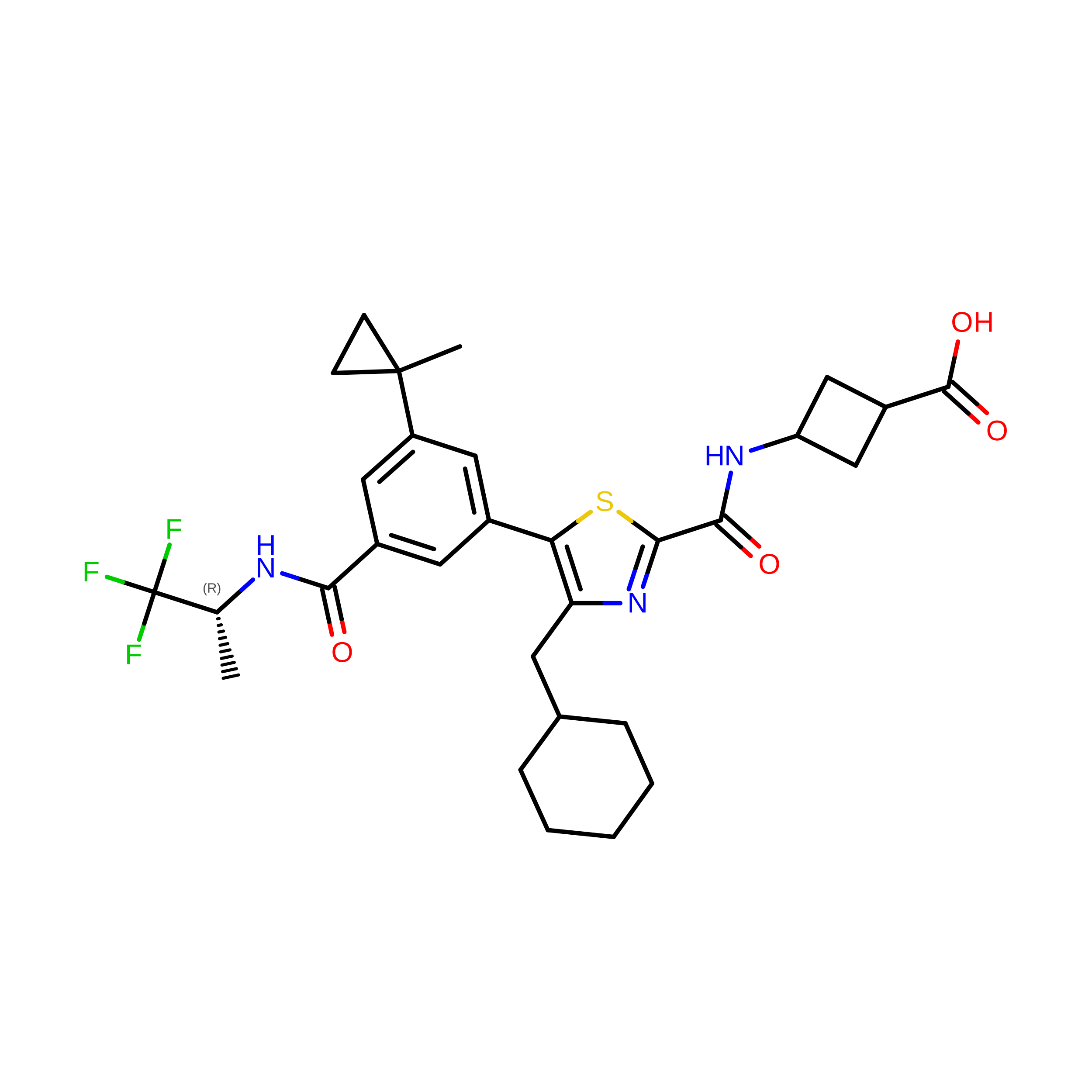
FJG
(Subject of Investigation/LOI)

Query on FJG


Download:Ideal Coordinates CCD File
B [auth A]trans-3-({4-(cyclohexylmethyl)-5-[3-(1-methylcyclopropyl)-5-{[(2R)-1,1,1-trifluoropropan-2-yl]carbamoyl}phenyl]-1,3-thiazole-2-carbonyl}amino)cyclobutane-1-carboxylic acid
C30 H36 F3 N3 O4 S
PSFPATVFAWGHAJ-BSLALVQMSA-N

Experimental Data & Validation

Experimental Data

  • Method: X-RAY DIFFRACTION
  • Resolution: 3.50 Å
  • R-Value Free:  0.310 (Depositor), 0.314 (DCC) 
  • R-Value Work:  0.260 (Depositor), 0.265 (DCC) 
  • R-Value Observed: 0.265 (Depositor) 
Space Group: P 61 2 2
Unit Cell:
Length ( Å )Angle ( ˚ )
a = 92.378α = 90
b = 92.378β = 90
c = 141.898γ = 120
Software Package:
Software NamePurpose
PHENIXrefinement
PDB_EXTRACTdata extraction
HKL-2000data reduction
HKL-2000data scaling
PHENIXphasing

Structure Validation

View Full Validation Report


Ligand Structure Quality Assessment 


Entry History 

Deposition Data

Revision History  (Full details and data files)

  • Version 1.0: 2018-04-25
    Type: Initial release
  • Version 1.1: 2018-05-02
    Changes: Data collection, Database references
  • Version 1.2: 2024-03-13
    Changes: Data collection, Database references