6CVD | pdb_00006cvd

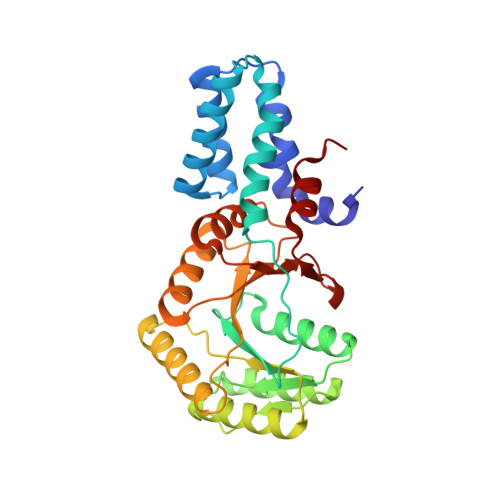
High resolution crystal structure of FtsY-NG domain of E. coli bound to fragment 1


Experimental Data Snapshot

  • Method: X-RAY DIFFRACTION
  • Resolution: 1.78 Å
  • R-Value Free: 
    0.252 (Depositor), 0.254 (DCC) 
  • R-Value Work: 
    0.202 (Depositor), 0.206 (DCC) 
  • R-Value Observed: 
    0.204 (Depositor) 

Starting Model: experimental
View more details

wwPDB Validation 3D Report Full Report

Validation slider image for 6CVD

Ligand Structure Quality Assessment 


This is version 1.1 of the entry. See complete history

Literature

Discovery of fragments that target key interactions in the signal recognition particle (SRP) as potential leads for a new class of antibiotics.

Faoro, C.Wilkinson-White, L.Kwan, A.H.Ataide, S.F.

(2018) PLoS One 13: e0200387-e0200387

  • DOI: https://doi.org/10.1371/journal.pone.0200387
  • Primary Citation Related Structures: 
    6CQP, 6CS8, 6CVD, 6DLX

  • PubMed Abstract: 

    Given the increasing incidence of antibiotic resistance, antibiotics that employ new strategies are urgently needed. Bacterial survival is dependent on proper function of the signal recognition particle (SRP) and its receptor (FtsY). A unique set of interactions in FtsY:SRP-RNA represents a promising candidate for new antibiotic development as no antibiotic targets this complex and these interactions are functionally replaced by protein:protein interactions in eukaryotes. We used a Fragment Based Drug Design (FBDD) approach to search for new compounds that can bind FtsY, and have identified three lead fragments. In vitro and in vivo analyses have shown that despite a high micromolar binding affinity, one fragment has some antimicrobial properties. X-ray structures of E. coli FtsY:fragments reveal the fragments bind in the targeted RNA interaction site. Our results show that FBDD is a suitable approach for targeting FtsY:SRP-RNA for antibiotic development and opens the possibility of targeting protein:RNA interactions in general.


  • Organizational Affiliation
    • School of Life and Environmental Sciences, The University of Sydney, Sydney, Australia.

Macromolecule Content 

  • Total Structure Weight: 66.96 kDa 
  • Atom Count: 5,072 
  • Modeled Residue Count: 605 
  • Deposited Residue Count: 606 
  • Unique protein chains: 1

Macromolecules

Find similar proteins by:|  3D Structure
Entity ID: 1
MoleculeChains  Sequence LengthOrganismDetailsImage
Signal recognition particle receptor FtsY
A, B
303Escherichia coli K-12Mutation(s): 0 
Gene Names: ftsYb3464JW3429
EC: 3.6.5.4
UniProt
Find proteins for P10121 (Escherichia coli (strain K12))
Explore P10121 
Go to UniProtKB:  P10121
Entity Groups
Sequence Clusters30% Identity50% Identity70% Identity90% Identity95% Identity100% Identity
UniProt GroupP10121
Sequence Annotations
Expand
Reference Sequence

Small Molecules

Ligands 3 Unique
IDChains Name / Formula / InChI Key2D Diagram3D Interactions
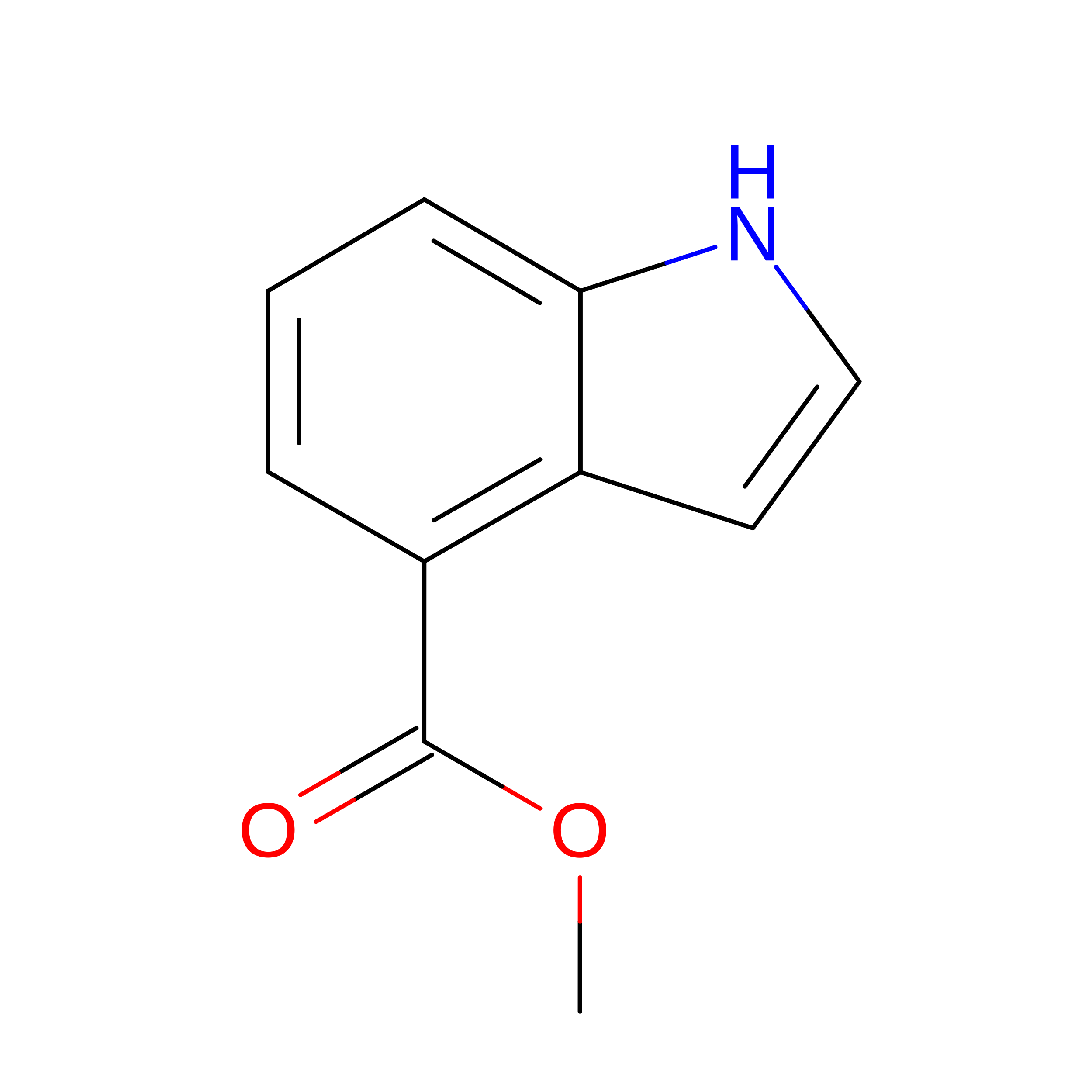
4ME

Query on 4ME


Download:Ideal Coordinates CCD File
C [auth A],
D [auth A],
G [auth B],
H [auth B]
methyl 1H-indole-4-carboxylate
C10 H9 N O2
WEAXQUBYRSEBJD-UHFFFAOYSA-N
NA

Query on NA


Download:Ideal Coordinates CCD File
I [auth B]SODIUM ION
Na
FKNQFGJONOIPTF-UHFFFAOYSA-N
NH4

Query on NH4


Download:Ideal Coordinates CCD File
E [auth A],
F [auth A]
AMMONIUM ION
H4 N
QGZKDVFQNNGYKY-UHFFFAOYSA-O

Experimental Data & Validation

Experimental Data

  • Method: X-RAY DIFFRACTION
  • Resolution: 1.78 Å
  • R-Value Free:  0.252 (Depositor), 0.254 (DCC) 
  • R-Value Work:  0.202 (Depositor), 0.206 (DCC) 
  • R-Value Observed: 0.204 (Depositor) 
Space Group: P 1 21 1
Unit Cell:
Length ( Å )Angle ( ˚ )
a = 34.341α = 90
b = 76.008β = 90.42
c = 108.032γ = 90
Software Package:
Software NamePurpose
PHENIXrefinement
XDSdata reduction
Aimlessdata scaling
PHASERphasing

Structure Validation

View Full Validation Report


Ligand Structure Quality Assessment 


Entry History 

Deposition Data

Revision History  (Full details and data files)

  • Version 1.0: 2018-08-22
    Type: Initial release
  • Version 1.1: 2023-10-04
    Changes: Data collection, Database references, Refinement description