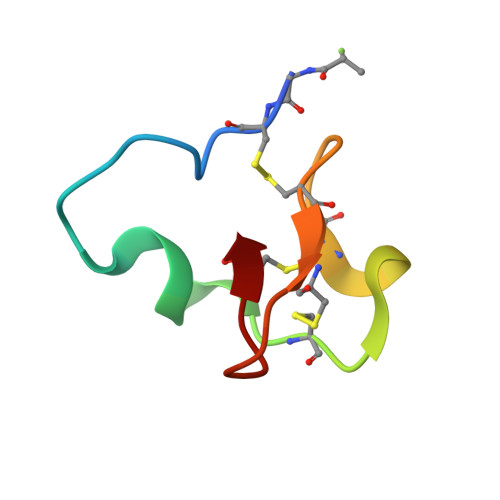
6CDX | pdb_00006cdx

High-resolution crystal structure of fluoropropylated cystine knot, binding to alpha-5 beta-6 integrin


Experimental Data Snapshot

  • Method: X-RAY DIFFRACTION
  • Resolution: 1.00 Å
  • R-Value Free: 
    0.226 (Depositor), 0.223 (DCC) 
  • R-Value Work: 
    0.203 (Depositor), 0.203 (DCC) 
  • R-Value Observed: 
    0.204 (Depositor) 

Starting Models: experimental
View more details

wwPDB Validation 3D Report Full Report

Validation slider image for 6CDX

This is version 1.5 of the entry. See complete history

Literature

Evaluation of integrin alpha v beta6cystine knot PET tracers to detect cancer and idiopathic pulmonary fibrosis.

Kimura, R.H.Wang, L.Shen, B.Huo, L.Tummers, W.Filipp, F.V.Guo, H.H.Haywood, T.Abou-Elkacem, L.Baratto, L.Habte, F.Devulapally, R.Witney, T.H.Cheng, Y.Tikole, S.Chakraborti, S.Nix, J.Bonagura, C.A.Hatami, N.Mooney, J.J.Desai, T.Turner, S.Gaster, R.S.Otte, A.Visser, B.C.Poultsides, G.A.Norton, J.Park, W.Stolowitz, M.Lau, K.Yang, E.Natarajan, A.Ilovich, O.Srinivas, S.Srinivasan, A.Paulmurugan, R.Willmann, J.Chin, F.T.Cheng, Z.Iagaru, A.Li, F.Gambhir, S.S.

(2019) Nat Commun 10: 4673-4673

  • DOI: https://doi.org/10.1038/s41467-019-11863-w
  • Primary Citation Related Structures: 
    6CDX

  • PubMed Abstract: 

    Advances in precision molecular imaging promise to transform our ability to detect, diagnose and treat disease. Here, we describe the engineering and validation of a new cystine knot peptide (knottin) that selectively recognizes human integrin αvβ 6 with single-digit nanomolar affinity. We solve its 3D structure by NMR and x-ray crystallography and validate leads with 3 different radiolabels in pre-clinical models of cancer. We evaluate the lead tracer's safety, biodistribution and pharmacokinetics in healthy human volunteers, and show its ability to detect multiple cancers (pancreatic, cervical and lung) in patients at two study locations. Additionally, we demonstrate that the knottin PET tracers can also detect fibrotic lung disease in idiopathic pulmonary fibrosis patients. Our results indicate that these cystine knot PET tracers may have potential utility in multiple disease states that are associated with upregulation of integrin α v β 6 .


  • Organizational Affiliation
    • Department of Radiology, Stanford University, Stanford, CA, 94305, USA.

Macromolecule Content 

  • Total Structure Weight: 7.83 kDa 
  • Atom Count: 589 
  • Modeled Residue Count: 73 
  • Deposited Residue Count: 74 
  • Unique protein chains: 1

Macromolecules

Find similar proteins by:|  3D Structure
Entity ID: 1
MoleculeChains  Sequence LengthOrganismDetailsImage
cystine knot (fluoropropylated)
A, B
37Momordica cochinchinensisMutation(s): 0 
UniProt
Find proteins for P82408 (Momordica cochinchinensis)
Explore P82408 
Go to UniProtKB:  P82408
Entity Groups
Sequence Clusters30% Identity50% Identity70% Identity90% Identity95% Identity100% Identity
UniProt GroupP82408
Sequence Annotations
Expand
Reference Sequence

Experimental Data & Validation

Experimental Data

  • Method: X-RAY DIFFRACTION
  • Resolution: 1.00 Å
  • R-Value Free:  0.226 (Depositor), 0.223 (DCC) 
  • R-Value Work:  0.203 (Depositor), 0.203 (DCC) 
  • R-Value Observed: 0.204 (Depositor) 
Space Group: P 21 21 21
Unit Cell:
Length ( Å )Angle ( ˚ )
a = 16.95α = 90
b = 44.25β = 90
c = 66.41γ = 90
Software Package:
Software NamePurpose
REFMACrefinement
PDB_EXTRACTdata extraction
XDSdata reduction
XDSdata scaling
PHASERphasing

Structure Validation

View Full Validation Report


Entry History 

& Funding Information

Deposition Data


Funding OrganizationLocationGrant Number
German Federal Ministry for Education and ResearchGermanyDJUSA
National Institutes of Health/National Cancer Institute (NIH/NCI)United StatesCA154887
The University Grants Committee, Research Grants Council (RGC)United StatesCRN-17-427258

Revision History  (Full details and data files)

  • Version 1.0: 2019-08-14
    Type: Initial release
  • Version 1.1: 2019-12-04
    Changes: Author supporting evidence
  • Version 1.2: 2020-02-26
    Changes: Database references
  • Version 1.3: 2020-09-23
    Changes: Database references
  • Version 1.4: 2023-10-04
    Changes: Data collection, Database references, Refinement description
  • Version 1.5: 2024-10-23
    Changes: Structure summary