6C54 | pdb_00006c54

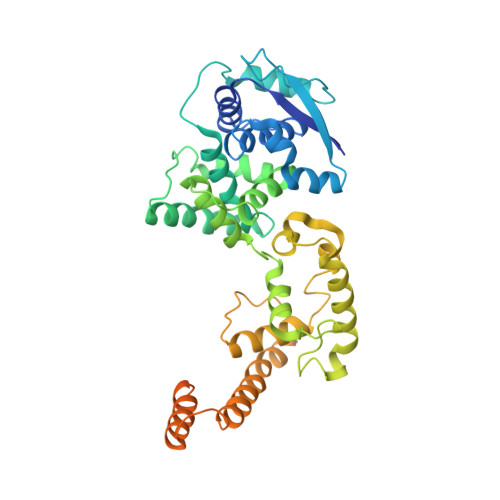
Ebola nucleoprotein nucleocapsid-like assembly and the asymmetric unit


Experimental Data Snapshot

  • Method: ELECTRON MICROSCOPY
  • Resolution: 5.80 Å
  • Aggregation State: FILAMENT 
  • Reconstruction Method: HELICAL 

wwPDB Validation 3D Report Full Report

Validation slider image for 6C54

This is version 1.4 of the entry. See complete history. 

Literature

Electron Cryo-microscopy Structure of Ebola Virus Nucleoprotein Reveals a Mechanism for Nucleocapsid-like Assembly.

Su, Z., Wu, C., Shi, L., Luthra, P., Pintilie, G.D., Johnson, B., Porter, J.R., Ge, P., Chen, M., Liu, G., Frederick, T.E., Binning, J.M., Bowman, G.R., Zhou, Z.H., Basler, C.F., Gross, M.L., Leung, D.W., Chiu, W., Amarasinghe, G.K.

(2018) Cell 172: 966-978.e12

  • DOI: https://doi.org/10.1016/j.cell.2018.02.009
  • Primary Citation Related Structures: 
    6C54

  • PubMed Abstract: 

    Ebola virus nucleoprotein (eNP) assembles into higher-ordered structures that form the viral nucleocapsid (NC) and serve as the scaffold for viral RNA synthesis. However, molecular insights into the NC assembly process are lacking. Using a hybrid approach, we characterized the NC-like assembly of eNP, identified novel regulatory elements, and described how these elements impact function. We generated a three-dimensional structure of the eNP NC-like assembly at 5.8 Å using electron cryo-microscopy and identified a new regulatory role for eNP helices α22-α23. Biochemical, biophysical, and mutational analyses revealed that inter-eNP contacts within α22-α23 are critical for viral NC assembly and regulate viral RNA synthesis. These observations suggest that the N terminus and α22-α23 of eNP function as context-dependent regulatory modules (CDRMs). Our current study provides a framework for a structural mechanism for NC-like assembly and a new therapeutic target.


  • Organizational Affiliation: 
    • Department of Bioengineering and Department of Microbiology and Immunology, James H. Clark Center, Stanford University, Stanford, CA 94305, USA.

Macromolecule Content 

  • Total Structure Weight: 96.29 kDa 
  • Atom Count: 5,664 
  • Modeled Residue Count: 720 
  • Deposited Residue Count: 866 
  • Unique protein chains: 1

Macromolecules

Find similar proteins by:|  3D Structure
Entity ID: 1
MoleculeChains  Sequence LengthOrganismDetailsImage
Nucleoprotein
A, B
433Zaire ebolavirusMutation(s): 0 
Gene Names: NP
UniProt
Find proteins for P18272 (Zaire ebolavirus (strain Mayinga-76))
Explore P18272 
Go to UniProtKB:  P18272
Entity Groups
Sequence Clusters30% Identity50% Identity70% Identity90% Identity95% Identity100% Identity
UniProt GroupP18272
Sequence Annotations
Expand
Reference Sequence

Experimental Data & Validation

Experimental Data

  • Method: ELECTRON MICROSCOPY
  • Resolution: 5.80 Å
  • Aggregation State: FILAMENT 
  • Reconstruction Method: HELICAL 
EM Software:
TaskSoftware PackageVersion
RECONSTRUCTIONRELION2-beta
MODEL REFINEMENTPHENIX1.11.1

Structure Validation

View Full Validation Report


Entry History 

& Funding Information

Deposition Data


Funding OrganizationLocationGrant Number
National Institutes of Health/National Institute of General Medical Sciences (NIH/NIGMS)United StatesP41GM103832
National Institutes of Health/National Institute of General Medical Sciences (NIH/NIGMS)United StatesP41GM103422
National Institutes of Health/National Institute of General Medical Sciences (NIH/NIGMS)United StatesR01GM12400701
National Institutes of Health/National Institute Of Allergy and Infectious Diseases (NIH/NIAID)United StatesU19AI109664
National Institutes of Health/National Institute Of Allergy and Infectious Diseases (NIH/NIAID)United StatesP01AI120943
National Institutes of Health/National Institute of General Medical Sciences (NIH/NIGMS)United StatesR01GM080139
Defense Threat Reduction Agency (DTRA)United StatesHDTRA1-16-1-0033

Revision History  (Full details and data files)

  • Version 1.0: 2018-03-07
    Type: Initial release
  • Version 1.1: 2019-02-20
    Changes: Author supporting evidence, Data collection
  • Version 1.2: 2019-12-18
    Changes: Author supporting evidence
  • Version 1.3: 2021-06-09
    Changes: Structure summary
  • Version 1.4: 2024-03-13
    Changes: Data collection, Database references, Derived calculations