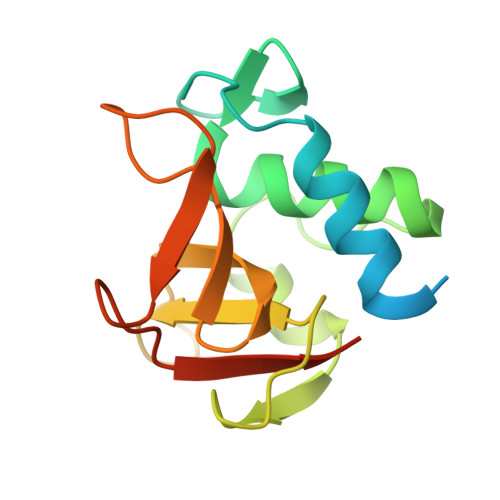
6B8C | pdb_00006b8c

Crystal structure of NlpC/p60 domain of peptidoglycan hydrolase SagA


Experimental Data Snapshot

  • Method: X-RAY DIFFRACTION
  • Resolution: 2.40 Å
  • R-Value Free: 
    0.269 (Depositor), 0.279 (DCC) 
  • R-Value Work: 
    0.239 (Depositor), 0.251 (DCC) 
  • R-Value Observed: 
    0.243 (Depositor) 

Starting Model: experimental
View more details

wwPDB Validation 3D Report Full Report

Validation slider image for 6B8C

This is version 1.3 of the entry. See complete history

Literature

Enterococcus faeciumsecreted antigen A generates muropeptides to enhance host immunity and limit bacterial pathogenesis.

Kim, B.Wang, Y.C.Hespen, C.W.Espinosa, J.Salje, J.Rangan, K.J.Oren, D.A.Kang, J.Y.Pedicord, V.A.Hang, H.C.

(2019) Elife 8

  • DOI: https://doi.org/10.7554/eLife.45343
  • Primary Citation Related Structures: 
    6B8C

  • PubMed Abstract: 

    We discovered that Enterococcus faecium ( E. faecium ), a ubiquitous commensal bacterium, and its secreted peptidoglycan hydrolase (SagA) were sufficient to enhance intestinal barrier function and pathogen tolerance, but the precise biochemical mechanism was unknown. Here we show E. faecium has unique peptidoglycan composition and remodeling activity through SagA, which generates smaller muropeptides that more effectively activates nucleotide-binding oligomerization domain-containing protein 2 (NOD2) in mammalian cells. Our structural and biochemical studies show that SagA is a NlpC/p60-endopeptidase that preferentially hydrolyzes crosslinked Lys-type peptidoglycan fragments. SagA secretion and NlpC/p60-endopeptidase activity was required for enhancing probiotic bacteria activity against Clostridium difficile pathogenesis in vivo . Our results demonstrate that the peptidoglycan composition and hydrolase activity of specific microbiota species can activate host immune pathways and enhance tolerance to pathogens.


  • Organizational Affiliation
    • Laboratory of Chemical Biology and Microbial Pathogenesis, The Rockefeller University, New York, United States.

Macromolecule Content 

  • Total Structure Weight: 15.72 kDa 
  • Atom Count: 878 
  • Modeled Residue Count: 117 
  • Deposited Residue Count: 150 
  • Unique protein chains: 1

Macromolecules

Find similar proteins by:|  3D Structure
Entity ID: 1
MoleculeChains  Sequence LengthOrganismDetailsImage
NLP/P60150Enterococcus faeciumMutation(s): 0 
Gene Names: FM130_01170

Experimental Data & Validation

Experimental Data

  • Method: X-RAY DIFFRACTION
  • Resolution: 2.40 Å
  • R-Value Free:  0.269 (Depositor), 0.279 (DCC) 
  • R-Value Work:  0.239 (Depositor), 0.251 (DCC) 
  • R-Value Observed: 0.243 (Depositor) 
Space Group: P 4 3 2
Unit Cell:
Length ( Å )Angle ( ˚ )
a = 100.385α = 90
b = 100.385β = 90
c = 100.385γ = 90
Software Package:
Software NamePurpose
PHENIXrefinement
HKL-2000data reduction
HKL-2000data scaling
PHENIXphasing

Structure Validation

View Full Validation Report


Entry History 

& Funding Information

Deposition Data


Funding OrganizationLocationGrant Number
National Institutes of Health/National Center for Advancing Translational Sciences (NIH/NCATS)United StatesUL1 TR0018663

Revision History  (Full details and data files)

  • Version 1.0: 2019-01-16
    Type: Initial release
  • Version 1.1: 2019-07-31
    Changes: Data collection, Database references
  • Version 1.2: 2019-12-04
    Changes: Author supporting evidence
  • Version 1.3: 2023-10-04
    Changes: Data collection, Database references, Refinement description