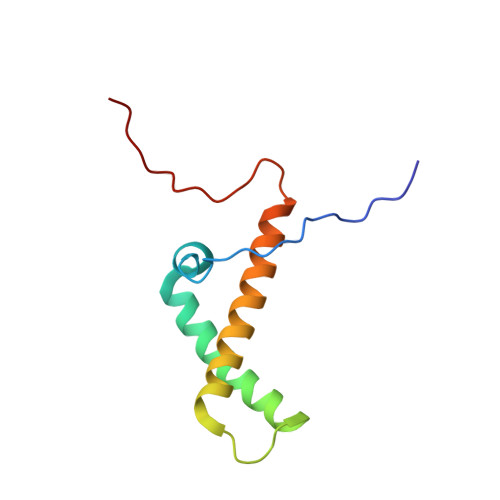
6ALY | pdb_00006aly

Solution structure of yeast Med15 ABD2 residues 277-368


Experimental Data Snapshot

  • Method: SOLUTION NMR
  • Conformers Calculated: 200 
  • Conformers Submitted: 20 
  • Selection Criteria: structures with the lowest energy 

wwPDB Validation 3D Report Full Report

Validation slider image for 6ALY

This is version 1.5 of the entry. See complete history

Literature

Gcn4-Mediator Specificity Is Mediated by a Large and Dynamic Fuzzy Protein-Protein Complex.

Tuttle, L.M.Pacheco, D.Warfield, L.Luo, J.Ranish, J.Hahn, S.Klevit, R.E.

(2018) Cell Rep 22: 3251-3264

  • DOI: https://doi.org/10.1016/j.celrep.2018.02.097
  • Primary Citation Related Structures: 
    6ALY

  • PubMed Abstract: 

    Transcription activation domains (ADs) are inherently disordered proteins that often target multiple coactivator complexes, but the specificity of these interactions is not understood. Efficient transcription activation by yeast Gcn4 requires its tandem ADs and four activator-binding domains (ABDs) on its target, the Mediator subunit Med15. Multiple ABDs are a common feature of coactivator complexes. We find that the large Gcn4-Med15 complex is heterogeneous and contains nearly all possible AD-ABD interactions. Gcn4-Med15 forms via a dynamic fuzzy protein-protein interface, where ADs bind the ABDs in multiple orientations via hydrophobic regions that gain helicity. This combinatorial mechanism allows individual low-affinity and specificity interactions to generate a biologically functional, specific, and higher affinity complex despite lacking a defined protein-protein interface. This binding strategy is likely representative of many activators that target multiple coactivators, as it allows great flexibility in combinations of activators that can cooperate to regulate genes with variable coactivator requirements.


  • Organizational Affiliation
    • Division of Basic Sciences, Fred Hutchinson Cancer Research Center, Seattle, WA 98109, USA; Department of Biochemistry, University of Washington, Seattle, WA 98195, USA.

Macromolecule Content 

  • Total Structure Weight: 10.53 kDa 
  • Atom Count: 738 
  • Modeled Residue Count: 92 
  • Deposited Residue Count: 92 
  • Unique protein chains: 1

Macromolecules

Find similar proteins by:|  3D Structure
Entity ID: 1
MoleculeChains  Sequence LengthOrganismDetailsImage
Mediator of RNA polymerase II transcription subunit 1592Saccharomyces cerevisiaeMutation(s): 0 
UniProt
Find proteins for P19659 (Saccharomyces cerevisiae (strain ATCC 204508 / S288c))
Explore P19659 
Go to UniProtKB:  P19659
Entity Groups
Sequence Clusters30% Identity50% Identity70% Identity90% Identity95% Identity100% Identity
UniProt GroupP19659
Sequence Annotations
Expand
Reference Sequence

Experimental Data & Validation

Experimental Data

  • Method: SOLUTION NMR
  • Conformers Calculated: 200 
  • Conformers Submitted: 20 
  • Selection Criteria: structures with the lowest energy 

Structure Validation

View Full Validation Report


Entry History 

& Funding Information

Deposition Data


Funding OrganizationLocationGrant Number
National Institutes of Health/National Institute of General Medical Sciences (NIH/NIGMS)United StatesGM075114

Revision History  (Full details and data files)

  • Version 1.0: 2018-03-21
    Type: Initial release
  • Version 1.1: 2018-04-04
    Changes: Data collection, Database references
  • Version 1.2: 2019-02-20
    Changes: Author supporting evidence, Data collection
  • Version 1.3: 2020-01-01
    Changes: Author supporting evidence, Data collection
  • Version 1.4: 2023-06-14
    Changes: Database references, Other
  • Version 1.5: 2024-05-15
    Changes: Data collection, Database references