5LZR | pdb_00005lzr

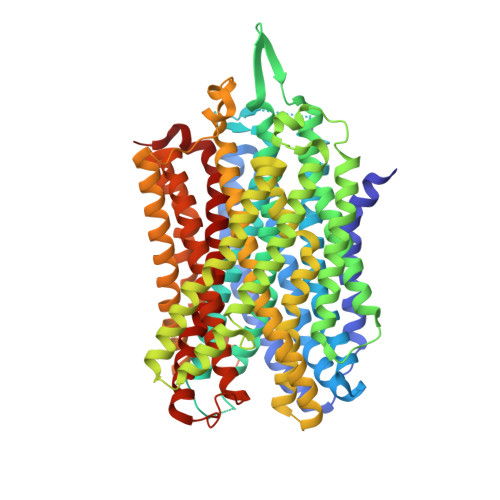
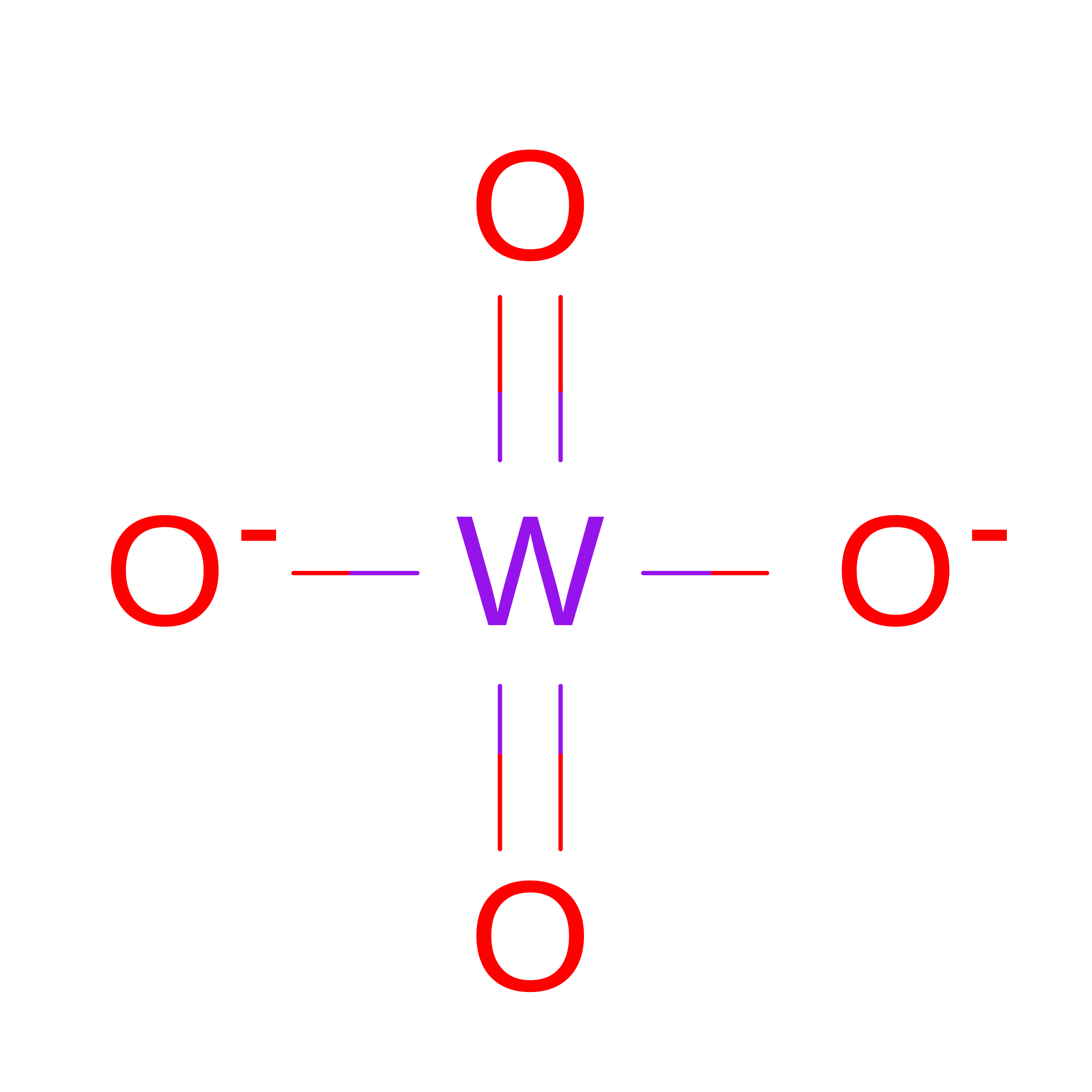
Crystal structure of Thermotoga maritima sodium pumping membrane integral pyrophosphatase in complex with tungstate and magnesium


Experimental Data Snapshot

  • Method: X-RAY DIFFRACTION
  • Resolution: 4.00 Å
  • R-Value Free: 
    0.279 (Depositor), 0.316 (DCC) 
  • R-Value Work: 
    0.232 (Depositor) 
  • R-Value Observed: 
    0.237 (Depositor) 

Starting Model: experimental
View more details

wwPDB Validation 3D Report Full Report

Validation slider image for 5LZR

This is version 1.1 of the entry. See complete history

Literature

Membrane pyrophosphatases from Thermotoga maritima and Vigna radiata suggest a conserved coupling mechanism.

Li, K.M.Wilkinson, C.Kellosalo, J.Tsai, J.Y.Kajander, T.Jeuken, L.J.Sun, Y.J.Goldman, A.

(2016) Nat Commun 7: 13596-13596

  • DOI: https://doi.org/10.1038/ncomms13596
  • Primary Citation Related Structures: 
    5GPJ, 5LZQ, 5LZR

  • PubMed Abstract: 

    Membrane-bound pyrophosphatases (M-PPases), which couple proton/sodium ion transport to pyrophosphate synthesis/hydrolysis, are important in abiotic stress resistance and in the infectivity of protozoan parasites. Here, three M-PPase structures in different catalytic states show that closure of the substrate-binding pocket by helices 5-6 affects helix 13 in the dimer interface and causes helix 12 to move down. This springs a 'molecular mousetrap', repositioning a conserved aspartate and activating the nucleophilic water. Corkscrew motion at helices 6 and 16 rearranges the key ionic gate residues and leads to ion pumping. The pumped ion is above the ion gate in one of the ion-bound structures, but below it in the other. Electrometric measurements show a single-turnover event with a non-hydrolysable inhibitor, supporting our model that ion pumping precedes hydrolysis. We propose a complete catalytic cycle for both proton and sodium-pumping M-PPases, and one that also explains the basis for ion specificity.


  • Organizational Affiliation
    • Department of Life Science and Institute of Bioinformatics and Structural Biology, College of Life Science, National Tsing Hua University, Hsinchu 30013, Taiwan.

Macromolecule Content 

  • Total Structure Weight: 157.03 kDa 
  • Atom Count: 9,796 
  • Modeled Residue Count: 1,387 
  • Deposited Residue Count: 1,470 
  • Unique protein chains: 1

Macromolecules

Find similar proteins by:|  3D Structure
Entity ID: 1
MoleculeChains  Sequence LengthOrganismDetailsImage
K(+)-stimulated pyrophosphate-energized sodium pump
A, B
735Thermotoga maritima MSB8Mutation(s): 2 
Gene Names: hppATM_0174
EC: 3.6.1.1 (PDB Primary Data), 7.2.3.1 (UniProt)
Membrane Entity: Yes 
UniProt
Find proteins for Q9S5X0 (Thermotoga maritima (strain ATCC 43589 / DSM 3109 / JCM 10099 / NBRC 100826 / MSB8))
Explore Q9S5X0 
Go to UniProtKB:  Q9S5X0
Entity Groups
Sequence Clusters30% Identity50% Identity70% Identity90% Identity95% Identity100% Identity
UniProt GroupQ9S5X0
Sequence Annotations
Expand
Reference Sequence

Experimental Data & Validation

Experimental Data

  • Method: X-RAY DIFFRACTION
  • Resolution: 4.00 Å
  • R-Value Free:  0.279 (Depositor), 0.316 (DCC) 
  • R-Value Work:  0.232 (Depositor) 
  • R-Value Observed: 0.237 (Depositor) 
Space Group: P 1 21 1
Unit Cell:
Length ( Å )Angle ( ˚ )
a = 83.72α = 90
b = 108.87β = 108.79
c = 105.81γ = 90
Software Package:
Software NamePurpose
PHENIXrefinement
PDB_EXTRACTdata extraction
XDSdata reduction
XDSdata scaling
PHASERphasing

Structure Validation

View Full Validation Report


Entry History 

Deposition Data

Revision History  (Full details and data files)

  • Version 1.0: 2016-12-14
    Type: Initial release
  • Version 1.1: 2024-01-17
    Changes: Data collection, Database references, Derived calculations, Refinement description