5JCO | pdb_00005jco

Structure and dynamics of single-isoform recombinant neuronal human tubulin


Experimental Data Snapshot

  • Method: ELECTRON MICROSCOPY
  • Resolution: 4.00 Å
  • Aggregation State: FILAMENT 
  • Reconstruction Method: HELICAL 

wwPDB Validation 3D Report Full Report

Validation slider image for 5JCO

This is version 1.5 of the entry. See complete history

Literature

Structure and Dynamics of Single-isoform Recombinant Neuronal Human Tubulin.

Vemu, A.Atherton, J.Spector, J.O.Szyk, A.Moores, C.A.Roll-Mecak, A.

(2016) J Biological Chem 291: 12907-12915

  • DOI: https://doi.org/10.1074/jbc.C116.731133
  • Primary Citation Related Structures: 
    5JCO

  • PubMed Abstract: 

    Microtubules are polymers that cycle stochastically between polymerization and depolymerization, i.e. they exhibit "dynamic instability." This behavior is crucial for cell division, motility, and differentiation. Although studies in the last decade have made fundamental breakthroughs in our understanding of how cellular effectors modulate microtubule dynamics, analysis of the relationship between tubulin sequence, structure, and dynamics has been held back by a lack of dynamics measurements with and structural characterization of homogeneous isotypically pure engineered tubulin. Here, we report for the first time the cryo-EM structure and in vitro dynamics parameters of recombinant isotypically pure human tubulin. α1A/βIII is a purely neuronal tubulin isoform. The 4.2-Å structure of post-translationally unmodified human α1A/βIII microtubules shows overall similarity to that of heterogeneous brain microtubules, but it is distinguished by subtle differences at polymerization interfaces, which are hot spots for sequence divergence between tubulin isoforms. In vitro dynamics assays show that, like mosaic brain microtubules, recombinant homogeneous microtubules undergo dynamic instability, but they polymerize slower and have fewer catastrophes. Interestingly, we find that epitaxial growth of α1A/βIII microtubules from heterogeneous brain seeds is inefficient but can be fully rescued by incorporating as little as 5% of brain tubulin into the homogeneous α1A/βIII lattice. Our study establishes a system to examine the structure and dynamics of mammalian microtubules with well defined tubulin species and is a first and necessary step toward uncovering how tubulin genetic and chemical diversity is exploited to modulate intrinsic microtubule dynamics.


  • Organizational Affiliation
    • From the Cell Biology and Biophysics Unit, NINDS, and.

Macromolecule Content 

  • Total Structure Weight: 585.31 kDa 
  • Atom Count: 40,512 
  • Modeled Residue Count: 5,124 
  • Deposited Residue Count: 5,178 
  • Unique protein chains: 2

Macromolecules

Find similar proteins by:|  3D Structure
Entity ID: 1
MoleculeChains  Sequence LengthOrganismDetailsImage
Tubulin beta-3 chain426Homo sapiensMutation(s): 0 
Gene Names: TUBB3TUBB4
UniProt & NIH Common Fund Data Resources
Find proteins for Q13509 (Homo sapiens)
Explore Q13509 
Go to UniProtKB:  Q13509
PHAROS:  Q13509
GTEx:  ENSG00000258947 
Entity Groups
Sequence Clusters30% Identity50% Identity70% Identity90% Identity95% Identity100% Identity
UniProt GroupQ13509
Sequence Annotations
Expand
Reference Sequence
Find similar proteins by:|  3D Structure
Entity ID: 2
MoleculeChains  Sequence LengthOrganismDetailsImage
Tubulin alpha-1A chain437Homo sapiensMutation(s): 0 
Gene Names: TUBA1ATUBA3
EC: 3.6.5
UniProt & NIH Common Fund Data Resources
Find proteins for Q71U36 (Homo sapiens)
Explore Q71U36 
Go to UniProtKB:  Q71U36
PHAROS:  Q71U36
GTEx:  ENSG00000167552 
Entity Groups
Sequence Clusters30% Identity50% Identity70% Identity90% Identity95% Identity100% Identity
UniProt GroupQ71U36
Sequence Annotations
Expand
Reference Sequence

Small Molecules

Ligands 3 Unique
IDChains Name / Formula / InChI Key2D Diagram3D Interactions
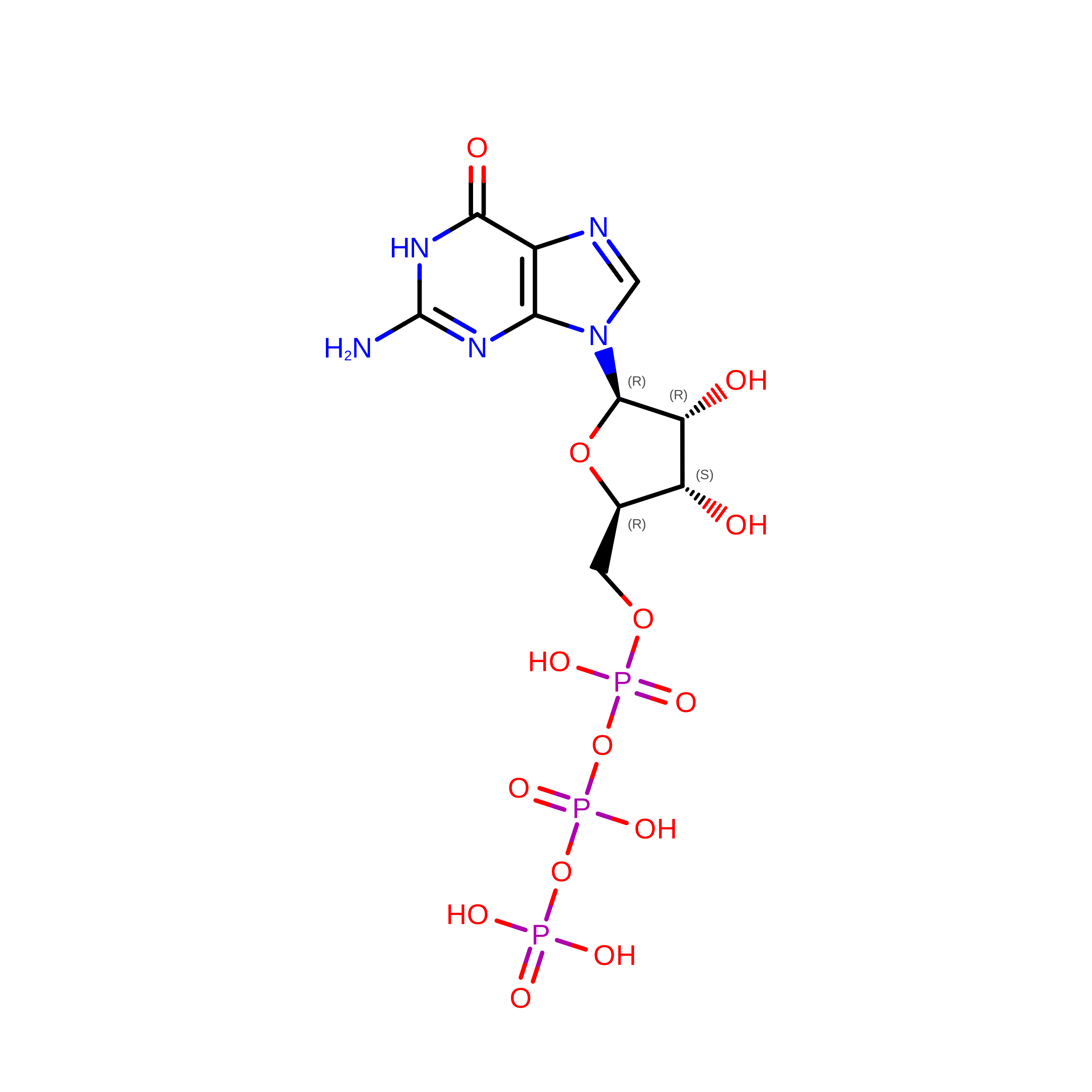
GTP

Query on GTP


Download:Ideal Coordinates CCD File
AA [auth F]
CA [auth A]
EA [auth B]
IA [auth G]
O [auth H]
AA [auth F],
CA [auth A],
EA [auth B],
IA [auth G],
O [auth H],
S [auth E]
GUANOSINE-5'-TRIPHOSPHATE
C10 H16 N5 O14 P3
XKMLYUALXHKNFT-UUOKFMHZSA-N
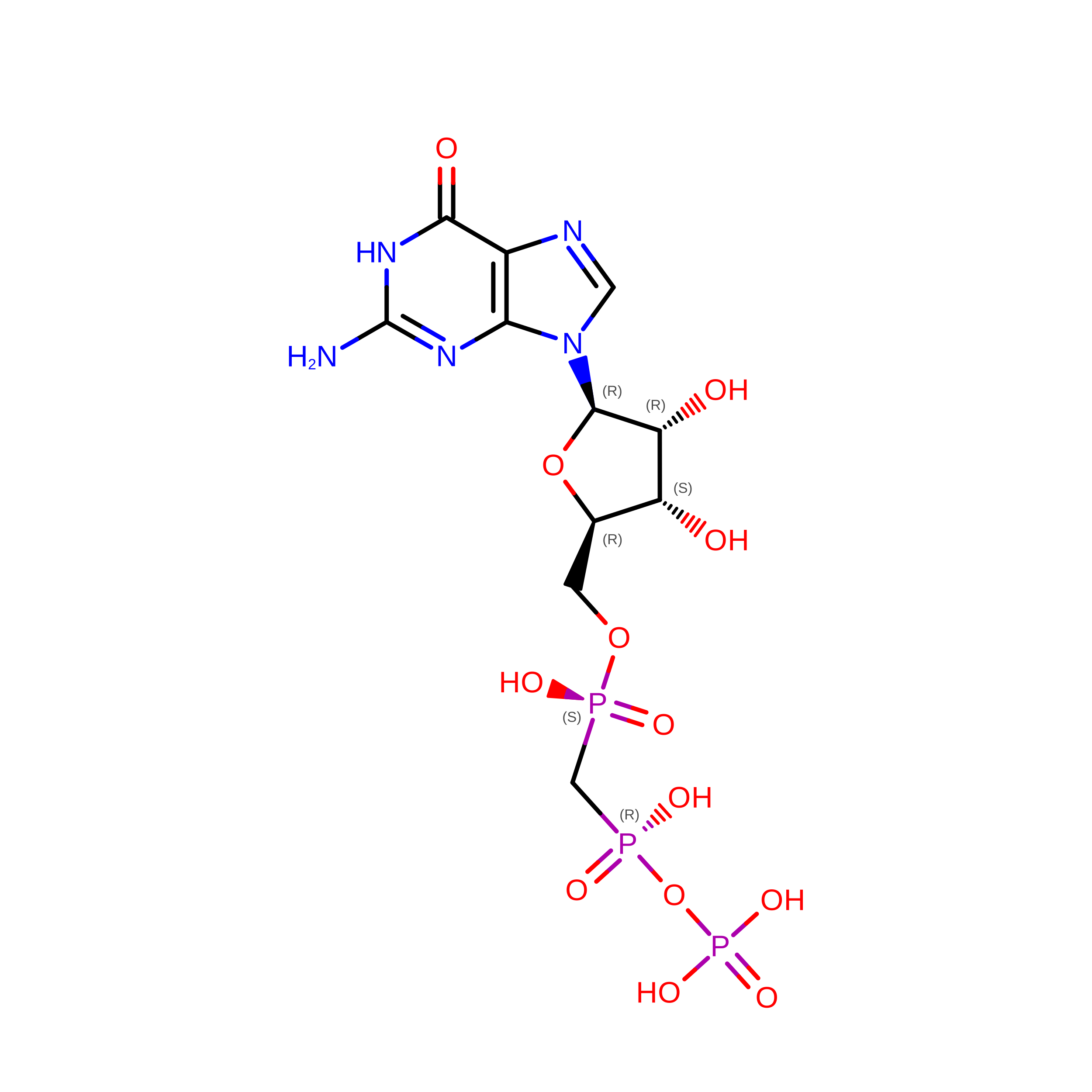
G2P

Query on G2P


Download:Ideal Coordinates CCD File
GA [auth L]
M [auth K]
Q [auth I]
U [auth J]
W [auth C]
GA [auth L],
M [auth K],
Q [auth I],
U [auth J],
W [auth C],
Y [auth D]
PHOSPHOMETHYLPHOSPHONIC ACID GUANYLATE ESTER
C11 H18 N5 O13 P3
GXTIEXDFEKYVGY-KQYNXXCUSA-N
MG

Query on MG


Download:Ideal Coordinates CCD File
BA [auth F]
DA [auth A]
FA [auth B]
HA [auth L]
JA [auth G]
BA [auth F],
DA [auth A],
FA [auth B],
HA [auth L],
JA [auth G],
N [auth K],
P [auth H],
R [auth I],
T [auth E],
V [auth J],
X [auth C],
Z [auth D]
MAGNESIUM ION
Mg
JLVVSXFLKOJNIY-UHFFFAOYSA-N

Experimental Data & Validation

Experimental Data

  • Method: ELECTRON MICROSCOPY
  • Resolution: 4.00 Å
  • Aggregation State: FILAMENT 
  • Reconstruction Method: HELICAL 

Structure Validation

View Full Validation Report


Entry History 

& Funding Information

Deposition Data


Funding OrganizationLocationGrant Number
Medical Research Council (MRC, United Kingdom)United Kingdom--
National Institutes of Health/National Institute of Neurological Disorders and Stroke (NIH/NINDS)United States--
National Institutes of Health/National Heart, Lung, and Blood Institute (NIH/NHLBI)United States--

Revision History  (Full details and data files)

  • Version 1.0: 2016-05-04
    Type: Initial release
  • Version 1.1: 2016-05-11
    Changes: Database references
  • Version 1.2: 2016-06-29
    Changes: Database references
  • Version 1.3: 2017-09-13
    Changes: Author supporting evidence, Data collection, Database references
  • Version 1.4: 2019-12-04
    Changes: Author supporting evidence
  • Version 1.5: 2024-03-06
    Changes: Data collection, Database references, Refinement description