5HKR | pdb_00005hkr

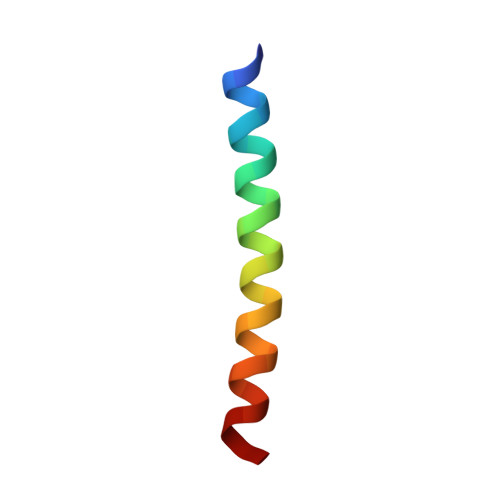
Crystal structure of de novo designed fullerene organising protein complex with fullerene


Experimental Data Snapshot

  • Method: X-RAY DIFFRACTION
  • Resolution: 2.35 Å
  • R-Value Free: 
    0.234 (Depositor), 0.229 (DCC) 
  • R-Value Work: 
    0.202 (Depositor), 0.197 (DCC) 
  • R-Value Observed: 
    0.209 (Depositor) 

wwPDB Validation 3D Report Full Report

Validation slider image for 5HKR

Ligand Structure Quality Assessment 


This is version 1.3 of the entry. See complete history

Literature

Protein-directed self-assembly of a fullerene crystal.

Kim, K.H.Ko, D.K.Kim, Y.T.Kim, N.H.Paul, J.Zhang, S.Q.Murray, C.B.Acharya, R.DeGrado, W.F.Kim, Y.H.Grigoryan, G.

(2016) Nat Commun 7: 11429-11429

  • DOI: https://doi.org/10.1038/ncomms11429
  • Primary Citation Related Structures: 
    5ET3, 5HKN, 5HKR

  • PubMed Abstract: 

    Learning to engineer self-assembly would enable the precise organization of molecules by design to create matter with tailored properties. Here we demonstrate that proteins can direct the self-assembly of buckminsterfullerene (C60) into ordered superstructures. A previously engineered tetrameric helical bundle binds C60 in solution, rendering it water soluble. Two tetramers associate with one C60, promoting further organization revealed in a 1.67-Å crystal structure. Fullerene groups occupy periodic lattice sites, sandwiched between two Tyr residues from adjacent tetramers. Strikingly, the assembly exhibits high charge conductance, whereas both the protein-alone crystal and amorphous C60 are electrically insulating. The affinity of C60 for its crystal-binding site is estimated to be in the nanomolar range, with lattices of known protein crystals geometrically compatible with incorporating the motif. Taken together, these findings suggest a new means of organizing fullerene molecules into a rich variety of lattices to generate new properties by design.


  • Organizational Affiliation
    • SKKU Advanced Institute of Nanotechnology, Sungkyunkwan University, Suwon 16419, Korea.

Macromolecule Content 

  • Total Structure Weight: 7.1 kDa 
  • Atom Count: 512 
  • Modeled Residue Count: 60 
  • Deposited Residue Count: 60 
  • Unique protein chains: 1

Macromolecules

Find similar proteins by:|  3D Structure
Entity ID: 1
MoleculeChains  Sequence LengthOrganismDetailsImage
fullerene organizing protein
A, B
30synthetic constructMutation(s): 0 

Small Molecules

Ligands 1 Unique
IDChains Name / Formula / InChI Key2D Diagram3D Interactions
60C

Query on 60C


Download:Ideal Coordinates CCD File
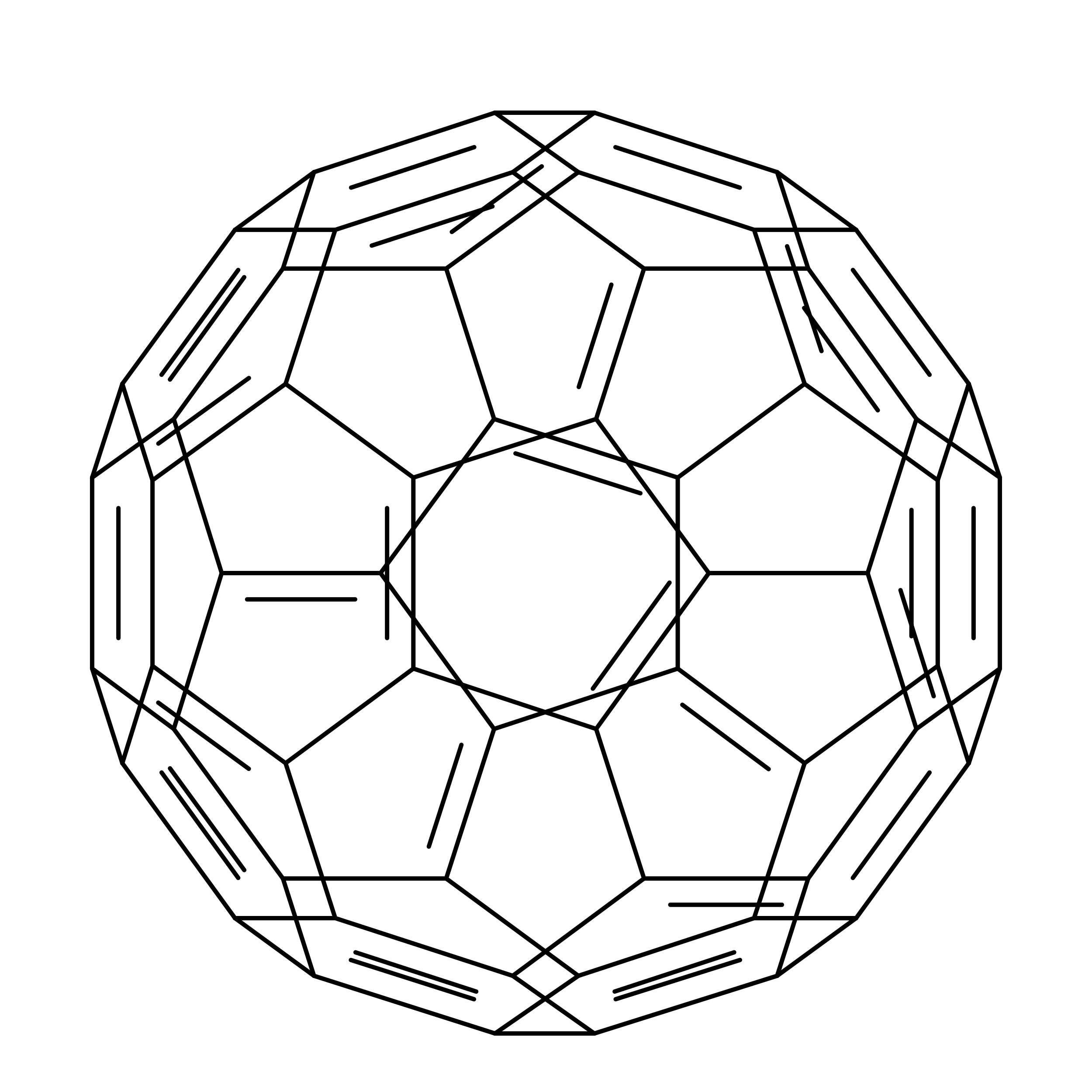
C [auth B](C_{60}-I_{h})[5,6]fullerene
C60
XMWRBQBLMFGWIX-UHFFFAOYSA-N

Experimental Data & Validation

Experimental Data

  • Method: X-RAY DIFFRACTION
  • Resolution: 2.35 Å
  • R-Value Free:  0.234 (Depositor), 0.229 (DCC) 
  • R-Value Work:  0.202 (Depositor), 0.197 (DCC) 
  • R-Value Observed: 0.209 (Depositor) 
Space Group: P 62
Unit Cell:
Length ( Å )Angle ( ˚ )
a = 41.713α = 90
b = 41.713β = 90
c = 66.808γ = 120
Software Package:
Software NamePurpose
PHENIXrefinement
MOSFLMdata reduction
SCALAdata scaling
PHASERphasing

Structure Validation

View Full Validation Report


Ligand Structure Quality Assessment 


Entry History 

Deposition Data

Revision History  (Full details and data files)

  • Version 1.0: 2016-05-04
    Type: Initial release
  • Version 1.1: 2017-09-27
    Changes: Data collection, Derived calculations
  • Version 1.2: 2020-01-01
    Changes: Database references
  • Version 1.3: 2024-03-20
    Changes: Data collection, Database references