5HGL | pdb_00005hgl

Hexameric HIV-1 CA, open conformation


Experimental Data Snapshot

  • Method: X-RAY DIFFRACTION
  • Resolution: 3.10 Å
  • R-Value Free: 
    0.282 (Depositor), 0.283 (DCC) 
  • R-Value Work: 
    0.250 (Depositor) 
  • R-Value Observed: 
    0.252 (Depositor) 

Starting Model: experimental
View more details

wwPDB Validation 3D Report Full Report

Validation slider image for 5HGL

Ligand Structure Quality Assessment 


This is version 1.6 of the entry. See complete history

Literature

HIV-1 uses dynamic capsid pores to import nucleotides and fuel encapsidated DNA synthesis.

Jacques, D.A.McEwan, W.A.Hilditch, L.Price, A.J.Towers, G.J.James, L.C.

(2016) Nature 536: 349-353

  • DOI: https://doi.org/10.1038/nature19098
  • Primary Citation Related Structures: 
    5HGK, 5HGL, 5HGM, 5HGN, 5HGO, 5HGP, 5JPA

  • PubMed Abstract: 

    During the early stages of infection, the HIV-1 capsid protects viral components from cytosolic sensors and nucleases such as cGAS and TREX, respectively, while allowing access to nucleotides for efficient reverse transcription. Here we show that each capsid hexamer has a size-selective pore bound by a ring of six arginine residues and a 'molecular iris' formed by the amino-terminal β-hairpin. The arginine ring creates a strongly positively charged channel that recruits the four nucleotides with on-rates that approach diffusion limits. Progressive removal of pore arginines results in a dose-dependent and concomitant decrease in nucleotide affinity, reverse transcription and infectivity. This positively charged channel is universally conserved in lentiviral capsids despite the fact that it is strongly destabilizing without nucleotides to counteract charge repulsion. We also describe a channel inhibitor, hexacarboxybenzene, which competes for nucleotide binding and efficiently blocks encapsidated reverse transcription, demonstrating the tractability of the pore as a novel drug target.

Macromolecule Content 

  • Total Structure Weight: 155.36 kDa 
  • Atom Count: 9,551 
  • Modeled Residue Count: 1,209 
  • Deposited Residue Count: 1,386 
  • Unique protein chains: 1

Macromolecules

Find similar proteins by:|  3D Structure
Entity ID: 1
MoleculeChains  Sequence LengthOrganismDetailsImage
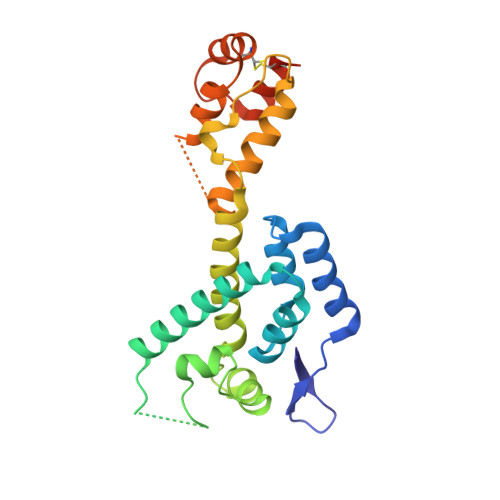
Capsid protein P24
A, B, C, D, E
A, B, C, D, E, F
231Human immunodeficiency virus 1Mutation(s): 4 
Gene Names: gag
UniProt
Find proteins for P12493 (Human immunodeficiency virus type 1 group M subtype B (isolate NY5))
Explore P12493 
Go to UniProtKB:  P12493
Entity Groups
Sequence Clusters30% Identity50% Identity70% Identity90% Identity95% Identity100% Identity
UniProt GroupP12493
Sequence Annotations
Expand
Reference Sequence

Small Molecules

Ligands 2 Unique
IDChains Name / Formula / InChI Key2D Diagram3D Interactions
1B0

Query on 1B0


Download:Ideal Coordinates CCD File
G [auth A]
H [auth B]
J [auth C]
K [auth D]
L [auth E]
G [auth A],
H [auth B],
J [auth C],
K [auth D],
L [auth E],
M [auth F]
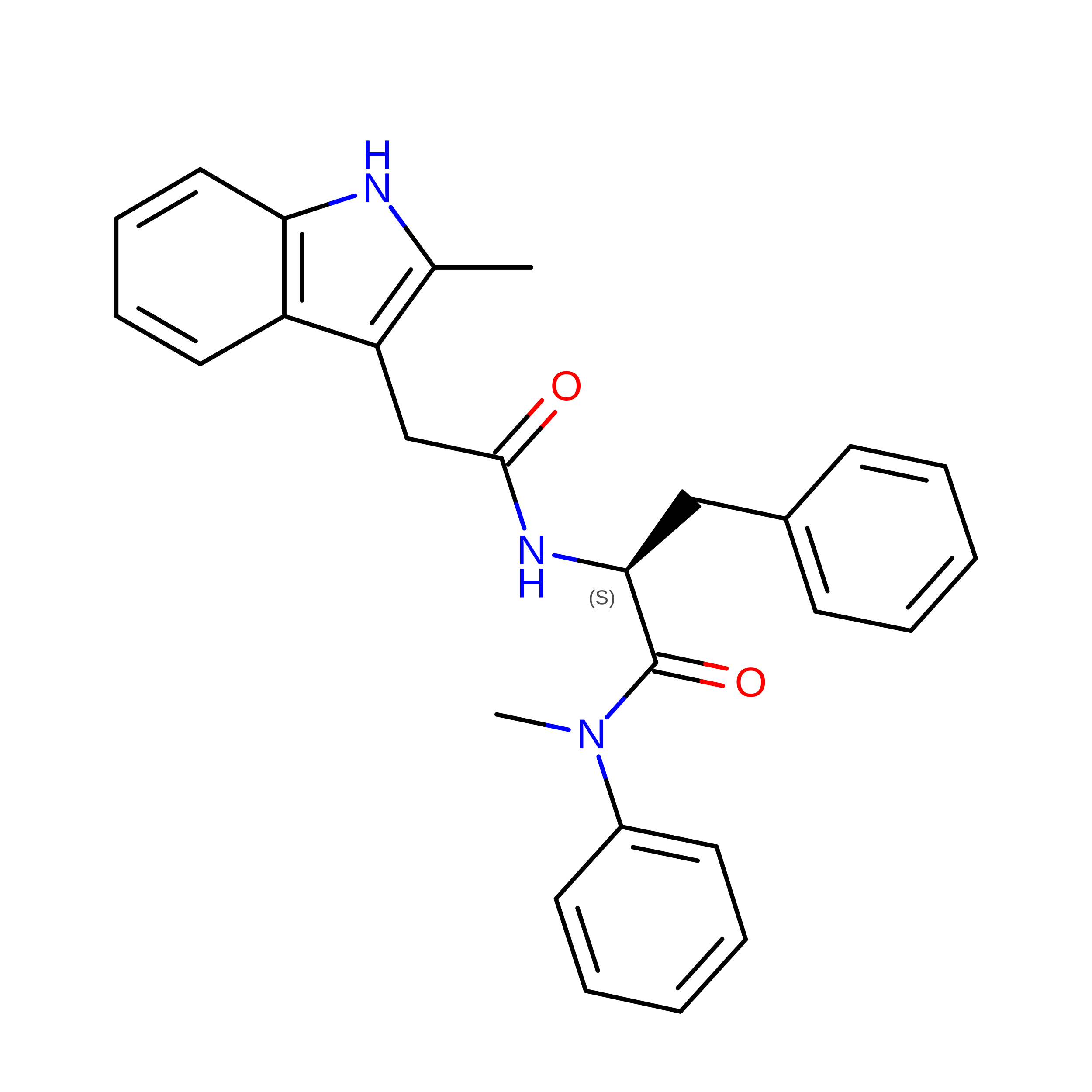
N-METHYL-NALPHA-[(2-METHYL-1H-INDOL-3-YL)ACETYL]-N-PHENYL-L-PHENYLALANINAMIDE
C27 H27 N3 O2
ACDFWSNAQWFRRF-VWLOTQADSA-N
CL

Query on CL


Download:Ideal Coordinates CCD File
I [auth B]CHLORIDE ION
Cl
VEXZGXHMUGYJMC-UHFFFAOYSA-M

Experimental Data & Validation

Experimental Data

  • Method: X-RAY DIFFRACTION
  • Resolution: 3.10 Å
  • R-Value Free:  0.282 (Depositor), 0.283 (DCC) 
  • R-Value Work:  0.250 (Depositor) 
  • R-Value Observed: 0.252 (Depositor) 
Space Group: C 2 2 21
Unit Cell:
Length ( Å )Angle ( ˚ )
a = 89.69α = 90
b = 159.27β = 90
c = 249.399γ = 90
Software Package:
Software NamePurpose
MAR345dtbdata collection
Aimlessdata scaling
PHASERphasing
REFMACrefinement
PDB_EXTRACTdata extraction
iMOSFLMdata reduction

Structure Validation

View Full Validation Report


Ligand Structure Quality Assessment 


Entry History 

& Funding Information

Deposition Data


Funding OrganizationLocationGrant Number
Medical Research Council (United Kingdom)United KingdomUK; U105181010
European Research CouncilUnited Kingdom281627 -IAI
National Health and Medical Research CouncilAustraliaGNT1036521

Revision History  (Full details and data files)

  • Version 1.0: 2016-08-10
    Type: Initial release
  • Version 1.1: 2016-08-24
    Changes: Database references
  • Version 1.2: 2016-08-31
    Changes: Database references
  • Version 1.3: 2017-09-13
    Changes: Author supporting evidence
  • Version 1.4: 2018-01-24
    Changes: Source and taxonomy
  • Version 1.5: 2024-01-10
    Changes: Data collection, Database references, Refinement description
  • Version 1.6: 2024-11-20
    Changes: Structure summary