5EMW | pdb_00005emw

Crystal structure of the palmitoylated human TEAD3 transcription factor


Experimental Data Snapshot

  • Method: X-RAY DIFFRACTION
  • Resolution: 2.55 Å
  • R-Value Free: 
    0.223 (Depositor), 0.227 (DCC) 
  • R-Value Work: 
    0.184 (Depositor), 0.192 (DCC) 
  • R-Value Observed: 
    0.186 (Depositor) 

Starting Model: experimental
View more details

wwPDB Validation 3D Report Full Report

Validation slider image for 5EMW

This is version 1.2 of the entry. See complete history

Literature

Palmitoylation of TEAD Transcription Factors Is Required for Their Stability and Function in Hippo Pathway Signaling.

Noland, C.L.Gierke, S.Schnier, P.D.Murray, J.Sandoval, W.N.Sagolla, M.Dey, A.Hannoush, R.N.Fairbrother, W.J.Cunningham, C.N.

(2016) Structure 24: 179-186

  • DOI: https://doi.org/10.1016/j.str.2015.11.005
  • Primary Citation Related Structures: 
    5EMV, 5EMW

  • PubMed Abstract: 

    The Hippo signaling pathway is responsible for regulating the function of TEAD family transcription factors in metazoans. TEADs, with their co-activators YAP/TAZ, are critical for controlling cell differentiation and organ size through their transcriptional activation of genes involved in cell growth and proliferation. Dysregulation of the Hippo pathway has been implicated in multiple forms of cancer. Here, we identify a novel form of regulation of TEAD family proteins. We show that human TEADs are palmitoylated at a universally conserved cysteine, and report the crystal structures of the human TEAD2 and TEAD3 YAP-binding domains in their palmitoylated forms. These structures show a palmitate bound within a highly conserved hydrophobic cavity at each protein's core. Our findings also demonstrate that this modification is required for proper TEAD folding and stability, indicating a potential new avenue for pharmacologically regulating the Hippo pathway through the modulation of TEAD palmitoylation.


  • Organizational Affiliation
    • Department of Structural Biology, Genentech, Inc., 1 DNA Way, South San Francisco, CA 94080, USA.

Macromolecule Content 

  • Total Structure Weight: 100.67 kDa 
  • Atom Count: 6,834 
  • Modeled Residue Count: 830 
  • Deposited Residue Count: 868 
  • Unique protein chains: 1

Macromolecules

Find similar proteins by:|  3D Structure
Entity ID: 1
MoleculeChains  Sequence LengthOrganismDetailsImage
Transcriptional enhancer factor TEF-5
A, B, C, D
217Homo sapiensMutation(s): 0 
Gene Names: TEAD3TEAD5TEF5
UniProt & NIH Common Fund Data Resources
Find proteins for Q99594 (Homo sapiens)
Explore Q99594 
Go to UniProtKB:  Q99594
PHAROS:  Q99594
GTEx:  ENSG00000007866 
Entity Groups
Sequence Clusters30% Identity50% Identity70% Identity90% Identity95% Identity100% Identity
UniProt GroupQ99594
Sequence Annotations
Expand
Reference Sequence

Small Molecules

Modified Residues  1 Unique
IDChains TypeFormula2D DiagramParent
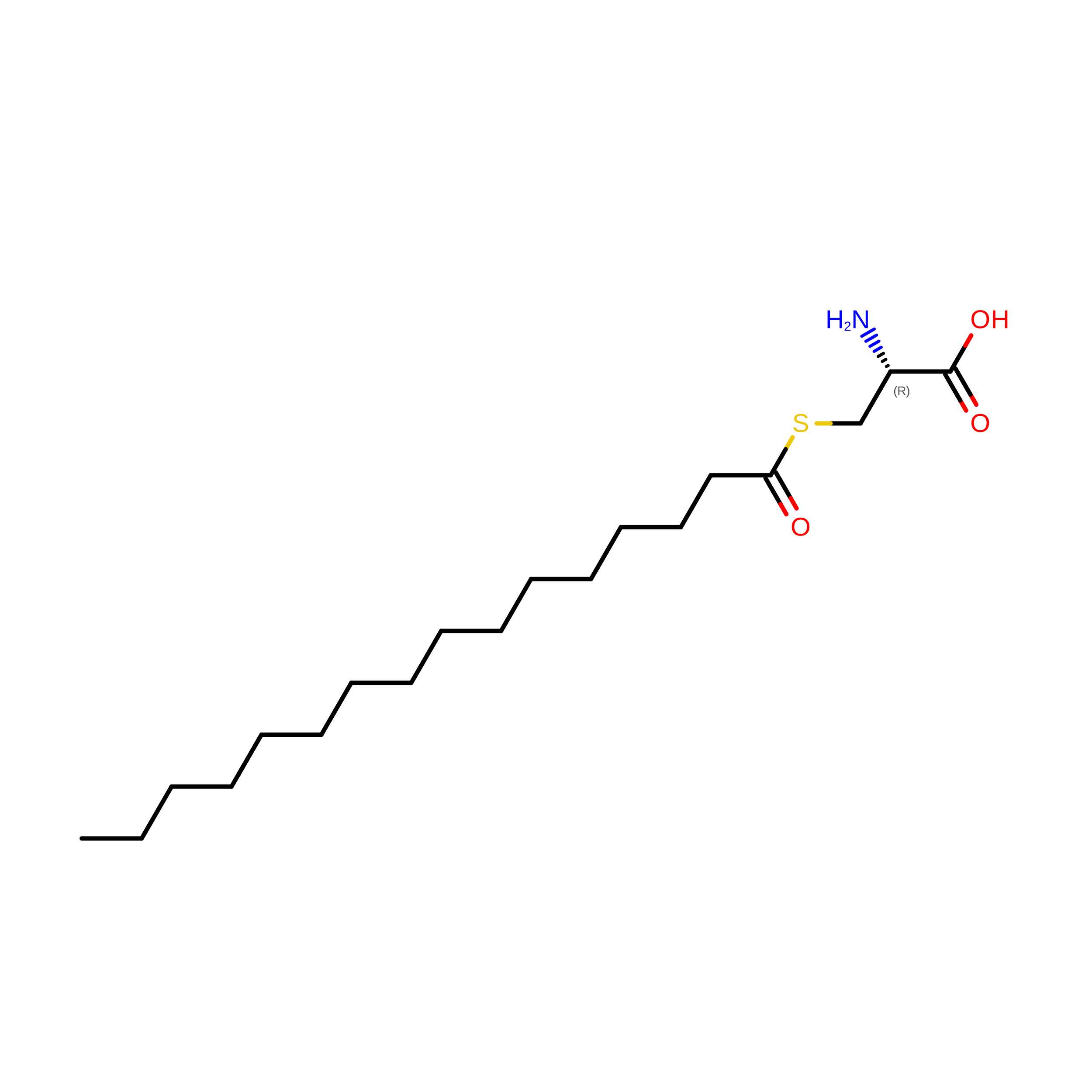
P1L
Query on P1L
A, B, C, D
L-PEPTIDE LINKINGC19 H37 N O3 SCYS

Experimental Data & Validation

Experimental Data

  • Method: X-RAY DIFFRACTION
  • Resolution: 2.55 Å
  • R-Value Free:  0.223 (Depositor), 0.227 (DCC) 
  • R-Value Work:  0.184 (Depositor), 0.192 (DCC) 
  • R-Value Observed: 0.186 (Depositor) 
Space Group: P 21 21 21
Unit Cell:
Length ( Å )Angle ( ˚ )
a = 65.31α = 90
b = 123.53β = 90
c = 150.73γ = 90
Software Package:
Software NamePurpose
PHENIXrefinement
MOSFLMdata reduction
SCALAdata scaling
PHASERphasing
PDB_EXTRACTdata extraction

Structure Validation

View Full Validation Report


Entry History 

Deposition Data

Revision History  (Full details and data files)

  • Version 1.0: 2015-12-23
    Type: Initial release
  • Version 1.1: 2016-01-20
    Changes: Database references
  • Version 1.2: 2023-09-27
    Changes: Data collection, Database references, Derived calculations, Refinement description