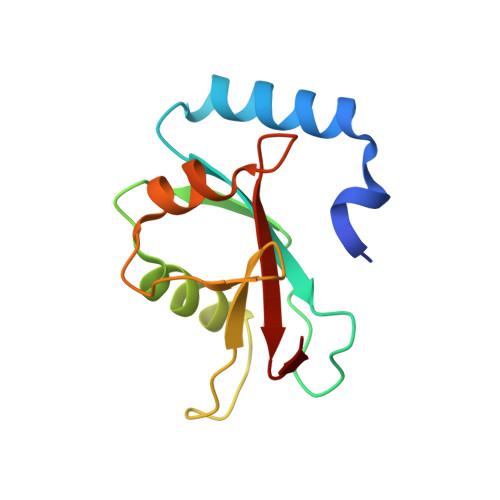
5DPW | pdb_00005dpw

Crystal structure of PLEKHM1 LIR in complex with human LC3C_8-125


Experimental Data Snapshot

  • Method: X-RAY DIFFRACTION
  • Resolution: 2.19 Å
  • R-Value Free: 
    0.246 (Depositor), 0.244 (DCC) 
  • R-Value Work: 
    0.200 (Depositor), 0.196 (DCC) 
  • R-Value Observed: 
    0.201 (Depositor) 

wwPDB Validation 3D Report Full Report

Validation slider image for 5DPW

This is version 1.2 of the entry. See complete history

Literature

Structural and functional analysis of the GABARAP interaction motif (GIM).

Rogov, V.V.Stolz, A.Ravichandran, A.C.Rios-Szwed, D.O.Suzuki, H.Kniss, A.Lohr, F.Wakatsuki, S.Dotsch, V.Dikic, I.Dobson, R.C.McEwan, D.G.

(2017) EMBO Rep 18: 1382-1396

  • DOI: https://doi.org/10.15252/embr.201643587
  • Primary Citation Related Structures: 
    5DPR, 5DPS, 5DPT, 5DPW

  • PubMed Abstract: 

    Through the canonical LC3 interaction motif (LIR), [W/F/Y]-X 1 -X 2 -[I/L/V], protein complexes are recruited to autophagosomes to perform their functions as either autophagy adaptors or receptors. How these adaptors/receptors selectively interact with either LC3 or GABARAP families remains unclear. Herein, we determine the range of selectivity of 30 known core LIR motifs towards individual LC3s and GABARAPs. From these, we define a G ABARAP I nteraction M otif (GIM) sequence ([W/F]-[V/I]-X 2 -V) that the adaptor protein PLEKHM1 tightly conforms to. Using biophysical and structural approaches, we show that the PLEKHM1-LIR is indeed 11-fold more specific for GABARAP than LC3B. Selective mutation of the X 1 and X 2 positions either completely abolished the interaction with all LC3 and GABARAPs or increased PLEKHM1-GIM selectivity 20-fold towards LC3B. Finally, we show that conversion of p62/SQSTM1, FUNDC1 and FIP200 LIRs into our newly defined GIM, by introducing two valine residues, enhances their interaction with endogenous GABARAP over LC3B. The identification of a GABARAP-specific interaction motif will aid the identification and characterization of the expanding array of autophagy receptor and adaptor proteins and their in vivo functions.


  • Organizational Affiliation
    • Institute of Biophysical Chemistry and Center for Biomolecular Magnetic Resonance, Goethe University, Frankfurt am Main, Germany.

Macromolecule Content 

  • Total Structure Weight: 124.44 kDa 
  • Atom Count: 8,460 
  • Modeled Residue Count: 992 
  • Deposited Residue Count: 1,056 
  • Unique protein chains: 2

Macromolecules

Find similar proteins by:|  3D Structure
Entity ID: 1
MoleculeChains  Sequence LengthOrganismDetailsImage
Microtubule-associated proteins 1A/1B light chain 3C
A, C, E, G, I
A, C, E, G, I, K, M, O
118Homo sapiensMutation(s): 0 
Gene Names: MAP1LC3C
UniProt & NIH Common Fund Data Resources
Find proteins for Q9BXW4 (Homo sapiens)
Explore Q9BXW4 
Go to UniProtKB:  Q9BXW4
PHAROS:  Q9BXW4
GTEx:  ENSG00000197769 
Entity Groups
Sequence Clusters30% Identity50% Identity70% Identity90% Identity95% Identity100% Identity
UniProt GroupQ9BXW4
Sequence Annotations
Expand
Reference Sequence
Find similar proteins by:  Sequence   |   3D Structure  
Entity ID: 2
MoleculeChains  Sequence LengthOrganismDetailsImage
Pleckstrin homology domain-containing family M member 1
B, D, F, H, J
B, D, F, H, J, L, N, P
14Homo sapiensMutation(s): 0 
Gene Names: PLEKHM1KIAA0356
UniProt & NIH Common Fund Data Resources
Find proteins for Q9Y4G2 (Homo sapiens)
Explore Q9Y4G2 
Go to UniProtKB:  Q9Y4G2
PHAROS:  Q9Y4G2
GTEx:  ENSG00000225190 
Entity Groups
Sequence Clusters30% Identity50% Identity70% Identity90% Identity95% Identity100% Identity
UniProt GroupQ9Y4G2
Sequence Annotations
Expand
Reference Sequence

Experimental Data & Validation

Experimental Data

  • Method: X-RAY DIFFRACTION
  • Resolution: 2.19 Å
  • R-Value Free:  0.246 (Depositor), 0.244 (DCC) 
  • R-Value Work:  0.200 (Depositor), 0.196 (DCC) 
  • R-Value Observed: 0.201 (Depositor) 
Space Group: P 1
Unit Cell:
Length ( Å )Angle ( ˚ )
a = 54.14α = 89.96
b = 73.225β = 89.99
c = 89.048γ = 77.31
Software Package:
Software NamePurpose
PHENIXrefinement
XDSdata reduction
Aimlessdata scaling
MOLREPphasing

Structure Validation

View Full Validation Report


Entry History 

Deposition Data

Revision History  (Full details and data files)

  • Version 1.0: 2016-09-28
    Type: Initial release
  • Version 1.1: 2018-06-20
    Changes: Data collection, Database references, Derived calculations
  • Version 1.2: 2024-03-06
    Changes: Data collection, Database references