5ZQS | pdb_00005zqs

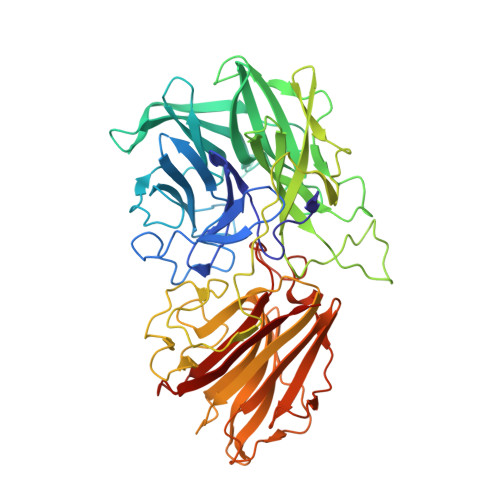
Crystal structure of beta-xylosidase mutant (E186Q/F503Y) from Bacillus pumilus


Experimental Data Snapshot

  • Method: X-RAY DIFFRACTION
  • Resolution: 1.78 Å
  • R-Value Free: 
    0.209 (Depositor), 0.209 (DCC) 
  • R-Value Work: 
    0.166 (Depositor), 0.166 (DCC) 
  • R-Value Observed: 
    0.168 (Depositor) 

Starting Model: experimental
View more details

wwPDB Validation 3D Report Full Report

Validation slider image for 5ZQS

Ligand Structure Quality Assessment 


This is version 2.1 of the entry. See complete history

Literature

Structure-based protein engineering of bacterial beta-xylosidase to increase the production yield of xylobiose from xylose

Hong, S.Kyung, M.Jo, I.Kim, Y.R.Ha, N.C.

(2018) Biochem Biophys Res Commun 501: 703-710

  • DOI: https://doi.org/10.1016/j.bbrc.2018.05.051
  • Primary Citation Related Structures: 
    5ZQJ, 5ZQS, 5ZQX

  • PubMed Abstract: 

    Xylobiose consists of two molecules of xylose and has been highly recognized as a food supplement because it possesses high prebiotic functions. β-xylosidase exhibits enzymatic activity to hydrolyze xylobiose, and the enzyme can also catalyze the reverse reaction in the presence of high concentrations of xylose. Previously, β-xylosidase from Bacillus pumilus IPO (BpXynB), belonging to GH family 43, was employed to produce xylobiose from xylose. To improve the enzymatic efficiency, this study determined the high-resolution structure of BpXynB in a complex with xylobiose and engineered BpXynB based on the structures. The structure of BpXynB deciphered the residues involved in the recognition of the xylobiose. A site-directed mutation at the residue for xylobiose recognition increased the yield of xylobiose by 20% compared to a similar activity of the wild type enzyme. The complex structure of the mutant enzyme and xylobiose provided the structural basis for a higher yield of the engineered protein. This engineered enzyme would enable a higher economic production of xylobiose, and a similar engineering strategy could be applied within the same family of enzymes.


  • Organizational Affiliation
    • Research Institute for Agriculture and Life Sciences, Center for Food and Bioconvergence, Center for Food Safety and Toxicology, Department of Agicultural Biotechnology, Seoul National University, Seoul, 08826, Republic of Korea.

Macromolecule Content 

  • Total Structure Weight: 124.93 kDa 
  • Atom Count: 9,219 
  • Modeled Residue Count: 1,063 
  • Deposited Residue Count: 1,082 
  • Unique protein chains: 1

Macromolecules

Find similar proteins by:|  3D Structure
Entity ID: 1
MoleculeChains  Sequence LengthOrganismDetailsImage
Beta-xylosidase
A, B
541Bacillus pumilusMutation(s): 2 
Gene Names: xynB
EC: 3.2.1.37
UniProt
Find proteins for P07129 (Bacillus pumilus)
Explore P07129 
Go to UniProtKB:  P07129
Entity Groups
Sequence Clusters30% Identity50% Identity70% Identity90% Identity95% Identity100% Identity
UniProt GroupP07129
Sequence Annotations
Expand
Reference Sequence

Oligosaccharides

Help  
Entity ID: 2
MoleculeChains Length2D Diagram GlycosylationD Interactions
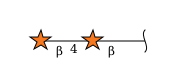
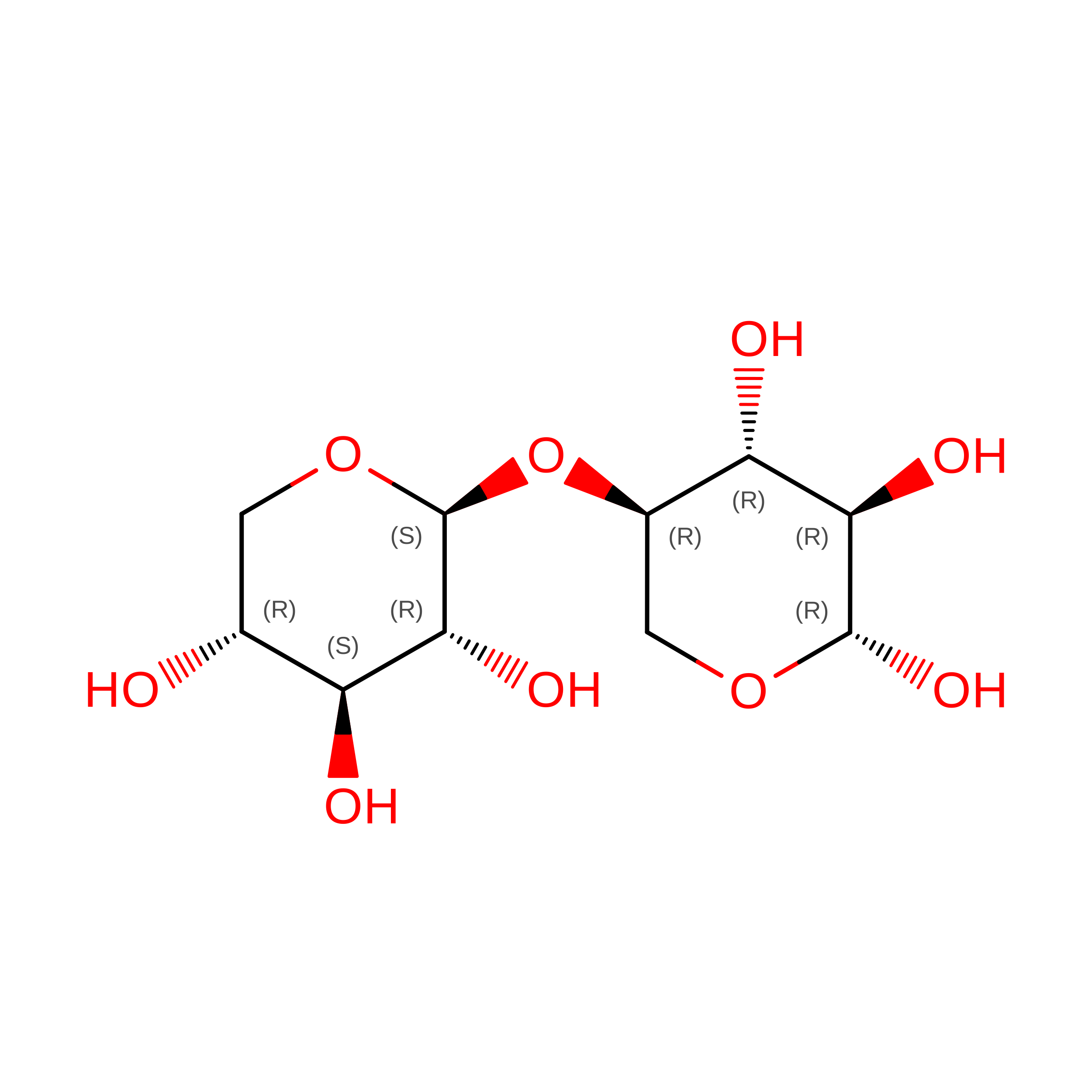
beta-D-xylopyranose-(1-4)-beta-D-xylopyranose
C, D
2N/A
Glycosylation Resources
GlyTouCan: G87728WL
GlyCosmos: G87728WL

Small Molecules

Ligands 1 Unique
IDChains Name / Formula / InChI Key2D Diagram3D Interactions
XYP

Query on XYP


Download:Ideal Coordinates CCD File
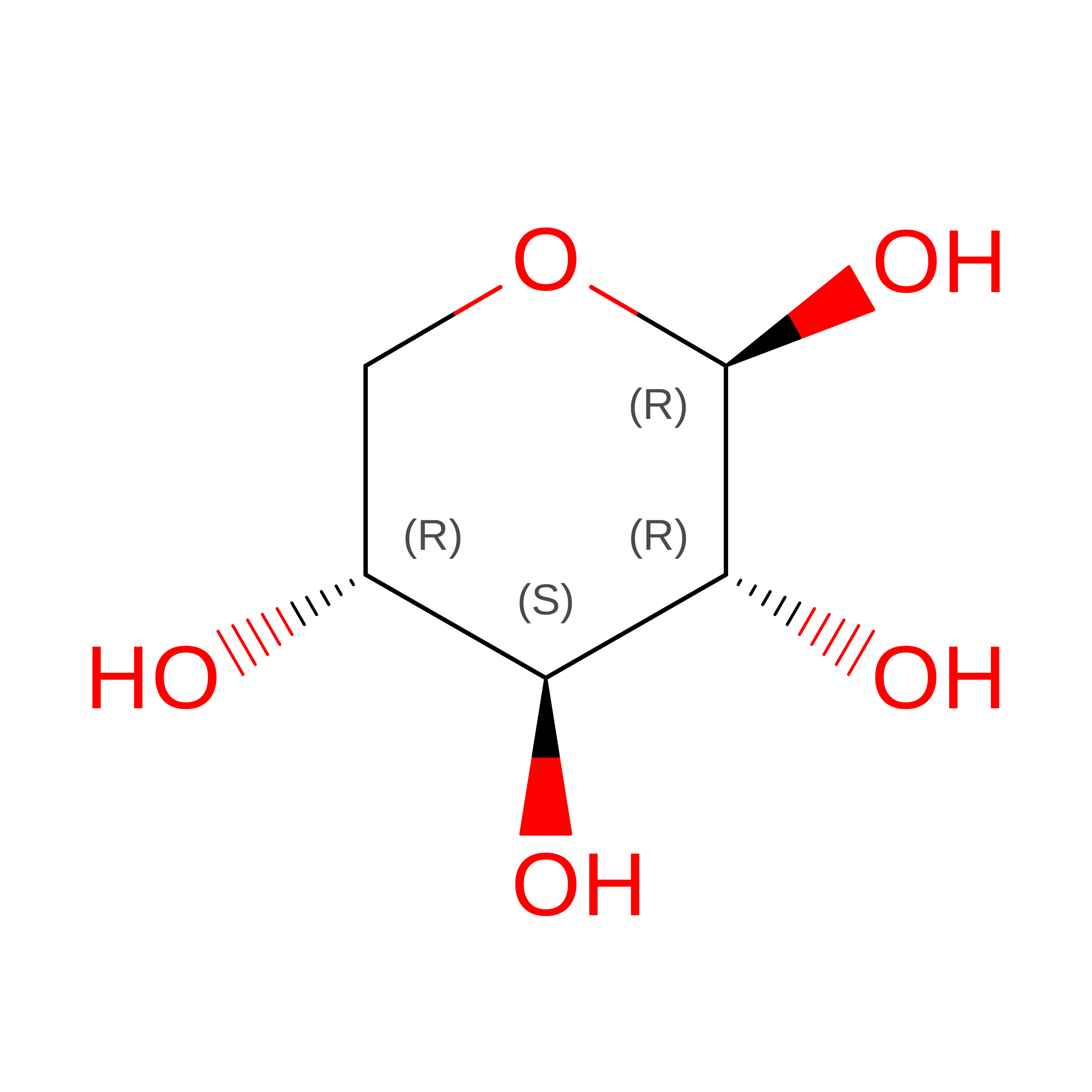
E [auth A]beta-D-xylopyranose
C5 H10 O5
SRBFZHDQGSBBOR-KKQCNMDGSA-N

Biologically Interesting Molecules (External Reference) 

1 Unique

Experimental Data & Validation

Experimental Data

  • Method: X-RAY DIFFRACTION
  • Resolution: 1.78 Å
  • R-Value Free:  0.209 (Depositor), 0.209 (DCC) 
  • R-Value Work:  0.166 (Depositor), 0.166 (DCC) 
  • R-Value Observed: 0.168 (Depositor) 
Space Group: C 1 2 1
Unit Cell:
Length ( Å )Angle ( ˚ )
a = 117.021α = 90
b = 103.437β = 123.08
c = 104.813γ = 90
Software Package:
Software NamePurpose
PHENIXrefinement
DENZOdata reduction
HKL-2000data scaling
MOLREPphasing

Structure Validation

View Full Validation Report


Ligand Structure Quality Assessment 


Entry History 

Deposition Data

Revision History  (Full details and data files)

  • Version 1.0: 2018-05-30
    Type: Initial release
  • Version 1.1: 2018-06-06
    Changes: Data collection, Database references
  • Version 2.0: 2020-07-29
    Type: Remediation
    Reason: Carbohydrate remediation
    Changes: Atomic model, Data collection, Derived calculations, Non-polymer description, Structure summary
  • Version 2.1: 2023-11-22
    Changes: Data collection, Database references, Refinement description, Structure summary