5ZMF | pdb_00005zmf

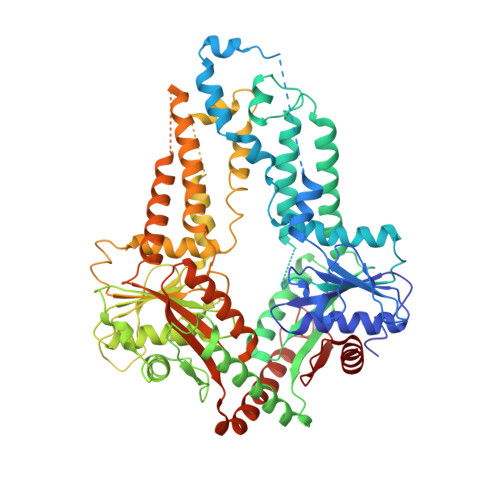
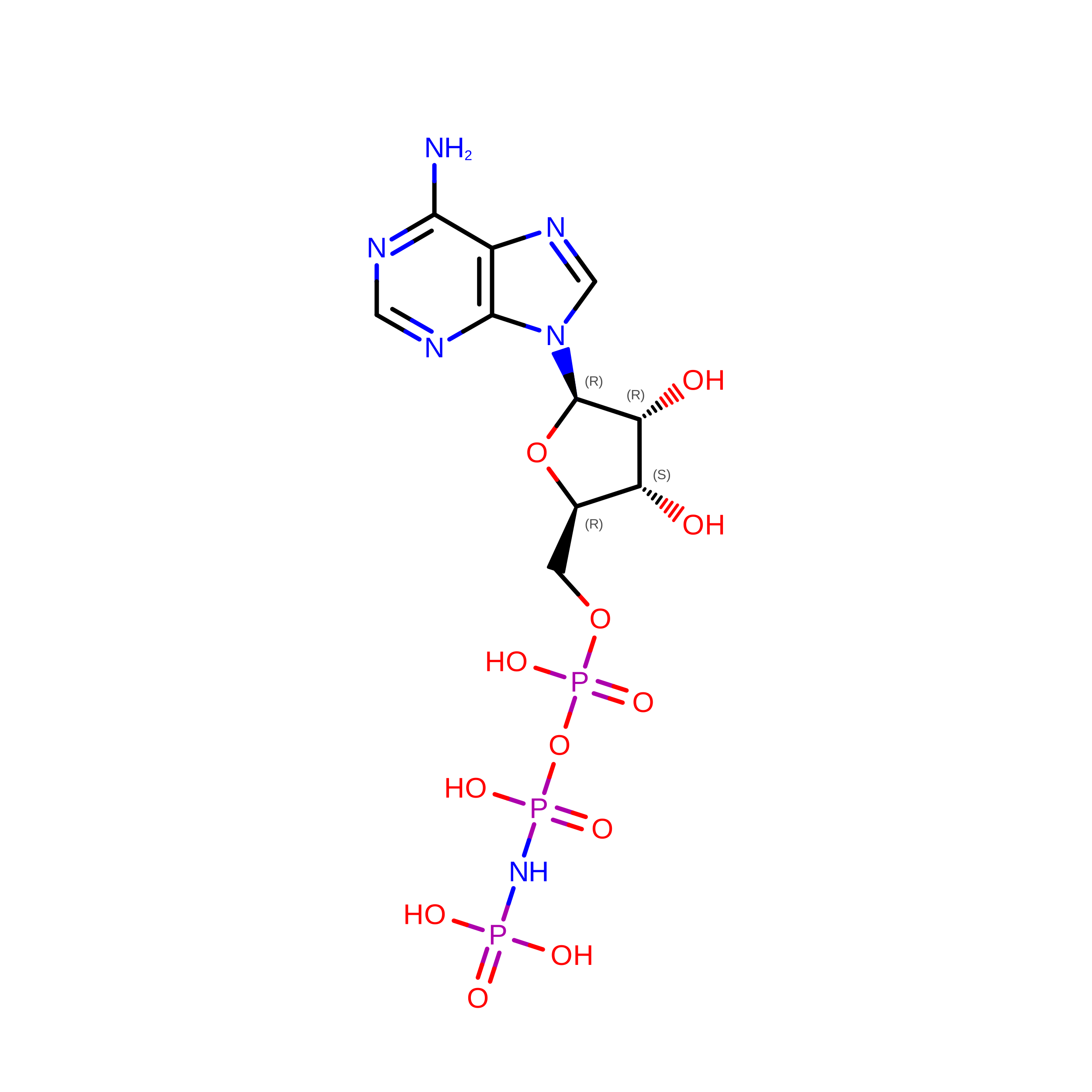
AMPPNP complex of C. reinhardtii ArsA1


Experimental Data Snapshot

  • Method: X-RAY DIFFRACTION
  • Resolution: 3.56 Å
  • R-Value Free: 
    0.327 (Depositor), 0.338 (DCC) 
  • R-Value Work: 
    0.275 (Depositor), 0.279 (DCC) 
  • R-Value Observed: 
    0.280 (Depositor) 

Starting Model: experimental
View more details

wwPDB Validation 3D Report Full Report

Validation slider image for 5ZMF

Ligand Structure Quality Assessment 


This is version 1.3 of the entry. See complete history

Literature

Structural analysis of chloroplast tail-anchored membrane protein recognition by ArsA1.

Lin, T.W.Chen, C.C.Wu, S.M.Chang, Y.C.Li, Y.C.Su, Y.W.Hsiao, C.D.Chang, H.Y.

(2019) Plant J 99: 128-143

  • DOI: https://doi.org/10.1111/tpj.14316
  • Primary Citation Related Structures: 
    5ZME, 5ZMF

  • PubMed Abstract: 

    In mammals and yeast, tail-anchored (TA) membrane proteins destined for the post-translational pathway are safely delivered to the endoplasmic reticulum (ER) membrane by a well-known targeting factor, TRC40/Get3. In contrast, the underlying mechanism for translocation of TA proteins in plants remains obscure. How this unique eukaryotic membrane-trafficking system correctly distinguishes different subsets of TA proteins destined for various organelles, including mitochondria, chloroplasts and the ER, is a key question of long standing. Here, we present crystal structures of algal ArsA1 (the Get3 homolog) in a distinct nucleotide-free open state and bound to adenylyl-imidodiphosphate. This approximately 80-kDa protein possesses a monomeric architecture, with two ATPase domains in a single polypeptide chain. It is capable of binding chloroplast (TOC34 and TOC159) and mitochondrial (TOM7) TA proteins based on features of its transmembrane domain as well as the regions immediately before and after the transmembrane domain. Several helices located above the TA-binding groove comprise the interlocking hook-like motif implicated by mutational analyses in TA substrate recognition. Our data provide insights into the molecular basis of the highly specific selectivity of interactions of algal ArsA1 with the correct sets of TA substrates before membrane targeting in plant cells.


  • Organizational Affiliation
    • Molecular and Cell Biology, International Graduate Program, Academia Sinica and Graduate Institute of Life Science, National Defense Medical Center, Taipei, Taiwan.

Macromolecule Content 

  • Total Structure Weight: 74.89 kDa 
  • Atom Count: 4,911 
  • Modeled Residue Count: 637 
  • Deposited Residue Count: 687 
  • Unique protein chains: 1

Macromolecules

Find similar proteins by:|  3D Structure
Entity ID: 1
MoleculeChains  Sequence LengthOrganismDetailsImage
ATPase ARSA1687Chlamydomonas reinhardtiiMutation(s): 0 
Gene Names: ARSA1AS1CHLREDRAFT_132949
EC: 3.6
UniProt
Find proteins for A8JGB0 (Chlamydomonas reinhardtii)
Explore A8JGB0 
Go to UniProtKB:  A8JGB0
Entity Groups
Sequence Clusters30% Identity50% Identity70% Identity90% Identity95% Identity100% Identity
UniProt GroupA8JGB0
Sequence Annotations
Expand
Reference Sequence

Experimental Data & Validation

Experimental Data

  • Method: X-RAY DIFFRACTION
  • Resolution: 3.56 Å
  • R-Value Free:  0.327 (Depositor), 0.338 (DCC) 
  • R-Value Work:  0.275 (Depositor), 0.279 (DCC) 
  • R-Value Observed: 0.280 (Depositor) 
Space Group: P 41 21 2
Unit Cell:
Length ( Å )Angle ( ˚ )
a = 90.456α = 90
b = 90.456β = 90
c = 306.668γ = 90
Software Package:
Software NamePurpose
PHENIXrefinement
HKL-2000data scaling
PHENIXphasing

Structure Validation

View Full Validation Report


Ligand Structure Quality Assessment 


Entry History 

Deposition Data

Revision History  (Full details and data files)

  • Version 1.0: 2019-03-20
    Type: Initial release
  • Version 1.1: 2019-04-03
    Changes: Data collection, Database references
  • Version 1.2: 2019-07-10
    Changes: Data collection, Database references
  • Version 1.3: 2023-11-22
    Changes: Data collection, Database references, Refinement description