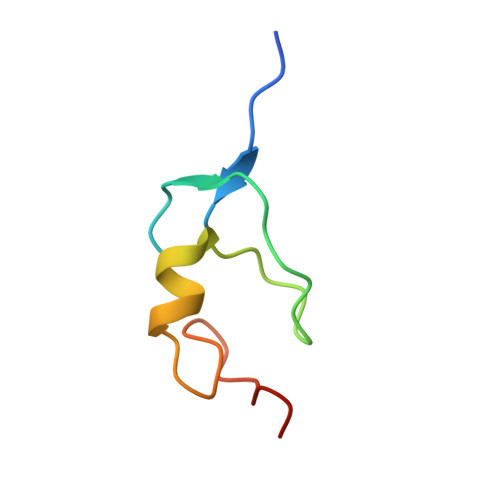
Find PDB structures and Computed Structure Models (CSM) by combining queries from tools in this suite: Attribute Search, Sequence Similarity, Sequence Motif, 3D Similarity, and 3D Motif with 'AND' logic.
ProMyelocyticLeukemia nuclear bodies (PML NBs) are stress-regulated domains directly implicated in acute promyelocytic leukemia eradication. Most TRIM family members bind ubiquitin E2s and many acquire ligase activity upon RING dimerization. In contrast, PML binds UBC9, the SUMO E2 enzyme. Here, using X-ray crystallography and SAXS characterization, we demonstrate that PML RING tetramerizes through highly conserved PML-specific sequences, which are required for NB assembly and PML sumoylation. Conserved residues implicated in RING dimerization of other TRIMs also contribute to PML tetramer stability. Wild-type PML rescues the ability of some RING mutants to form NBs as well as their sumoylation. Impaired RING tetramerization abolishes PML/RARA-driven leukemogenesis in vivo and arsenic-induced differentiation ex vivo. Our studies thus identify RING tetramerization as a key step in the NB macro-molecular scaffolding. They suggest that higher order RING interactions allow efficient UBC9 recruitment and thus change the biochemical nature of TRIM-facilitated post-translational modifications.
Organizational Affiliation:
State Key Laboratory of Medical Genomics, Shanghai Institute of Hematology, Rui Jin Hospital affiliated to Shanghai Jiao Tong University School of Medicine, 197 Ruijin Er Road, Shanghai, 200025, China.
Institute of Health Sciences, Shanghai Institutes for Biological Sciences and Graduate School, Chinese Academy of Sciences, 320 Yueyang Road, Shanghai, 200031, China.
University Paris Diderot, Sorbonne Paris Cité, INSERM U944, CNRS UMR7212, Equipe labellisée LNCC, Hôpital St. Louis 1, Paris, 75475, France.
Laboratoire International Associé, Hematology and Cancer, RuiJin Hospital, INSERM and CNRS, Shanghai, China.
Key Laboratory of Systems Biomedicine, Shanghai Center for Systems Biomedicine, Shanghai Jiao Tong University, 800 Dong Chuan Road, Shanghai, 200240, China.
Collège de France, Paris Sciences Lettres research university, 11 place Marcelin Berthelot, 75005, Paris, France.
State Key Laboratory of Medical Genomics, Shanghai Institute of Hematology, Rui Jin Hospital affiliated to Shanghai Jiao Tong University School of Medicine, 197 Ruijin Er Road, Shanghai, 200025, China. zchen@stn.sh.cn.
Institute of Health Sciences, Shanghai Institutes for Biological Sciences and Graduate School, Chinese Academy of Sciences, 320 Yueyang Road, Shanghai, 200031, China. zchen@stn.sh.cn.
Laboratoire International Associé, Hematology and Cancer, RuiJin Hospital, INSERM and CNRS, Shanghai, China. zchen@stn.sh.cn.
Key Laboratory of Systems Biomedicine, Shanghai Center for Systems Biomedicine, Shanghai Jiao Tong University, 800 Dong Chuan Road, Shanghai, 200240, China. zchen@stn.sh.cn.
University Paris Diderot, Sorbonne Paris Cité, INSERM U944, CNRS UMR7212, Equipe labellisée LNCC, Hôpital St. Louis 1, Paris, 75475, France. hugues.dethe@inserm.fr.
Laboratoire International Associé, Hematology and Cancer, RuiJin Hospital, INSERM and CNRS, Shanghai, China. hugues.dethe@inserm.fr.
Collège de France, Paris Sciences Lettres research university, 11 place Marcelin Berthelot, 75005, Paris, France. hugues.dethe@inserm.fr.
Service de Biochimie, Hôpital St. Louis, Assistance Publique Hôpitaux de Paris, Paris, 75475, France. hugues.dethe@inserm.fr.
State Key Laboratory of Medical Genomics, Shanghai Institute of Hematology, Rui Jin Hospital affiliated to Shanghai Jiao Tong University School of Medicine, 197 Ruijin Er Road, Shanghai, 200025, China. guoyumeng@shsmu.edu.cn.
Laboratoire International Associé, Hematology and Cancer, RuiJin Hospital, INSERM and CNRS, Shanghai, China. guoyumeng@shsmu.edu.cn.

 Download Mendeley