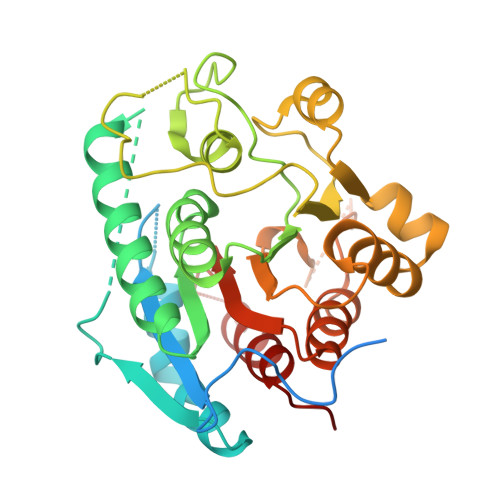
5YNL | pdb_00005ynl

Structure of Glaciozyma antarctica Arginase Reveals Cold-active Adaptation via Increased Flexible Access to the Active Site


Experimental Data Snapshot

  • Method: X-RAY DIFFRACTION
  • Resolution: 2.35 Å
  • R-Value Free: 
    0.280 (Depositor), 0.280 (DCC) 
  • R-Value Work: 
    0.221 (Depositor), 0.221 (DCC) 

Starting Model: in silico
View more details

wwPDB Validation 3D Report Full Report

Validation slider image for 5YNL

This is version 2.2 of the entry. See complete history

Literature

Crystal structure of a cold-active arginase from Glaciozyma antarctica.

Quay, D.H.X.Yusof, N.Y.Jonet, M.A.Kamaruddin, S.Md Illias, R.Mahadi, N.M.Keep, N.Firdaus-Raih, M.Abu Bakar, F.D.Abdul Murad, A.M.

(2026) Acta Crystallogr F Struct Biol Commun 82: 167-175

  • DOI: https://doi.org/10.1107/S2053230X26003092
  • Primary Citation Related Structures: 
    5YNL

  • PubMed Abstract: 

    Arginase is a metal-dependent metalloenzyme that catalyses the hydrolysis of L-arginine to L-ornithine and urea and is widely distributed across animals, bacteria, fungi and protozoa. Here, we report the first three-dimensional crystal structure of a cold-active arginase from the psychrophilic yeast Glaciozyma antarctica (GaArg). The apo structure was solved at 2.35 Å resolution in space group H3 by molecular replacement using an AlphaFold-generated model. GaArg adopts a conserved αβα sandwich fold similar to previously characterized arginases. The crystal structure reveals four regions lacking interpretable electron density, three of which are located near the entrance to the active site. Despite conservation of the identities and the coordination geometry of metal-binding residues, the apo GaArg structure exhibits broadly conserved ligand-binding residue orientations relative to homologous arginases, with minor conformational differences and a disordered loop corresponding to a substrate-interacting region. Analytical size-exclusion chromatography and multimer prediction support the hexameric assembly of GaArg in solution. Quantitative analysis of intramolecular interactions indicates that GaArg contains fewer hydrogen bonds than mesophilic and thermophilic homologues, while its salt-bridge content is comparable to that of the mesophilic enzyme but lower than that of the thermophilic homologue. These features are consistent with a modest reduction in structural rigidity associated with cold adaptation. Ligand- and metal-bound structures will be required to establish their contributions to cold-adaptation.


  • Organizational Affiliation
    • Department of Applied Physics, Faculty of Science and Technology, Universiti Kebangsaan Malaysia, 43600 Bangi, Selangor, Malaysia.

Macromolecule Content 

  • Total Structure Weight: 38.78 kDa 
  • Atom Count: 2,226 
  • Modeled Residue Count: 292 
  • Deposited Residue Count: 362 
  • Unique protein chains: 1

Macromolecules

Find similar proteins by:|  3D Structure
Entity ID: 1
MoleculeChains  Sequence LengthOrganismDetailsImage
Arginase362Glaciozyma antarcticaMutation(s): 0 
EC: 3.5.3.1
UniProt
Find proteins for A0A2R2JFW7 (Glaciozyma antarctica (strain PI12))
Explore A0A2R2JFW7 
Go to UniProtKB:  A0A2R2JFW7
Entity Groups
Sequence Clusters30% Identity50% Identity70% Identity90% Identity95% Identity100% Identity
UniProt GroupA0A2R2JFW7
Sequence Annotations
Expand
Reference Sequence

Experimental Data & Validation

Experimental Data

  • Method: X-RAY DIFFRACTION
  • Resolution: 2.35 Å
  • R-Value Free:  0.280 (Depositor), 0.280 (DCC) 
  • R-Value Work:  0.221 (Depositor), 0.221 (DCC) 
Space Group: H 3
Unit Cell:
Length ( Å )Angle ( ˚ )
a = 91.193α = 90
b = 91.193β = 90
c = 107.779γ = 120
Software Package:
Software NamePurpose
REFMACrefinement
HKL-3000data reduction
HKL-3000data scaling
PHASERphasing

Structure Validation

View Full Validation Report


Entry History 

& Funding Information

Deposition Data


Funding OrganizationLocationGrant Number
Ministry of Science, Technology and Innovation (MOSTI, Malaysia)Malaysia02-05-20-SF0007

Revision History  (Full details and data files)

  • Version 1.0: 2018-01-31
    Type: Initial release
  • Version 1.1: 2023-11-22
    Changes: Data collection, Database references, Refinement description
  • Version 2.0: 2025-12-31
    Type: Coordinate replacement
    Reason: Model completeness
    Changes: Advisory, Atomic model, Author supporting evidence, Data collection, Database references, Derived calculations, Other, Polymer sequence, Refinement description, Structure summary
  • Version 2.1: 2026-03-18
    Changes: Refinement description
  • Version 2.2: 2026-05-13
    Changes: Database references