5YC5 | pdb_00005yc5

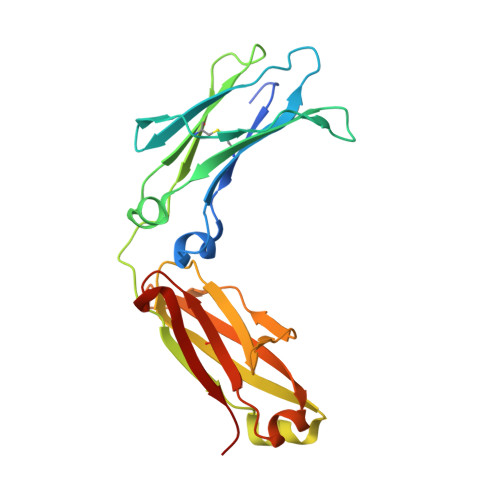
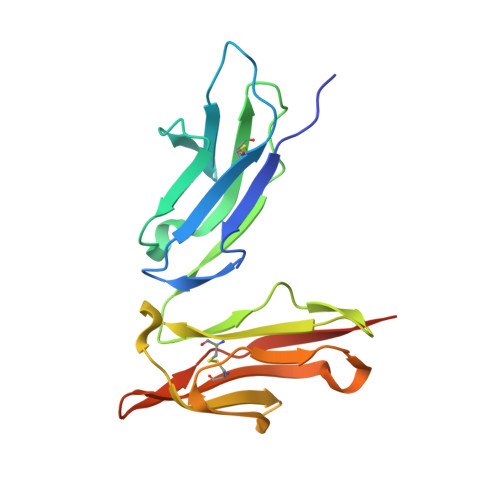
Crystal structure of human IgG-Fc in complex with aglycan and optimized Fc gamma receptor IIIa


Experimental Data Snapshot

  • Method: X-RAY DIFFRACTION
  • Resolution: 2.71 Å
  • R-Value Free: 
    0.273 (Depositor), 0.275 (DCC) 
  • R-Value Work: 
    0.209 (Depositor), 0.214 (DCC) 
  • R-Value Observed: 
    0.212 (Depositor) 

Starting Model: experimental
View more details

wwPDB Validation 3D Report Full Report

Validation slider image for 5YC5

This is version 2.2 of the entry. See complete history

Literature

Assessing the Heterogeneity of the Fc-Glycan of a Therapeutic Antibody Using an engineered Fc gamma Receptor IIIa-Immobilized Column.

Kiyoshi, M.Caaveiro, J.M.M.Tada, M.Tamura, H.Tanaka, T.Terao, Y.Morante, K.Harazono, A.Hashii, N.Shibata, H.Kuroda, D.Nagatoishi, S.Oe, S.Ide, T.Tsumoto, K.Ishii-Watabe, A.

(2018) Sci Rep 8: 3955-3955

  • DOI: https://doi.org/10.1038/s41598-018-22199-8
  • Primary Citation Related Structures: 
    5YC5

  • PubMed Abstract: 

    The N-glycan moiety of IgG-Fc has a significant impact on multifaceted properties of antibodies such as in their effector function, structure, and stability. Numerous studies have been devoted to understanding its biological effect since the exact composition of the Fc N-glycan modulates the magnitude of effector functions such as the antibody-dependent cell mediated cytotoxicity (ADCC), and the complement-dependent cytotoxicity (CDC). To date, systematic analyses of the properties and influence of glycan variants have been of great interest. Understanding the principles on how N-glycosylation modulates those properties is important for the molecular design, manufacturing, process optimization, and quality control of therapeutic antibodies. In this study, we have separated a model therapeutic antibody into three fractions according to the composition of the N-glycan by using a novel FcγRIIIa chromatography column. Notably, Fc galactosylation was a major factor influencing the affinity of IgG-Fc to the FcγRIIIa immobilized on the column. Each antibody fraction was employed for structural, biological, and physicochemical analysis, illustrating the mechanism by which galactose modulates the affinity to FcγRIIIa. In addition, we discuss the benefits of the FcγRIIIa chromatography column to assess the heterogeneity of the N-glycan.


  • Organizational Affiliation
    • Division of Biological Chemistry and Biologicals, National Institute of Health Sciences, Tokyo, 158-8501, Japan. m.kiyoshi@nihs.go.jp.

Macromolecule Content 

  • Total Structure Weight: 74.06 kDa 
  • Atom Count: 4,995 
  • Modeled Residue Count: 595 
  • Deposited Residue Count: 628 
  • Unique protein chains: 2

Macromolecules

Find similar proteins by:|  3D Structure
Entity ID: 1
MoleculeChains  Sequence LengthOrganismDetailsImage
Immunoglobulin gamma-1 heavy chain
A, B
223Homo sapiensMutation(s): 0 
UniProt
Find proteins for P0DOX5 (Homo sapiens)
Explore P0DOX5 
Go to UniProtKB:  P0DOX5
Entity Groups
Sequence Clusters30% Identity50% Identity70% Identity90% Identity95% Identity100% Identity
UniProt GroupP0DOX5
Glycosylation
Glycosylation Sites: 1
Sequence Annotations
Expand
Reference Sequence
Find similar proteins by:|  3D Structure
Entity ID: 2
MoleculeChains  Sequence LengthOrganismDetailsImage
Low affinity immunoglobulin gamma Fc region receptor III-A182Homo sapiensMutation(s): 10 
Gene Names: FCGR3ACD16AFCG3FCGR3IGFR3
UniProt & NIH Common Fund Data Resources
Find proteins for P08637 (Homo sapiens)
Explore P08637 
Go to UniProtKB:  P08637
PHAROS:  P08637
GTEx:  ENSG00000203747 
Entity Groups
Sequence Clusters30% Identity50% Identity70% Identity90% Identity95% Identity100% Identity
UniProt GroupP08637
Sequence Annotations
Expand
Reference Sequence

Oligosaccharides

Help  
Entity ID: 3
MoleculeChains Length2D Diagram GlycosylationD Interactions
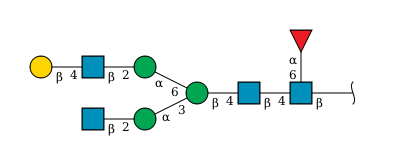
beta-D-galactopyranose-(1-4)-2-acetamido-2-deoxy-beta-D-glucopyranose-(1-2)-alpha-D-mannopyranose-(1-6)-[2-acetamido-2-deoxy-beta-D-glucopyranose-(1-2)-alpha-D-mannopyranose-(1-3)]beta-D-mannopyranose-(1-4)-2-acetamido-2-deoxy-beta-D-glucopyranose-(1-4)-[alpha-L-fucopyranose-(1-6)]2-acetamido-2-deoxy-beta-D-glucopyranose
D
9N-Glycosylation
Glycosylation Resources
GlyTouCan: G27919IH
GlyCosmos: G27919IH
GlyGen: G27919IH
Entity ID: 4
MoleculeChains Length2D Diagram GlycosylationD Interactions
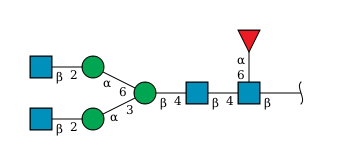
2-acetamido-2-deoxy-beta-D-glucopyranose-(1-2)-alpha-D-mannopyranose-(1-3)-[2-acetamido-2-deoxy-beta-D-glucopyranose-(1-2)-alpha-D-mannopyranose-(1-6)]beta-D-mannopyranose-(1-4)-2-acetamido-2-deoxy-beta-D-glucopyranose-(1-4)-[alpha-L-fucopyranose-(1-6)]2-acetamido-2-deoxy-beta-D-glucopyranose
E
8N-Glycosylation
Glycosylation Resources
GlyTouCan: G80858MF
GlyCosmos: G80858MF
GlyGen: G80858MF

Small Molecules

Ligands 1 Unique
IDChains Name / Formula / InChI Key2D Diagram3D Interactions
CL

Query on CL


Download:Ideal Coordinates CCD File
F [auth A]CHLORIDE ION
Cl
VEXZGXHMUGYJMC-UHFFFAOYSA-M

Experimental Data & Validation

Experimental Data

  • Method: X-RAY DIFFRACTION
  • Resolution: 2.71 Å
  • R-Value Free:  0.273 (Depositor), 0.275 (DCC) 
  • R-Value Work:  0.209 (Depositor), 0.214 (DCC) 
  • R-Value Observed: 0.212 (Depositor) 
Space Group: P 21 21 21
Unit Cell:
Length ( Å )Angle ( ˚ )
a = 72.79α = 90
b = 101.42β = 90
c = 122.6γ = 90
Software Package:
Software NamePurpose
REFMACrefinement
iMOSFLMdata reduction
Aimlessdata scaling
PHASERphasing

Structure Validation

View Full Validation Report


Entry History 

& Funding Information

Deposition Data


Funding OrganizationLocationGrant Number
Japan Society for the Promotion of ScienceJapan25249115
Japan Agency for Medical Research and Development (AMED)JapanResearch on Regulatory Science of 427 Pharmaceuticals and Medical Devices
Japan Society for the Promotion of ScienceJapan15K06962

Revision History  (Full details and data files)

  • Version 1.0: 2018-03-21
    Type: Initial release
  • Version 1.1: 2018-07-04
    Changes: Data collection, Database references
  • Version 2.0: 2020-07-29
    Type: Remediation
    Reason: Carbohydrate remediation
    Changes: Atomic model, Data collection, Derived calculations, Structure summary
  • Version 2.1: 2023-11-22
    Changes: Data collection, Database references, Derived calculations, Refinement description, Structure summary
  • Version 2.2: 2024-11-13
    Changes: Structure summary