5X3C | pdb_00005x3c

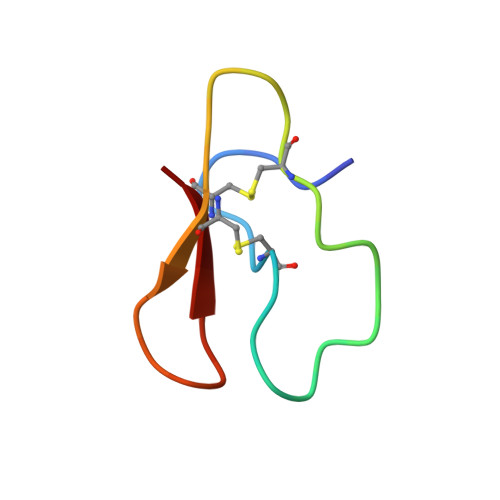
Solution structure of the Family 1 carbohydrate-binding module Y5A mutant with mannosylated Ser3

  • Classification: HYDROLASE
  • Organism(s): Trichoderma reesei
  • Mutation(s): Yes 

  • Deposited: 2017-02-04 Released: 2017-05-31 
  • Deposition Author(s): Feng, Y., Tan, Z.
  • Funding Organization(s): the NSF CAREER Award, the National Natural Science Foundation of China, Chinese Government Scholarship

Experimental Data Snapshot

  • Method: SOLUTION NMR
  • Conformers Calculated: 100 
  • Conformers Submitted: 20 
  • Selection Criteria: structures with the lowest energy 

wwPDB Validation 3D Report Full Report

Validation slider image for 5X3C

This is version 1.4 of the entry. See complete history

Literature

Structural Insight into the Stabilizing Effect of O-Glycosylation

Chaffey, P.K.Guan, X.Chen, C.Ruan, Y.Wang, X.Tran, A.H.Koelsch, T.N.Cui, Q.Feng, Y.Tan, Z.

(2017) Biochemistry 56: 2897-2906

  • DOI: https://doi.org/10.1021/acs.biochem.7b00195
  • Primary Citation Related Structures: 
    5X34, 5X35, 5X36, 5X37, 5X38, 5X39, 5X3C

  • PubMed Abstract: 

    Protein glycosylation has been shown to have a variety of site-specific and glycan-specific effects, but so far, the molecular logic that leads to such observations has been elusive. Understanding the structural changes that occur and being able to correlate those with the physical properties of the glycopeptide are valuable steps toward being able to predict how specific glycosylation patterns will affect the stability of glycoproteins. By systematically comparing the structural features of the O-glycosylated carbohydrate-binding module of a Trichoderma reesei-derived Family 7 cellobiohydrolase, we were able to develop a better understanding of the influence of O-glycan structure on the molecule's physical stability. Our results indicate that the previously observed stabilizing effects of O-glycans come from the introduction of new bonding interactions to the structure and increased rigidity, while the decreased stability seemed to result from the impaired interactions and increased conformational flexibility. This type of knowledge provides a powerful and potentially general mechanism for improving the stability of proteins through glycoengineering.


  • Organizational Affiliation
    • Department of Chemistry and Biochemistry and BioFrontiers Institute, University of Colorado , Boulder, Colorado 80303, United States.

Macromolecule Content 

  • Total Structure Weight: 3.83 kDa 
  • Atom Count: 264 
  • Modeled Residue Count: 36 
  • Deposited Residue Count: 36 
  • Unique protein chains: 1

Macromolecules

Find similar proteins by:|  3D Structure
Entity ID: 1
MoleculeChains  Sequence LengthOrganismDetailsImage
Exoglucanase 136Trichoderma reeseiMutation(s): 1 
EC: 3.2.1.91
UniProt
Find proteins for P62694 (Hypocrea jecorina)
Explore P62694 
Go to UniProtKB:  P62694
Entity Groups
Sequence Clusters30% Identity50% Identity70% Identity90% Identity95% Identity100% Identity
UniProt GroupP62694
Glycosylation
Glycosylation Sites: 1
Sequence Annotations
Expand
Reference Sequence

Small Molecules

Ligands 1 Unique
IDChains Name / Formula / InChI Key2D Diagram3D Interactions
MAN

Query on MAN


Download:Ideal Coordinates CCD File
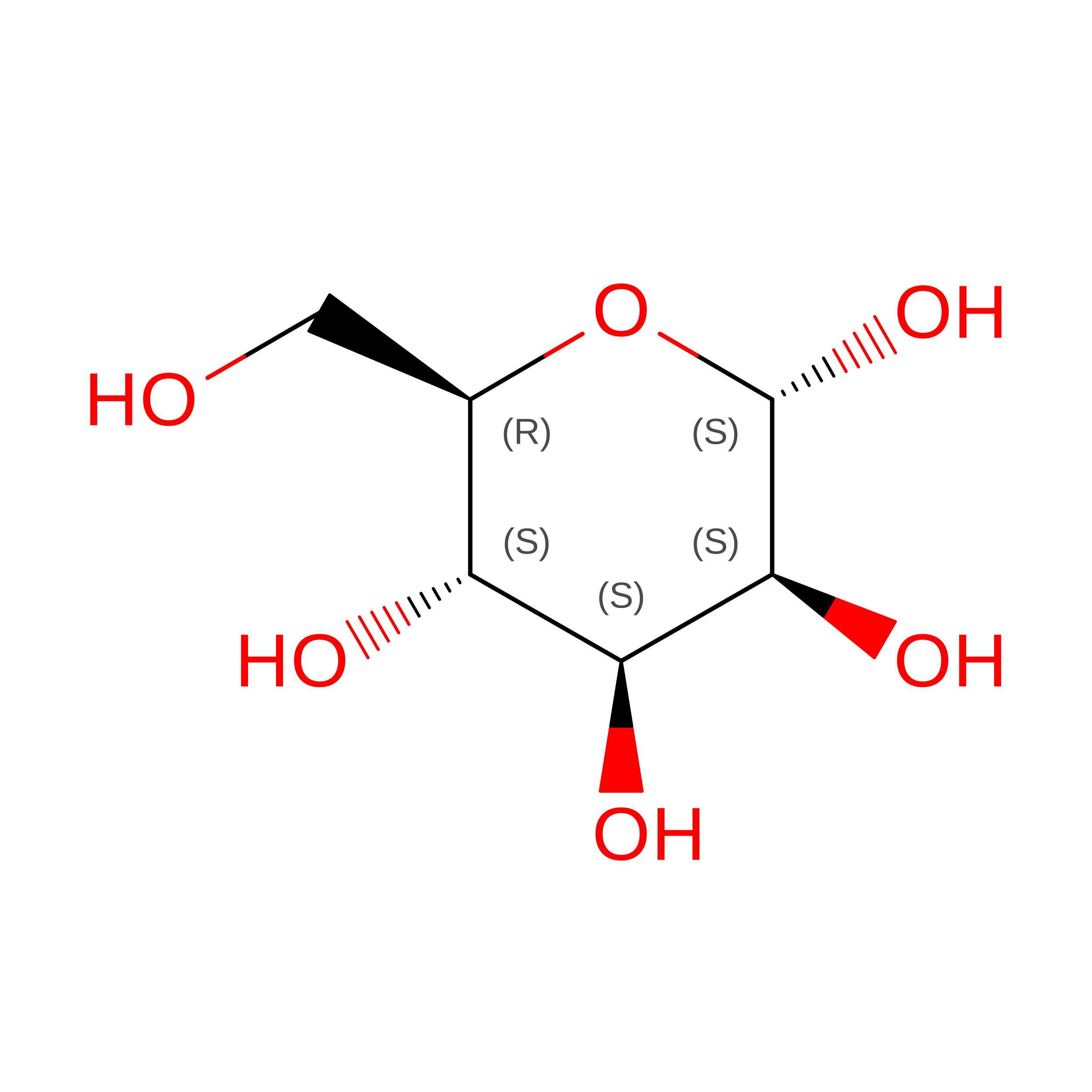
B [auth A]alpha-D-mannopyranose
C6 H12 O6
WQZGKKKJIJFFOK-PQMKYFCFSA-N

Experimental Data & Validation

Experimental Data

  • Method: SOLUTION NMR
  • Conformers Calculated: 100 
  • Conformers Submitted: 20 
  • Selection Criteria: structures with the lowest energy 

Structure Validation

View Full Validation Report


Entry History 

& Funding Information

Deposition Data


Funding OrganizationLocationGrant Number
the NSF CAREER AwardUnited StatesCHE-1454925
the National Natural Science Foundation of ChinaChina31270784
the National Natural Science Foundation of ChinaChina31670735
Chinese Government ScholarshipChina201604910035

Revision History  (Full details and data files)

  • Version 1.0: 2017-05-31
    Type: Initial release
  • Version 1.1: 2017-06-28
    Changes: Database references
  • Version 1.2: 2020-07-29
    Type: Remediation
    Reason: Carbohydrate remediation
    Changes: Data collection, Derived calculations, Structure summary
  • Version 1.3: 2023-06-14
    Changes: Database references, Other, Structure summary
  • Version 1.4: 2024-11-13
    Changes: Data collection, Database references, Structure summary