Download Mendeley
De Novo Design of Tetranuclear Transition Metal Clusters Stabilized by Hydrogen-Bonded Networks in Helical Bundles.
Zhang, S.Q., Chino, M., Liu, L., Tang, Y., Hu, X., DeGrado, W.F., Lombardi, A.(2018) J Am Chem Soc 140: 1294-1304
- PubMed: 29249157 Search on PubMedSearch on PubMed Central
- DOI: https://doi.org/10.1021/jacs.7b08261
- Primary Citation Related Structures:
5WLJ, 5WLK, 5WLL, 5WLM - PubMed Abstract:
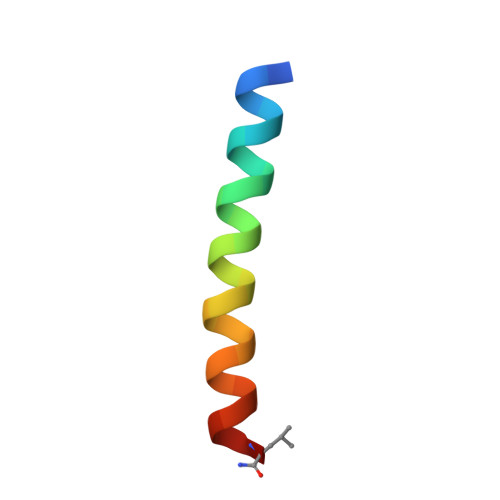
De novo design provides an attractive approach to test the mechanism by which metalloproteins define the geometry and reactivity of their metal ion cofactors. While there has been considerable progress in designing proteins that bind transition metal ions including iron-sulfur clusters, the design of tetranuclear clusters with oxygen-rich environments has not been accomplished. Here, we describe the design of tetranuclear clusters, consisting of four Zn 2+ and four carboxylate oxygens situated at the vertices of a distorted cube-like structure. The tetra-Zn 2+ clusters are bound at a buried site within a four-helix bundle, with each helix donating a single carboxylate (Glu or Asp) and imidazole (His) ligand, as well as second- and third-shell ligands. Overall, the designed site consists of four Zn 2+ and 16 polar side chains in a fully connected hydrogen-bonded network. The designed proteins have apolar cores at the top and bottom of the bundle, which drive the assembly of the liganding residues near the center of the bundle. The steric bulk of the apolar residues surrounding the binding site was varied to determine how subtle changes in helix-helix packing affect the binding site. The crystal structures of two of four proteins synthesized were in good agreement with the overall design; both formed a distorted cuboidal site stabilized by flanking second- and third-shell interactions that stabilize the primary ligands. A third structure bound a single Zn 2+ in an unanticipated geometry, and the fourth bound multiple Zn 2+ at multiple sites at partial occupancy. The metal-binding and conformational properties of the helical bundles in solution, probed by circular dichroism spectroscopy, analytical ultracentrifugation, and NMR, were consistent with the crystal structures.
- Department of Chemistry, University of Pennsylvania , 209 South 33rd Street, Philadelphia, Pennsylvania 19104-6396, United States.
Organizational Affiliation: