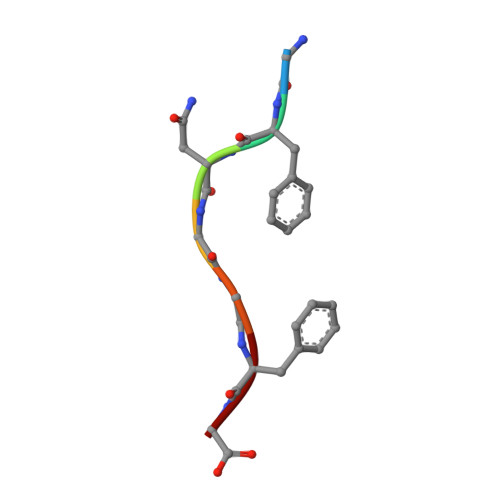
5WIQ | pdb_00005wiq

Crystal structure of the segment, GFNGGFG, from the low complexity domain of TDP-43, residues 396-402


Experimental Data Snapshot

  • Method: X-RAY DIFFRACTION
  • Resolution: 1.25 Å
  • R-Value Free: 
    0.168 (Depositor), 0.164 (DCC) 
  • R-Value Work: 
    0.152 (Depositor), 0.150 (DCC) 
  • R-Value Observed: 
    0.153 (Depositor) 

Starting Model: experimental
View more details

wwPDB Validation 3D Report Full Report

Validation slider image for 5WIQ

This is version 1.6 of the entry. See complete history. 

Literature

Atomic structures of TDP-43 LCD segments and insights into reversible or pathogenic aggregation.

Guenther, E.L., Cao, Q., Trinh, H., Lu, J., Sawaya, M.R., Cascio, D., Boyer, D.R., Rodriguez, J.A., Hughes, M.P., Eisenberg, D.S.

(2018) Nat Struct Mol Biol 25: 463-471

  • DOI: https://doi.org/10.1038/s41594-018-0064-2
  • Primary Citation Related Structures: 
    5WHN, 5WHP, 5WIA, 5WIQ, 5WKB, 5WKD, 6CB9, 6CEW, 6CF4, 6CFH

  • PubMed Abstract: 

    The normally soluble TAR DNA-binding protein 43 (TDP-43) is found aggregated both in reversible stress granules and in irreversible pathogenic amyloid. In TDP-43, the low-complexity domain (LCD) is believed to be involved in both types of aggregation. To uncover the structural origins of these two modes of β-sheet-rich aggregation, we have determined ten structures of segments of the LCD of human TDP-43. Six of these segments form steric zippers characteristic of the spines of pathogenic amyloid fibrils; four others form LARKS, the labile amyloid-like interactions characteristic of protein hydrogels and proteins found in membraneless organelles, including stress granules. Supporting a hypothetical pathway from reversible to irreversible amyloid aggregation, we found that familial ALS variants of TDP-43 convert LARKS to irreversible aggregates. Our structures suggest how TDP-43 adopts both reversible and irreversible β-sheet aggregates and the role of mutation in the possible transition of reversible to irreversible pathogenic aggregation.


  • Organizational Affiliation: 
    • Howard Hughes Medical Institute, University of California, Los Angeles, Los Angeles, CA, USA.

Macromolecule Content 

  • Total Structure Weight: 1.31 kDa 
  • Atom Count: 102 
  • Modeled Residue Count: 14 
  • Deposited Residue Count: 14 
  • Unique protein chains: 1

Macromolecules

Find similar proteins by:  Sequence   |   3D Structure  
Entity ID: 1
MoleculeChains  Sequence LengthOrganismDetailsImage
TAR DNA-binding protein 43
A, B
7Homo sapiensMutation(s): 0 
UniProt & NIH Common Fund Data Resources
Find proteins for Q13148 (Homo sapiens)
Explore Q13148 
Go to UniProtKB:  Q13148
PHAROS:  Q13148
GTEx:  ENSG00000120948 
Entity Groups
UniProt GroupQ13148
Sequence Annotations
Expand
Reference Sequence

Experimental Data & Validation

Experimental Data

  • Method: X-RAY DIFFRACTION
  • Resolution: 1.25 Å
  • R-Value Free:  0.168 (Depositor), 0.164 (DCC) 
  • R-Value Work:  0.152 (Depositor), 0.150 (DCC) 
  • R-Value Observed: 0.153 (Depositor) 
Space Group: P 1
Unit Cell:
Length ( Å )Angle ( ˚ )
a = 4.81α = 90.63
b = 16.439β = 96.37
c = 22.672γ = 91.26
Software Package:
Software NamePurpose
PHENIXrefinement
DENZOdata reduction
PDB_EXTRACTdata extraction
SCALEPACKdata scaling
PHASERphasing

Structure Validation

View Full Validation Report


Entry History 

& Funding Information

Deposition Data


Funding OrganizationLocationGrant Number
National Institutes of Health/National Institute on Aging (NIH/NIA)United StatesNIH NIA AG029430

Revision History  (Full details and data files)

  • Version 1.0: 2018-04-18
    Type: Initial release
  • Version 1.1: 2018-05-30
    Changes: Data collection, Database references
  • Version 1.2: 2018-06-06
    Changes: Data collection, Database references
  • Version 1.3: 2018-06-20
    Changes: Data collection, Database references
  • Version 1.4: 2019-02-20
    Changes: Author supporting evidence, Data collection
  • Version 1.5: 2019-12-18
    Changes: Author supporting evidence
  • Version 1.6: 2023-10-04
    Changes: Data collection, Database references, Refinement description