Download Mendeley
Selective Targeting by a Mechanism-Based Inactivator against Pyridoxal 5'-Phosphate-Dependent Enzymes: Mechanisms of Inactivation and Alternative Turnover.
Mascarenhas, R., Le, H.V., Clevenger, K.D., Lehrer, H.J., Ringe, D., Kelleher, N.L., Silverman, R.B., Liu, D.(2017) Biochemistry 56: 4951-4961
- PubMed: 28816437 Search on PubMedSearch on PubMed Central
- DOI: https://doi.org/10.1021/acs.biochem.7b00499
- Primary Citation Related Structures:
5VWO, 5VWQ, 5VWR - PubMed Abstract:
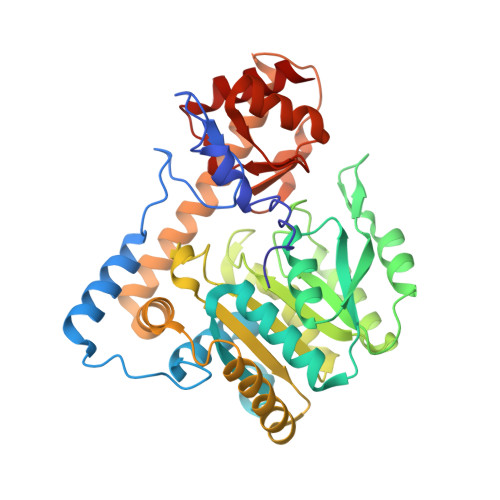
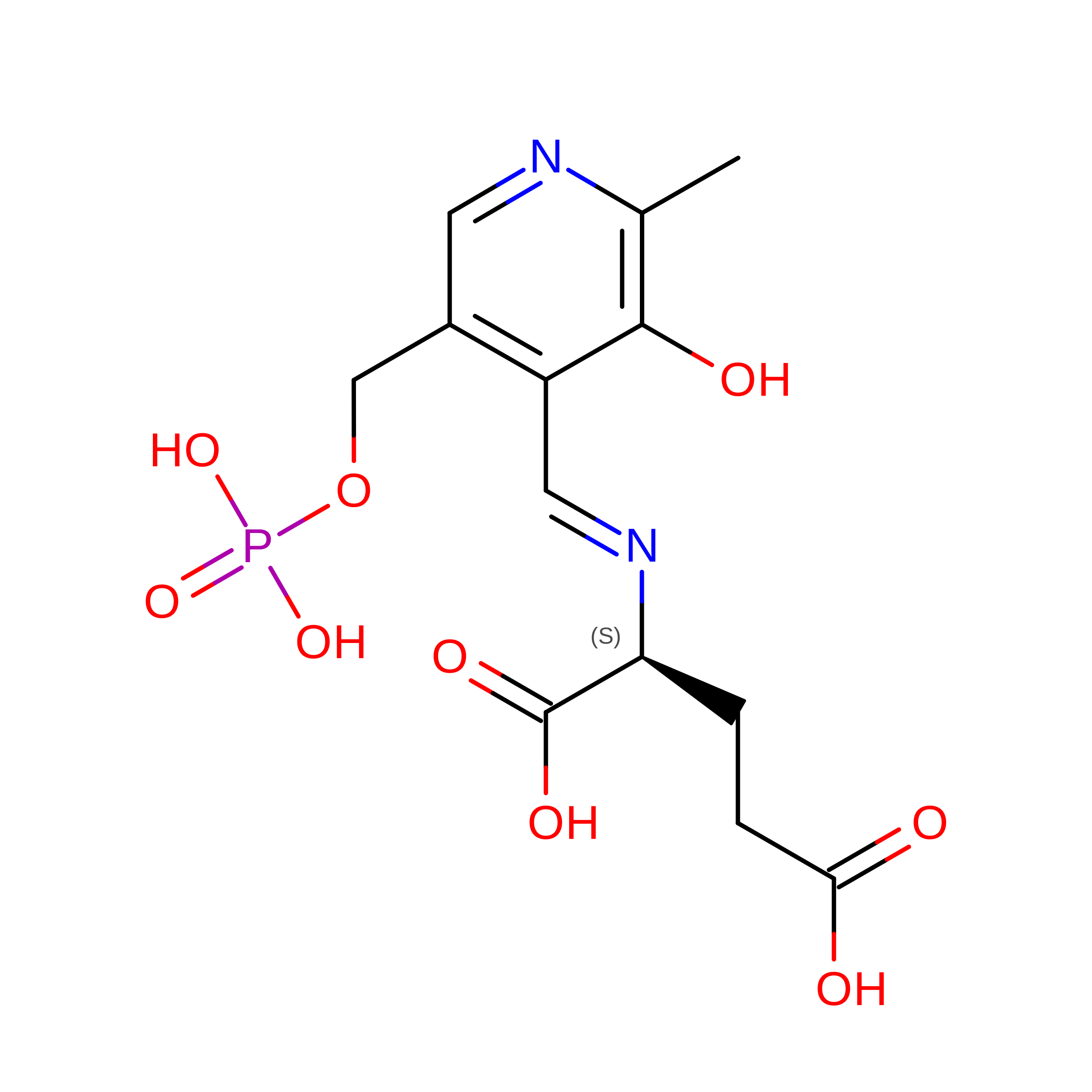
Potent mechanism-based inactivators can be rationally designed against pyridoxal 5'-phosphate (PLP)-dependent drug targets, such as ornithine aminotransferase (OAT) or γ-aminobutyric acid aminotransferase (GABA-AT). An important challenge, however, is the lack of selectivity toward other PLP-dependent, off-target enzymes, because of similarities in mechanisms of all PLP-dependent aminotransferase reactions. On the basis of complex crystal structures, we investigate the inactivation mechanism of OAT, a hepatocellular carcinoma target, by (1R,3S,4S)-3-amino-4-fluorocyclopentane-1-carboxylic acid (FCP), a known inactivator of GABA-AT. A crystal structure of OAT and FCP showed the formation of a ternary adduct. This adduct can be rationalized as occurring via an enamine mechanism of inactivation, similar to that reported for GABA-AT. However, the crystal structure of an off-target, PLP-dependent enzyme, aspartate aminotransferase (Asp-AT), in complex with FCP, along with the results of attempted inhibition assays, suggests that FCP is not an inactivator of Asp-AT, but rather an alternate substrate. Turnover of FCP by Asp-AT is also supported by high-resolution mass spectrometry. Amid existing difficulties in achieving selectivity of inactivation among a large number of PLP-dependent enzymes, the obtained results provide evidence that a desirable selectivity could be achieved, taking advantage of subtle structural and mechanistic differences between a drug-target enzyme and an off-target enzyme, despite their largely similar substrate binding sites and catalytic mechanisms.
- Department of Chemistry and Biochemistry, Loyola University Chicago , Chicago, Illinois 60660, United States.
Organizational Affiliation: