Download Mendeley
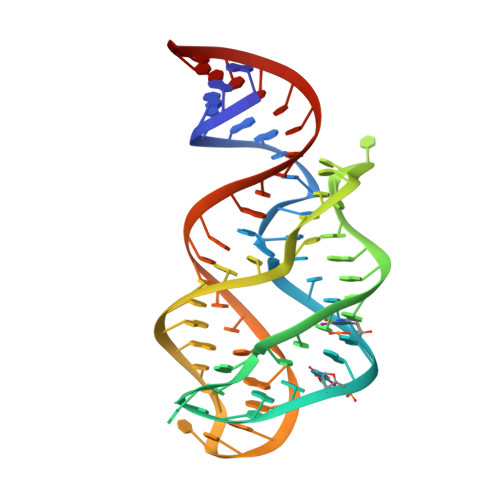
Incorporation of isotopic, fluorescent, and heavy-atom-modified nucleotides into RNAs by position-selective labeling of RNA.
Liu, Y., Holmstrom, E., Yu, P., Tan, K., Zuo, X., Nesbitt, D.J., Sousa, R., Stagno, J.R., Wang, Y.X.(2018) Nat Protoc 13: 987-1005
- PubMed: 29651055 Search on PubMedSearch on PubMed Central
- DOI: https://doi.org/10.1038/nprot.2018.002
- Primary Citation Related Structures:
5UZA - PubMed Abstract:
Site-specific incorporation of labeled nucleotides is an extremely useful synthetic tool for many structural studies (e.g., NMR, electron paramagnetic resonance (EPR), fluorescence resonance energy transfer (FRET), and X-ray crystallography) of RNA. However, specific-position-labeled RNAs >60 nt are not commercially available on a milligram scale. Position-selective labeling of RNA (PLOR) has been applied to prepare large RNAs labeled at desired positions, and all the required reagents are commercially available. Here, we present a step-by-step protocol for the solid-liquid hybrid phase method PLOR to synthesize 71-nt RNA samples with three different modification applications, containing (i) a 13 C 15 N-labeled segment; (ii) discrete residues modified with Cy3, Cy5, or biotin; or (iii) two iodo-U residues. The flexible procedure enables a wide range of downstream biophysical analyses using precisely localized functionalized nucleotides. All three RNAs were obtained in <2 d, excluding time for preparing reagents and optimizing experimental conditions. With optimization, the protocol can be applied to other RNAs with various labeling schemes, such as ligation of segmentally labeled fragments.
- State Key Laboratory of Microbial Metabolism, School of Life Science and Biotechnology, Shanghai Jiao Tong University, Shanghai, China.
Organizational Affiliation: