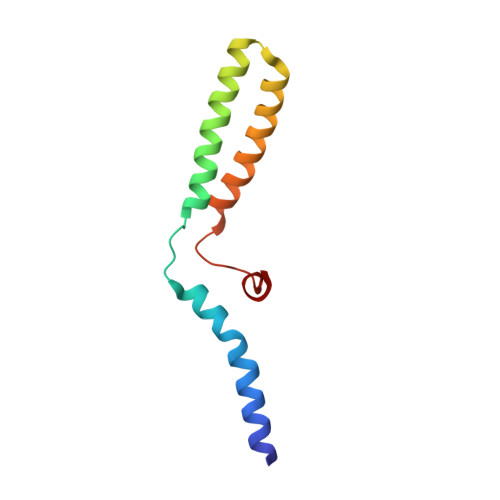
5UHQ | pdb_00005uhq

Structure of a SemiSWEET Q20A mutant


Experimental Data Snapshot

  • Method: X-RAY DIFFRACTION
  • Resolution: 2.78 Å
  • R-Value Free: 
    0.267 (Depositor), 0.278 (DCC) 
  • R-Value Work: 
    0.227 (Depositor), 0.242 (DCC) 
  • R-Value Observed: 
    0.231 (Depositor) 

Starting Model: experimental
View more details

wwPDB Validation 3D Report Full Report

Validation slider image for 5UHQ

This is version 1.4 of the entry. See complete history

Literature

Mechanism of Substrate Translocation in an Alternating Access Transporter.

Latorraca, N.R.Fastman, N.M.Venkatakrishnan, A.J.Frommer, W.B.Dror, R.O.Feng, L.

(2017) Cell 169: 96-107.e12

  • DOI: https://doi.org/10.1016/j.cell.2017.03.010
  • Primary Citation Related Structures: 
    5UHQ, 5UHS

  • PubMed Abstract: 

    Transporters shuttle molecules across cell membranes by alternating among distinct conformational states. Fundamental questions remain about how transporters transition between states and how such structural rearrangements regulate substrate translocation. Here, we capture the translocation process by crystallography and unguided molecular dynamics simulations, providing an atomic-level description of alternating access transport. Simulations of a SWEET-family transporter initiated from an outward-open, glucose-bound structure reported here spontaneously adopt occluded and inward-open conformations. Strikingly, these conformations match crystal structures, including our inward-open structure. Mutagenesis experiments further validate simulation predictions. Our results reveal that state transitions are driven by favorable interactions formed upon closure of extracellular and intracellular "gates" and by an unfavorable transmembrane helix configuration when both gates are closed. This mechanism leads to tight allosteric coupling between gates, preventing them from opening simultaneously. Interestingly, the substrate appears to take a "free ride" across the membrane without causing major structural rearrangements in the transporter.


  • Organizational Affiliation
    • Biophysics Program, Stanford University, Stanford, CA 94305, USA; Department of Computer Science, Stanford University, Stanford, CA 94305, USA; Department of Molecular and Cellular Physiology, Stanford University School of Medicine, Stanford, CA 94305, USA; Institute for Computational and Mathematical Engineering, Stanford University, Stanford, CA 94305, USA.

Macromolecule Content 

  • Total Structure Weight: 42.67 kDa 
  • Atom Count: 2,729 
  • Modeled Residue Count: 335 
  • Deposited Residue Count: 372 
  • Unique protein chains: 1

Macromolecules

Find similar proteins by:|  3D Structure
Entity ID: 1
MoleculeChains  Sequence LengthOrganismDetailsImage
Sugar transporter SemiSWEET
A, B, C, D
93Leptospira biflexa serovar Patoc strain 'Patoc 1 (Paris)Mutation(s): 0 
Gene Names: LEPBI_I1613
Membrane Entity: Yes 
UniProt
Find proteins for B0SR19 (Leptospira biflexa serovar Patoc (strain Patoc 1 / ATCC 23582 / Paris))
Explore B0SR19 
Go to UniProtKB:  B0SR19
Entity Groups
Sequence Clusters30% Identity50% Identity70% Identity90% Identity95% Identity100% Identity
UniProt GroupB0SR19
Sequence Annotations
Expand
Reference Sequence

Experimental Data & Validation

Experimental Data

  • Method: X-RAY DIFFRACTION
  • Resolution: 2.78 Å
  • R-Value Free:  0.267 (Depositor), 0.278 (DCC) 
  • R-Value Work:  0.227 (Depositor), 0.242 (DCC) 
  • R-Value Observed: 0.231 (Depositor) 
Space Group: C 2 2 21
Unit Cell:
Length ( Å )Angle ( ˚ )
a = 63.709α = 90
b = 189.014β = 90
c = 90.858γ = 90
Software Package:
Software NamePurpose
PHENIXrefinement
XDSdata reduction
XDSdata scaling
PHASERphasing

Structure Validation

View Full Validation Report


Entry History 

& Funding Information

Deposition Data


Funding OrganizationLocationGrant Number
National Institutes of Health/National Institute of General Medical Sciences (NIH/NIGMS)United States1R01 GM117108
Alfred P. Sloan FoundationUnited StatesBR2014-093

Revision History  (Full details and data files)

  • Version 1.0: 2017-08-02
    Type: Initial release
  • Version 1.1: 2017-09-27
    Changes: Author supporting evidence
  • Version 1.2: 2018-01-17
    Changes: Author supporting evidence
  • Version 1.3: 2020-01-01
    Changes: Author supporting evidence
  • Version 1.4: 2023-10-04
    Changes: Data collection, Database references, Refinement description