5TVJ | pdb_00005tvj

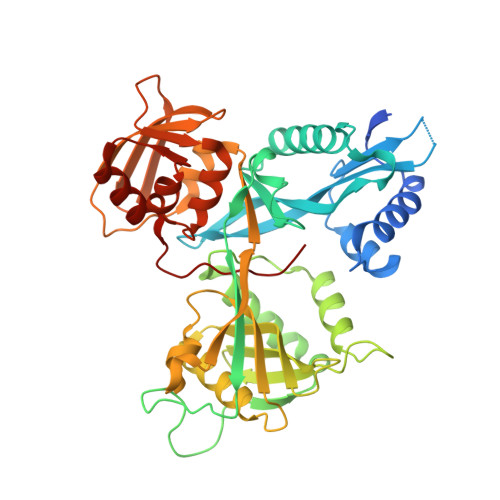
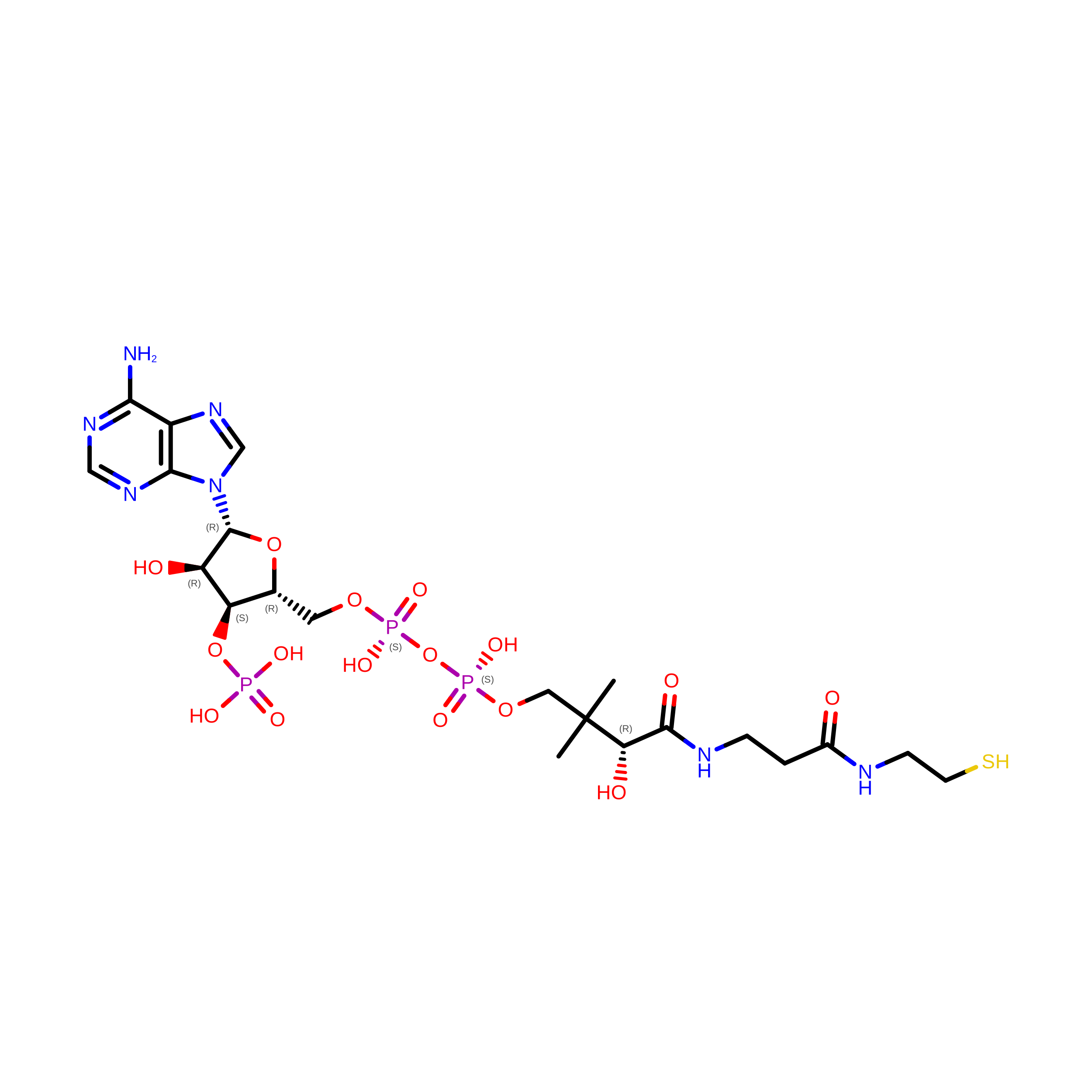
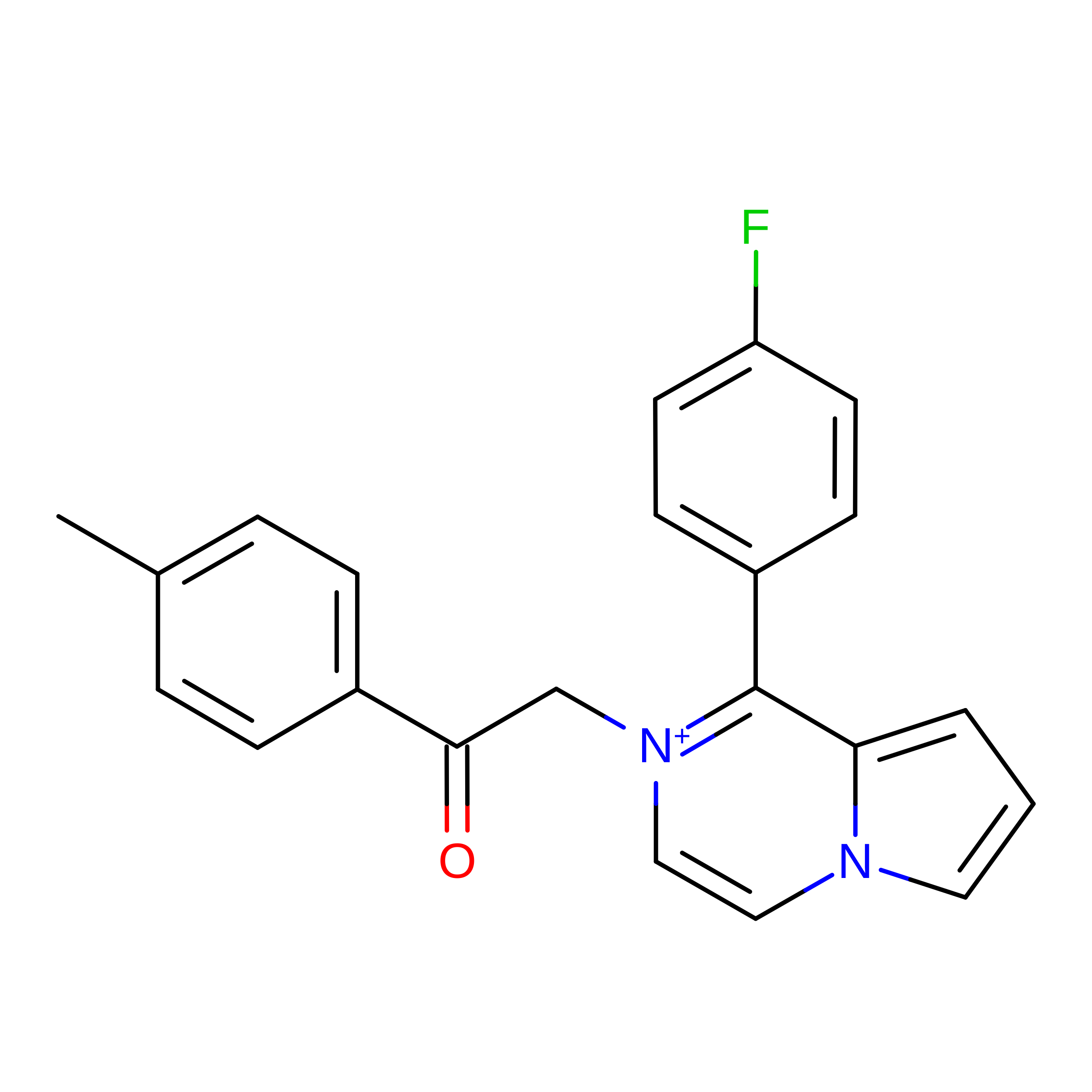
Crystal structure of acetyltransferase Eis from Mycobacterium tuberculosis in complex with CoA and inhibitor 2k*: 1-(4-fluorophenyl)-2-[2-(4-methylphenyl)-2-oxoethyl]pyrrolo[1,2-a]pyrazin-2-ium


Experimental Data Snapshot

  • Method: X-RAY DIFFRACTION
  • Resolution: 2.30 Å
  • R-Value Free: 
    0.224 (Depositor), 0.231 (DCC) 
  • R-Value Work: 
    0.192 (Depositor), 0.201 (DCC) 
  • R-Value Observed: 
    0.193 (Depositor) 

Starting Model: experimental
View more details

wwPDB Validation 3D Report Full Report

Validation slider image for 5TVJ

Ligand Structure Quality Assessment 


This is version 1.4 of the entry. See complete history

Literature

Combating Enhanced Intracellular Survival (Eis)-Mediated Kanamycin Resistance of Mycobacterium tuberculosis by Novel Pyrrolo[1,5-a]pyrazine-Based Eis Inhibitors.

Garzan, A.Willby, M.J.Ngo, H.X.Gajadeera, C.S.Green, K.D.Holbrook, S.Y.Hou, C.Posey, J.E.Tsodikov, O.V.Garneau-Tsodikova, S.

(2017) ACS Infect Dis 3: 302-309

  • DOI: https://doi.org/10.1021/acsinfecdis.6b00193
  • Primary Citation Related Structures: 
    5TVJ

  • PubMed Abstract: 

    Tuberculosis (TB) remains one of the leading causes of mortality worldwide. Hence, the identification of highly effective antitubercular drugs with novel modes of action is crucial. In this paper, we report the discovery and development of pyrrolo[1,5-a]pyrazine-based analogues as highly potent inhibitors of the Mycobacterium tuberculosis (Mtb) acetyltransferase enhanced intracellular survival (Eis), whose up-regulation causes clinically observed resistance to the aminoglycoside (AG) antibiotic kanamycin A (KAN). We performed a structure-activity relationship (SAR) study to optimize these compounds as potent Eis inhibitors both against purified enzyme and in mycobacterial cells. A crystal structure of Eis in complex with one of the most potent inhibitors reveals that the compound is bound to Eis in the AG binding pocket, serving as the structural basis for the SAR. These Eis inhibitors have no observed cytotoxicity to mammalian cells and are promising leads for the development of innovative AG adjuvant therapies against drug-resistant TB.


  • Organizational Affiliation
    • Department of Pharmaceutical Sciences, College of Pharmacy, University of Kentucky , 789 South Limestone Street, Lexington, Kentucky 40536-0596, United States.

Macromolecule Content 

  • Total Structure Weight: 47.24 kDa 
  • Atom Count: 3,217 
  • Modeled Residue Count: 396 
  • Deposited Residue Count: 422 
  • Unique protein chains: 1

Macromolecules

Find similar proteins by:|  3D Structure
Entity ID: 1
MoleculeChains  Sequence LengthOrganismDetailsImage
Enhanced intracellular survival protein422Mycobacterium tuberculosis H37RvMutation(s): 1 
Gene Names: eisRv2416cMTCY253.04
EC: 2.3.1
UniProt
Find proteins for P9WFK7 (Mycobacterium tuberculosis (strain ATCC 25618 / H37Rv))
Explore P9WFK7 
Go to UniProtKB:  P9WFK7
Entity Groups
Sequence Clusters30% Identity50% Identity70% Identity90% Identity95% Identity100% Identity
UniProt GroupP9WFK7
Sequence Annotations
Expand
Reference Sequence

Experimental Data & Validation

Experimental Data

  • Method: X-RAY DIFFRACTION
  • Resolution: 2.30 Å
  • R-Value Free:  0.224 (Depositor), 0.231 (DCC) 
  • R-Value Work:  0.192 (Depositor), 0.201 (DCC) 
  • R-Value Observed: 0.193 (Depositor) 
Space Group: H 3 2
Unit Cell:
Length ( Å )Angle ( ˚ )
a = 175.106α = 90
b = 175.106β = 90
c = 122.94γ = 120
Software Package:
Software NamePurpose
REFMACrefinement
HKL-2000data reduction
HKL-2000data scaling
PHASERphasing

Structure Validation

View Full Validation Report


Ligand Structure Quality Assessment 


Entry History 

& Funding Information

Deposition Data


Funding OrganizationLocationGrant Number
National Institutes of Health/National Institute Of Allergy and Infectious Diseases (NIH/NIAID)United StatesAI090048

Revision History  (Full details and data files)

  • Version 1.0: 2017-03-01
    Type: Initial release
  • Version 1.1: 2017-04-26
    Changes: Database references
  • Version 1.2: 2017-09-20
    Changes: Author supporting evidence
  • Version 1.3: 2019-12-11
    Changes: Author supporting evidence
  • Version 1.4: 2023-10-04
    Changes: Data collection, Database references, Refinement description