5TIG | pdb_00005tig

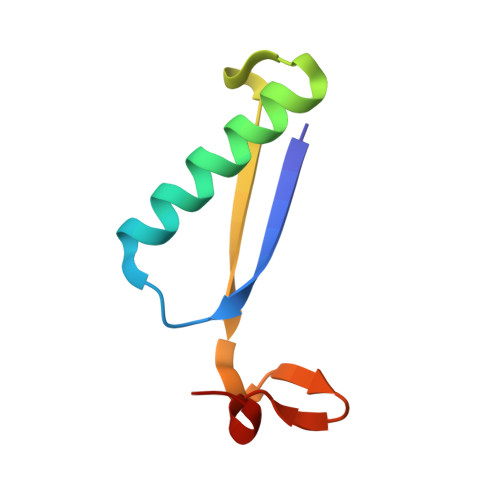
CRYSTAL STRUCTURE OF 4-OXALOCROTONATE TAUTOMERASE INACTIVATED BY BrHPD


Experimental Data Snapshot

  • Method: X-RAY DIFFRACTION
  • Resolution: 2.70 Å
  • R-Value Free: 
    0.254 (Depositor), 0.250 (DCC) 
  • R-Value Work: 
    0.221 (Depositor), 0.220 (DCC) 
  • R-Value Observed: 
    0.223 (Depositor) 

wwPDB Validation   3D Report Full Report


This is version 1.3 of the entry. See complete history


Literature

Inactivation of 4-Oxalocrotonate Tautomerase by 5-Halo-2-hydroxy-2,4-pentadienoates.

Stack, T.M.M.Li, W.Johnson, W.H.Zhang, Y.J.Whitman, C.P.

(2018) Biochemistry 57: 1012-1021

  • DOI: https://doi.org/10.1021/acs.biochem.7b00899
  • Primary Citation of Related Structures:  
    5TIG, 6BGN

  • PubMed Abstract: 

    5-Halo-2-hydroxy-2,4-pentadienoates (5-halo-HPDs) are reportedly generated in the bacterial catabolism of halogenated aromatic hydrocarbons by the meta-fission pathway. The 5-halo-HPDs, where the halogen can be bromide, chloride, or fluoride, result in the irreversible inactivation of 4-oxalocrotonate tautomerase (4-OT), which precedes the enzyme that generates them. The loss of activity is due to the covalent modification of the nucleophilic amino-terminal proline. Mass spectral and crystallographic analysis of the modified enzymes indicates that inactivation of 4-OT by 5-chloro- and 5-bromo-2-hydroxy-2,4-pentadienoate follows a mechanism different from that for the inactivation of 4-OT by 5-fluoro-2-hydroxy-2,4-pentadienoate. The 5-chloro and 5-bromo derivatives undergo 4-OT-catalyzed tautomerization to their respective α,β-unsaturated ketones followed by attack at C5 (by the prolyl nitrogen) with concomitant loss of the halide. For the 5-fluoro species, the presence of a small amount of the α,β-unsaturated ketone could result in a Michael addition of the prolyl nitrogen to C4 followed by protonation at C3. The fluoride is not eliminated. These observations suggest that the inactivation of 4-OT by a downstream metabolite could hamper the efficacy of the pathway, which is the first time that such a bottleneck has been reported for the meta-fission pathway.


  • Organizational Affiliation
    • Department of Molecular Biosciences, The University of Texas at Austin , Austin, Texas 78712, United States.

Macromolecules
Find similar proteins by:  (by identity cutoff)  |  3D Structure
Entity ID: 1
MoleculeChains Sequence LengthOrganismDetailsImage
2-hydroxymuconate tautomerase62Pseudomonas putidaMutation(s): 0 
Gene Names: xylH
EC: 5.3.2.6
UniProt
Find proteins for Q01468 (Pseudomonas putida)
Explore Q01468 
Go to UniProtKB:  Q01468
Entity Groups  
Sequence Clusters30% Identity50% Identity70% Identity90% Identity95% Identity100% Identity
UniProt GroupQ01468
Sequence Annotations
Expand
  • Reference Sequence
Small Molecules
Ligands 1 Unique
IDChains Name / Formula / InChI Key2D Diagram3D Interactions
7DH
Query on 7DH

Download Ideal Coordinates CCD File 
EA [auth A]
FA [auth B]
GA [auth C]
HA [auth F]
IA [auth G]
EA [auth A],
FA [auth B],
GA [auth C],
HA [auth F],
IA [auth G],
JA [auth L],
KA [auth O],
LA [auth P],
MA [auth R]
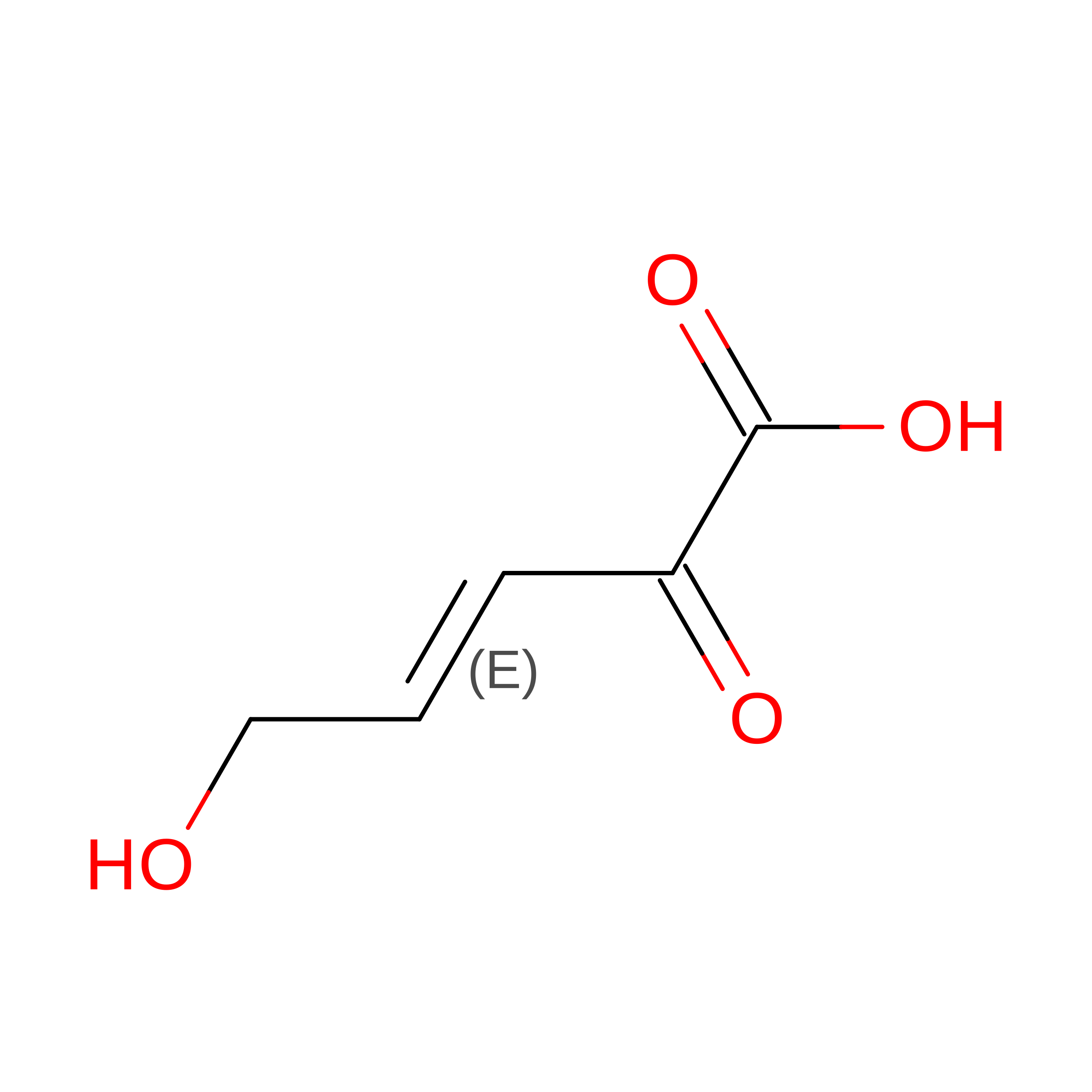
(3E)-5-hydroxy-2-oxopent-3-enoic acid
C5 H6 O4
NQCOHZOKLYGXBP-OWOJBTEDSA-N
Experimental Data & Validation

Experimental Data

  • Method: X-RAY DIFFRACTION
  • Resolution: 2.70 Å
  • R-Value Free:  0.254 (Depositor), 0.250 (DCC) 
  • R-Value Work:  0.221 (Depositor), 0.220 (DCC) 
  • R-Value Observed: 0.223 (Depositor) 
Space Group: P 1 21 1
Unit Cell:
Length ( Å )Angle ( ˚ )
a = 62.746α = 90
b = 90.121β = 96.85
c = 171.445γ = 90
Software Package:
Software NamePurpose
REFMACrefinement
HKL-2000data collection
PDB_EXTRACTdata extraction
HKL-2000data reduction
HKL-2000data scaling
PHASERphasing

Structure Validation

View Full Validation Report


Entry History 

Deposition Data

Revision History  (Full details and data files)

  • Version 1.0: 2018-02-21
    Type: Initial release
  • Version 1.1: 2018-02-28
    Changes: Database references
  • Version 1.2: 2019-04-17
    Changes: Advisory, Author supporting evidence, Data collection, Derived calculations
  • Version 1.3: 2024-10-30
    Changes: Data collection, Database references, Refinement description, Structure summary