5PNT | pdb_00005pnt

CRYSTAL STRUCTURE OF A HUMAN LOW MOLECULAR WEIGHT PHOSPHOTYROSYL PHOSPHATASE. IMPLICATIONS FOR SUBSTRATE SPECIFICITY


Experimental Data Snapshot

  • Method: X-RAY DIFFRACTION
  • Resolution: 2.20 Å
  • R-Value Free: 
    0.248 (Depositor) 
  • R-Value Work: 
    0.181 (Depositor) 
  • R-Value Observed: 
    0.181 (Depositor) 

Starting Model: experimental
View more details

wwPDB Validation 3D Report Full Report

Validation slider image for 5PNT

This is version 1.4 of the entry. See complete history

Literature

Crystal structure of a human low molecular weight phosphotyrosyl phosphatase. Implications for substrate specificity.

Zhang, M.Stauffacher, C.V.Lin, D.Van Etten, R.L.

(1998) J Biological Chem 273: 21714-21720

  • DOI: https://doi.org/10.1074/jbc.273.34.21714
  • Primary Citation Related Structures: 
    5PNT

  • PubMed Abstract: 

    The low molecular weight phosphotyrosine phosphatases (PTPases) constitute a distinctive class of phosphotyrosine phosphatases that is widely distributed among vertebrate and invertebrate organisms. In vertebrates, two isoenzymes of these low molecular weight PTPases are commonly expressed. The two human isoenzymes, HCPTPA and HCPTPB, differ in an alternatively spliced sequence (residues 40-73) referred to as the variable loop, resulting in isoenzymes that have different substrate specificities and inhibitor/activator responses. We present here the x-ray crystallographic structure of a human low molecular weight PTPase solved by molecular replacement to 2.2 A. The structure of human low molecular weight PTPase is compared with a structure representing the other isoenzyme in this PTPase class, in each case with a sulfonate inhibitor bound to the active site. Possible aromatic residue interactions with the phosphotyrosine substrate are proposed from an examination of the binding site of the inhibitors. Differences are observed in the variable loop region, which forms one wall and the floor of a long crevice leading from the active-site loop. A set of residues lying along this crevice (amino acids 49, 50, and 53) is suggested to be responsible for differences in substrate specificity in these two enzymes.


  • Organizational Affiliation
    • Department of Chemistry, Purdue University, West Lafayette, Indiana 47907-1393, USA.

Macromolecule Content 

  • Total Structure Weight: 18.13 kDa 
  • Atom Count: 1,347 
  • Modeled Residue Count: 157 
  • Deposited Residue Count: 157 
  • Unique protein chains: 1

Macromolecules

Find similar proteins by:|  3D Structure
Entity ID: 1
MoleculeChains  Sequence LengthOrganismDetailsImage
LOW MOLECULAR WEIGHT PHOSPHOTYROSYL PHOSPHATASE157Homo sapiensMutation(s): 0 
EC: 3.1.3.2 (PDB Primary Data), 3.1.3.48 (UniProt)
UniProt & NIH Common Fund Data Resources
Find proteins for P24666 (Homo sapiens)
Explore P24666 
Go to UniProtKB:  P24666
PHAROS:  P24666
GTEx:  ENSG00000143727 
Entity Groups
Sequence Clusters30% Identity50% Identity70% Identity90% Identity95% Identity100% Identity
UniProt GroupP24666
Sequence Annotations
Expand
Reference Sequence

Small Molecules

Ligands 1 Unique
IDChains Name / Formula / InChI Key2D Diagram3D Interactions
MES

Query on MES


Download:Ideal Coordinates CCD File
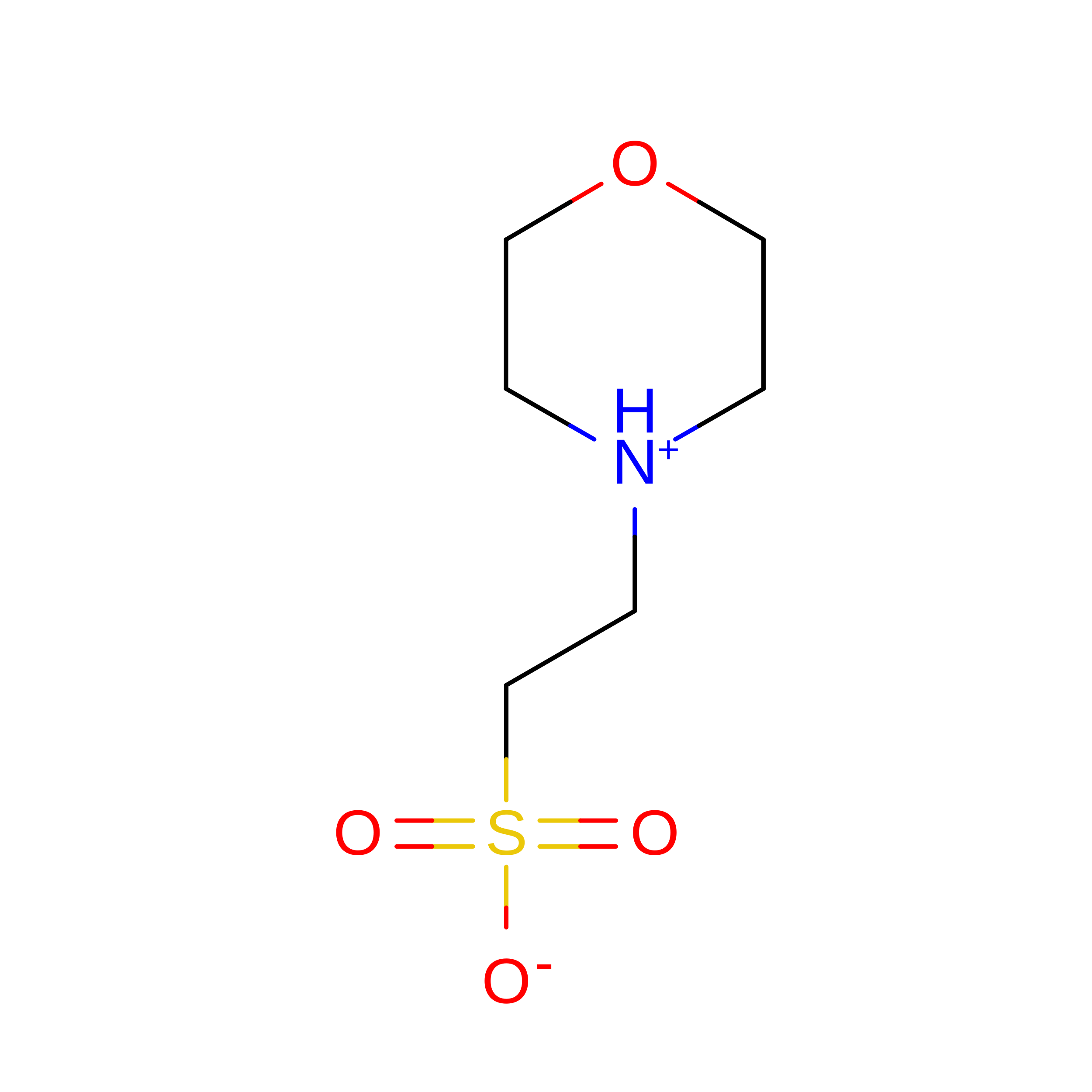
B [auth A]2-(N-MORPHOLINO)-ETHANESULFONIC ACID
C6 H13 N O4 S
SXGZJKUKBWWHRA-UHFFFAOYSA-N

Experimental Data & Validation

Experimental Data

  • Method: X-RAY DIFFRACTION
  • Resolution: 2.20 Å
  • R-Value Free:  0.248 (Depositor) 
  • R-Value Work:  0.181 (Depositor) 
  • R-Value Observed: 0.181 (Depositor) 
Space Group: P 21 21 21
Unit Cell:
Length ( Å )Angle ( ˚ )
a = 34.1α = 90
b = 56.6β = 90
c = 97.3γ = 90
Software Package:
Software NamePurpose
X-PLORmodel building
X-PLORrefinement
DENZOdata reduction
SCALEPACKdata scaling
X-PLORphasing

Structure Validation

View Full Validation Report


Entry History 

Deposition Data

Revision History  (Full details and data files)

  • Version 1.0: 1998-10-14
    Type: Initial release
  • Version 1.1: 2008-03-25
    Changes: Version format compliance
  • Version 1.2: 2011-07-13
    Changes: Version format compliance
  • Version 1.3: 2023-08-09
    Changes: Database references, Derived calculations, Other, Refinement description
  • Version 1.4: 2024-05-22
    Changes: Data collection