5O7M | pdb_00005o7m

Single-shot pink beam serial crystallography: Phycocyanin (One chip, chip_1)


Experimental Data Snapshot

  • Method: X-RAY DIFFRACTION
  • Resolution: 2.46 Å
  • R-Value Free: 
    0.196 (Depositor), 0.196 (DCC) 
  • R-Value Work: 
    0.142 (Depositor), 0.144 (DCC) 
  • R-Value Observed: 
    0.147 (Depositor) 

Starting Model: experimental
View more details

wwPDB Validation 3D Report Full Report

Validation slider image for 5O7M

Ligand Structure Quality Assessment 


This is version 2.0 of the entry. See complete history

Literature

Pink-beam serial crystallography.

Meents, A.Wiedorn, M.O.Srajer, V.Henning, R.Sarrou, I.Bergtholdt, J.Barthelmess, M.Reinke, P.Y.A.Dierksmeyer, D.Tolstikova, A.Schaible, S.Messerschmidt, M.Ogata, C.M.Kissick, D.J.Taft, M.H.Manstein, D.J.Lieske, J.Oberthuer, D.Fischetti, R.F.Chapman, H.N.

(2017) Nat Commun 8: 1281-1281

  • DOI: https://doi.org/10.1038/s41467-017-01417-3
  • Primary Citation Related Structures: 
    5MJL, 5MJM, 5MJP, 5MJQ, 5O7M

  • PubMed Abstract: 

    Serial X-ray crystallography allows macromolecular structure determination at both X-ray free electron lasers (XFELs) and, more recently, synchrotron sources. The time resolution for serial synchrotron crystallography experiments has been limited to millisecond timescales with monochromatic beams. The polychromatic, "pink", beam provides a more than two orders of magnitude increased photon flux and hence allows accessing much shorter timescales in diffraction experiments at synchrotron sources. Here we report the structure determination of two different protein samples by merging pink-beam diffraction patterns from many crystals, each collected with a single 100 ps X-ray pulse exposure per crystal using a setup optimized for very low scattering background. In contrast to experiments with monochromatic radiation, data from only 50 crystals were required to obtain complete datasets. The high quality of the diffraction data highlights the potential of this method for studying irreversible reactions at sub-microsecond timescales using high-brightness X-ray facilities.


  • Organizational Affiliation
    • Center for Free Electron Laser Science, DESY, Notkestrasse 85, 22607, Hamburg, Germany. alke.meents@desy.de.

Macromolecule Content 

  • Total Structure Weight: 37.44 kDa 
  • Atom Count: 2,694 
  • Modeled Residue Count: 334 
  • Deposited Residue Count: 334 
  • Unique protein chains: 2

Macromolecules

Find similar proteins by:|  3D Structure
Entity ID: 1
MoleculeChains  Sequence LengthOrganismDetailsImage
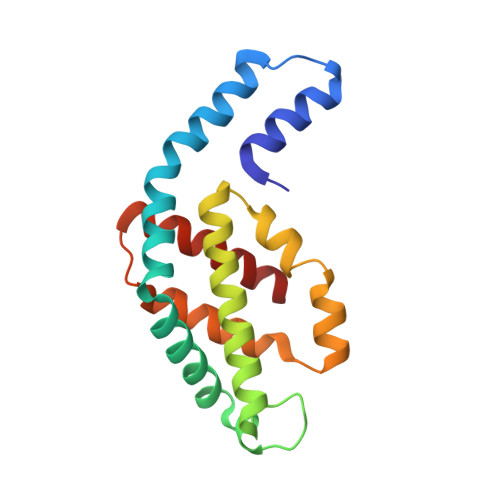
C-phycocyanin alpha chain162Thermosynechococcus vestitus BP-1Mutation(s): 0 
UniProt
Find proteins for P50032 (Thermosynechococcus vestitus (strain NIES-2133 / IAM M-273 / BP-1))
Explore P50032 
Go to UniProtKB:  P50032
Entity Groups
Sequence Clusters30% Identity50% Identity70% Identity90% Identity95% Identity100% Identity
UniProt GroupP50032
Sequence Annotations
Expand
Reference Sequence
Find similar proteins by:|  3D Structure
Entity ID: 2
MoleculeChains  Sequence LengthOrganismDetailsImage
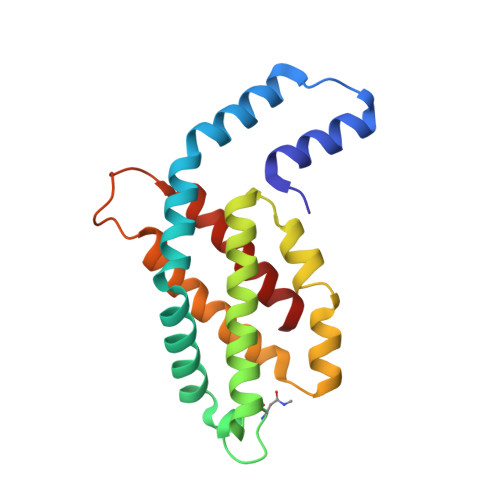
C-phycocyanin beta chain172Thermosynechococcus vestitus BP-1Mutation(s): 0 
UniProt
Find proteins for P50033 (Thermosynechococcus vestitus (strain NIES-2133 / IAM M-273 / BP-1))
Explore P50033 
Go to UniProtKB:  P50033
Entity Groups
Sequence Clusters30% Identity50% Identity70% Identity90% Identity95% Identity100% Identity
UniProt GroupP50033
Sequence Annotations
Expand
Reference Sequence

Experimental Data & Validation

Experimental Data

  • Method: X-RAY DIFFRACTION
  • Resolution: 2.46 Å
  • R-Value Free:  0.196 (Depositor), 0.196 (DCC) 
  • R-Value Work:  0.142 (Depositor), 0.144 (DCC) 
  • R-Value Observed: 0.147 (Depositor) 
Space Group: H 3 2
Unit Cell:
Length ( Å )Angle ( ˚ )
a = 187.8α = 90
b = 187.8β = 90
c = 60.7γ = 120
Software Package:
Software NamePurpose
PHENIXrefinement
Precognitiondata reduction
PHASERphasing
Epinormdata reduction

Structure Validation

View Full Validation Report


Ligand Structure Quality Assessment 


Entry History 

Deposition Data

Revision History  (Full details and data files)

  • Version 1.0: 2017-11-15
    Type: Initial release
  • Version 2.0: 2024-01-17
    Changes: Atomic model, Data collection, Database references, Refinement description