5M42 | pdb_00005m42

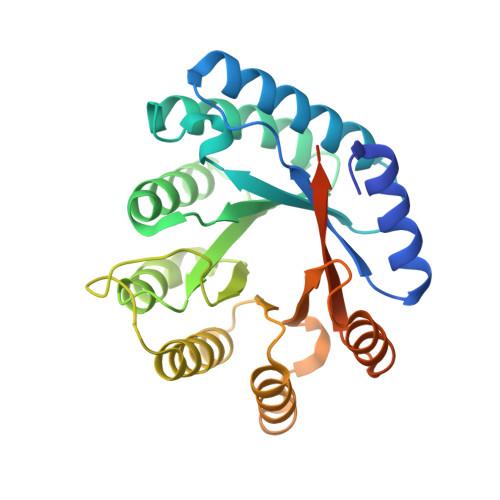
Structure of Thermus thermophilus L-proline dehydrogenase lacking alpha helices A, B and C


Experimental Data Snapshot

  • Method: X-RAY DIFFRACTION
  • Resolution: 2.20 Å
  • R-Value Free: 
    0.225 (Depositor), 0.234 (DCC) 
  • R-Value Work: 
    0.182 (Depositor), 0.192 (DCC) 
  • R-Value Observed: 
    0.185 (Depositor) 

Starting Model: experimental
View more details

wwPDB Validation 3D Report Full Report

Validation slider image for 5M42

Ligand Structure Quality Assessment 


This is version 1.1 of the entry. See complete history

Literature

Proline dehydrogenase from Thermus thermophilus does not discriminate between FAD and FMN as cofactor.

Huijbers, M.M.Martinez-Julvez, M.Westphal, A.H.Delgado-Arciniega, E.Medina, M.van Berkel, W.J.

(2017) Sci Rep 7: 43880-43880

  • DOI: https://doi.org/10.1038/srep43880
  • Primary Citation Related Structures: 
    5M42

  • PubMed Abstract: 

    Flavoenzymes are versatile biocatalysts containing either FAD or FMN as cofactor. FAD often binds to a Rossmann fold, while FMN prefers a TIM-barrel or flavodoxin-like fold. Proline dehydrogenase is denoted as an exception: it possesses a TIM barrel-like fold while binding FAD. Using a riboflavin auxotrophic Escherichia coli strain and maltose-binding protein as solubility tag, we produced the apoprotein of Thermus thermophilus ProDH (MBP-TtProDH). Remarkably, reconstitution with FAD or FMN revealed that MBP-TtProDH has no preference for either of the two prosthetic groups. Kinetic parameters of both holo forms are similar, as are the dissociation constants for FAD and FMN release. Furthermore, we show that the holo form of MBP-TtProDH, as produced in E. coli TOP10 cells, contains about three times more FMN than FAD. In line with this flavin content, the crystal structure of TtProDH variant ΔABC, which lacks helices αA, αB and αC, shows no electron density for an AMP moiety of the cofactor. To the best of our knowledge, this is the first example of a flavoenzyme that does not discriminate between FAD and FMN as cofactor. Therefore, classification of TtProDH as an FAD-binding enzyme should be reconsidered.


  • Organizational Affiliation
    • Laboratory of Biochemistry, Wageningen University &Research, Stippeneng 4, 6708 WE Wageningen, The Netherlands.

Macromolecule Content 

  • Total Structure Weight: 32.88 kDa 
  • Atom Count: 2,071 
  • Modeled Residue Count: 242 
  • Deposited Residue Count: 279 
  • Unique protein chains: 1

Macromolecules

Find similar proteins by:|  3D Structure
Entity ID: 1
MoleculeChains  Sequence LengthOrganismDetailsImage
Proline dehydrogenase279Thermus thermophilus HB27Mutation(s): 0 
Gene Names: TT_C1214
EC: 1.5.5.2
UniProt
Find proteins for Q72IB8 (Thermus thermophilus (strain ATCC BAA-163 / DSM 7039 / HB27))
Explore Q72IB8 
Go to UniProtKB:  Q72IB8
Entity Groups
Sequence Clusters30% Identity50% Identity70% Identity90% Identity95% Identity100% Identity
UniProt GroupQ72IB8
Sequence Annotations
Expand
Reference Sequence

Small Molecules

Ligands 1 Unique
IDChains Name / Formula / InChI Key2D Diagram3D Interactions
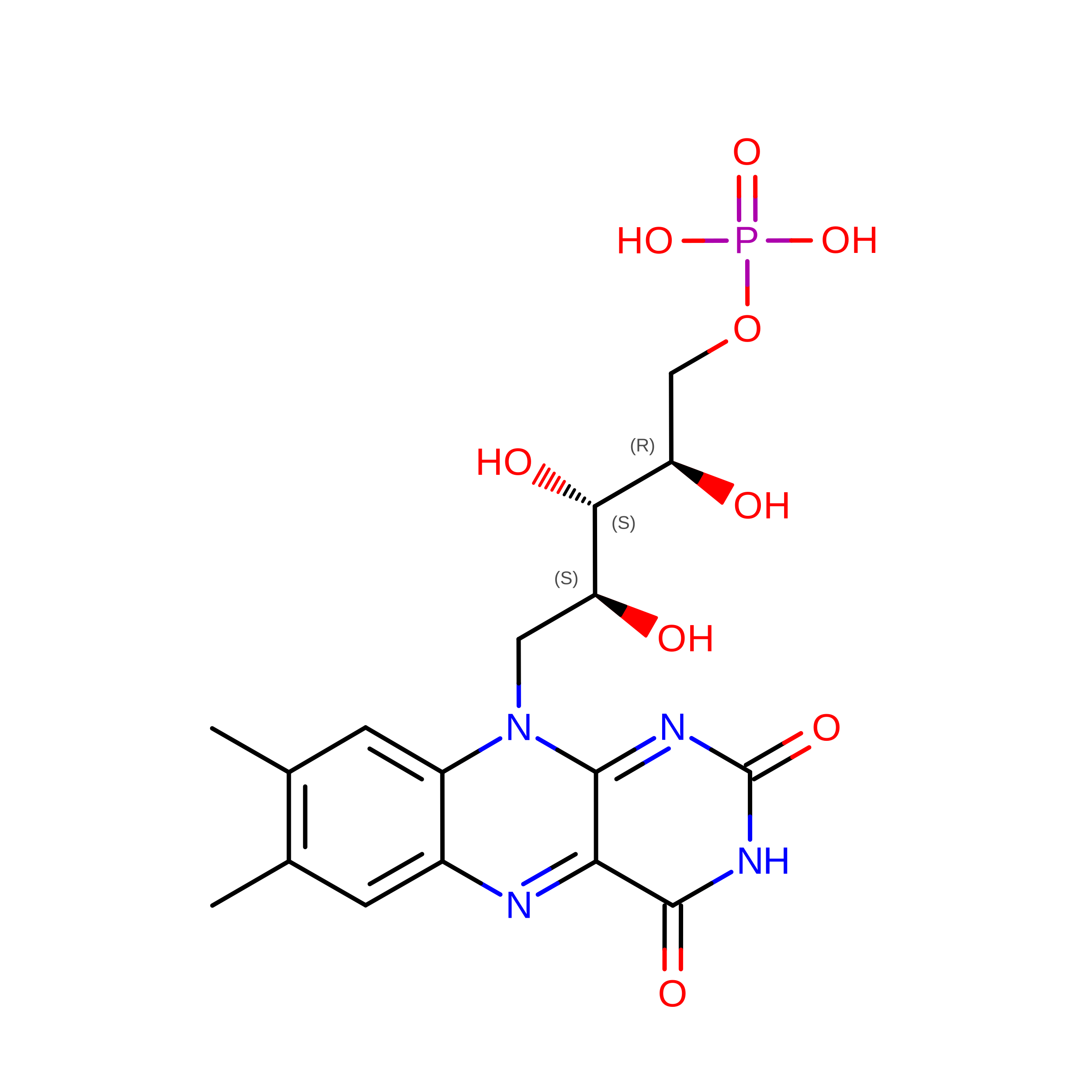
FMN

Query on FMN


Download:Ideal Coordinates CCD File
B [auth A]FLAVIN MONONUCLEOTIDE
C17 H21 N4 O9 P
FVTCRASFADXXNN-SCRDCRAPSA-N

Experimental Data & Validation

Experimental Data

  • Method: X-RAY DIFFRACTION
  • Resolution: 2.20 Å
  • R-Value Free:  0.225 (Depositor), 0.234 (DCC) 
  • R-Value Work:  0.182 (Depositor), 0.192 (DCC) 
  • R-Value Observed: 0.185 (Depositor) 
Space Group: P 62
Unit Cell:
Length ( Å )Angle ( ˚ )
a = 131.92α = 90
b = 131.92β = 90
c = 36.58γ = 120
Software Package:
Software NamePurpose
REFMACrefinement
XDSdata reduction
SCALAdata scaling
MOLREPphasing

Structure Validation

View Full Validation Report


Ligand Structure Quality Assessment 


Entry History 

& Funding Information

Deposition Data


Funding OrganizationLocationGrant Number
MINECOSpainBIO2013-42978-P
NWO and the Graduate School VLAGNetherlandsERA-IB-2

Revision History  (Full details and data files)

  • Version 1.0: 2017-03-15
    Type: Initial release
  • Version 1.1: 2024-01-17
    Changes: Data collection, Database references, Refinement description