5LO1 | pdb_00005lo1

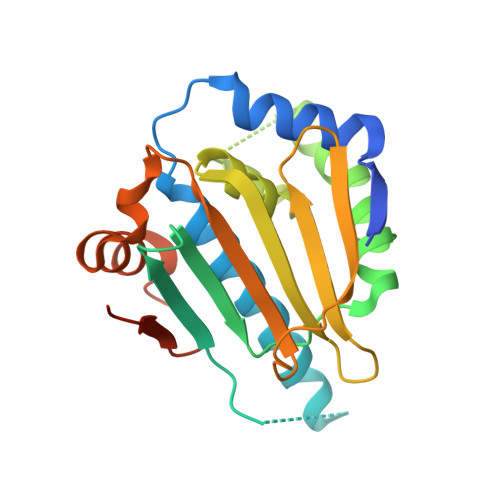
HSP90 WITH indazole derivative


Experimental Data Snapshot

  • Method: X-RAY DIFFRACTION
  • Resolution: 2.70 Å
  • R-Value Free: 
    0.246 (Depositor), 0.245 (DCC) 
  • R-Value Work: 
    0.233 (Depositor), 0.228 (DCC) 
  • R-Value Observed: 
    0.234 (Depositor) 

wwPDB Validation 3D Report Full Report

Validation slider image for 5LO1

Ligand Structure Quality Assessment 


This is version 1.3 of the entry. See complete history

Literature

Ligand Desolvation Steers On-Rate and Impacts Drug Residence Time of Heat Shock Protein 90 (Hsp90) Inhibitors.

Schuetz, D.A.Richter, L.Amaral, M.Grandits, M.Gradler, U.Musil, D.Buchstaller, H.P.Eggenweiler, H.M.Frech, M.Ecker, G.F.

(2018) J Med Chem 61: 4397-4411

  • DOI: https://doi.org/10.1021/acs.jmedchem.8b00080
  • Primary Citation Related Structures: 
    5LNY, 5LNZ, 5LO0, 5LO1, 5NYH, 5OCI, 5OD7, 5ODX

  • PubMed Abstract: 

    Residence time and more recently the association rate constant k on are increasingly acknowledged as important parameters for in vivo efficacy and safety of drugs. However, their broader consideration in drug development is limited by a lack of knowledge of how to optimize these parameters. In this study on a set of 176 heat shock protein 90 inhibitors, structure-kinetic relationships, X-ray crystallography, and molecular dynamics simulations were combined to retrieve a concrete scheme of how to rationally slow down on-rates. We discovered that an increased ligand desolvation barrier by introducing polar substituents resulted in a significant k on decrease. The slowdown was accomplished by introducing polar moieties to those parts of the ligand that point toward a hydrophobic cavity. We validated this scheme by increasing polarity of three Hsp90 inhibitors and observed a 9-, 13-, and 45-fold slowdown of on-rates and a 9-fold prolongation in residence time. This prolongation was driven by transition state destabilization rather than ground state stabilization.


  • Organizational Affiliation
    • Department of Pharmaceutical Chemistry , University of Vienna , UZA 2, Althanstrasse 14 , 1090 Vienna , Austria.

Macromolecule Content 

  • Total Structure Weight: 26.13 kDa 
  • Atom Count: 1,571 
  • Modeled Residue Count: 192 
  • Deposited Residue Count: 229 
  • Unique protein chains: 1

Macromolecules

Find similar proteins by:|  3D Structure
Entity ID: 1
MoleculeChains  Sequence LengthOrganismDetailsImage
Heat shock protein HSP 90-alpha229Homo sapiensMutation(s): 0 
Gene Names: HSP90AA1HSP90AHSPC1HSPCA
EC: 3.6.4.10
UniProt & NIH Common Fund Data Resources
Find proteins for P07900 (Homo sapiens)
Explore P07900 
Go to UniProtKB:  P07900
PHAROS:  P07900
GTEx:  ENSG00000080824 
Entity Groups
Sequence Clusters30% Identity50% Identity70% Identity90% Identity95% Identity100% Identity
UniProt GroupP07900
Sequence Annotations
Expand
Reference Sequence

Small Molecules

Ligands 1 Unique
IDChains Name / Formula / InChI Key2D Diagram3D Interactions
70L

Query on 70L


Download:Ideal Coordinates CCD File
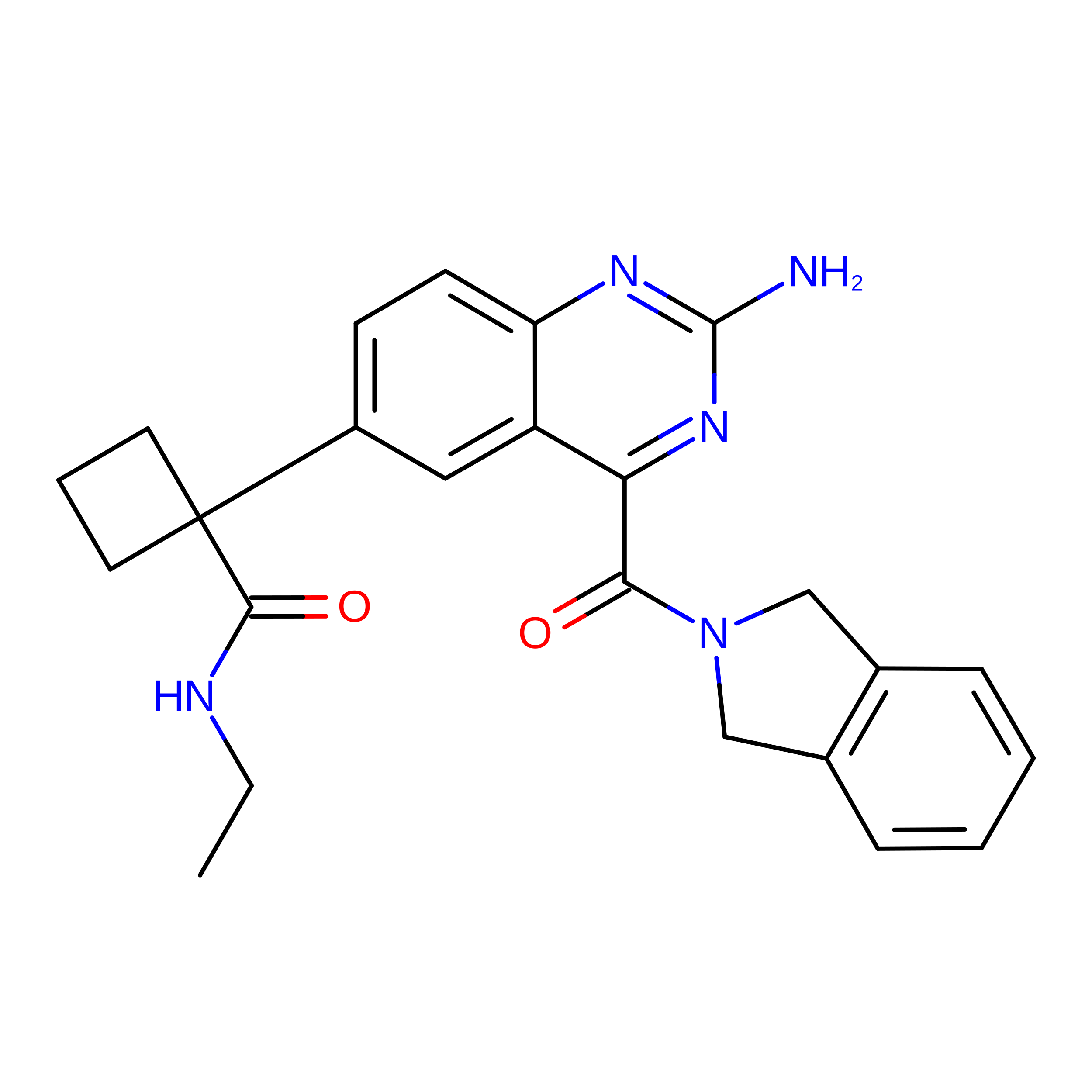
B [auth A]1-[2-Amino-4-(1,3-dihydro-isoindole-2-carbonyl)-quinazolin-6-yl]-cyclobutanecarboxylic acid ethylamide
C24 H25 N5 O2
LPUMTECTUIKIIR-UHFFFAOYSA-N

Experimental Data & Validation

Experimental Data

  • Method: X-RAY DIFFRACTION
  • Resolution: 2.70 Å
  • R-Value Free:  0.246 (Depositor), 0.245 (DCC) 
  • R-Value Work:  0.233 (Depositor), 0.228 (DCC) 
  • R-Value Observed: 0.234 (Depositor) 
Space Group: I 2 2 2
Unit Cell:
Length ( Å )Angle ( ˚ )
a = 65.86α = 90
b = 92.36β = 90
c = 97.11γ = 90
Software Package:
Software NamePurpose
BUSTERrefinement
d*TREKdata reduction
d*TREKdata scaling
MOLREPphasing

Structure Validation

View Full Validation Report


Ligand Structure Quality Assessment 


Entry History 

Deposition Data

Revision History  (Full details and data files)

  • Version 1.0: 2017-11-29
    Type: Initial release
  • Version 1.1: 2018-05-23
    Changes: Data collection, Database references
  • Version 1.2: 2018-06-06
    Changes: Data collection, Database references
  • Version 1.3: 2024-05-08
    Changes: Advisory, Data collection, Database references