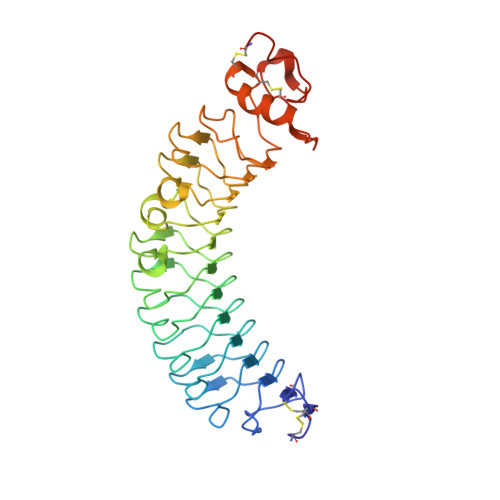
5LFN | pdb_00005lfn

Crystal structure of human chondroadherin


Experimental Data Snapshot

  • Method: X-RAY DIFFRACTION
  • Resolution: 2.10 Å
  • R-Value Free: 
    0.262 (Depositor), 0.262 (DCC) 
  • R-Value Work: 
    0.245 (Depositor), 0.247 (DCC) 
  • R-Value Observed: 
    0.246 (Depositor) 

Starting Model: in silico
View more details

wwPDB Validation 3D Report Full Report

Validation slider image for 5LFN

This is version 1.6 of the entry. See complete history

Literature

Crystal structure of human chondroadherin: solving a difficult molecular-replacement problem using de novo models.

Ramisch, S.Pramhed, A.Tillgren, V.Aspberg, A.Logan, D.T.

(2017) Acta Crystallogr D Struct Biol 73: 53-63

  • DOI: https://doi.org/10.1107/S205979831601980X
  • Primary Citation Related Structures: 
    5LFN

  • PubMed Abstract: 

    Chondroadherin (CHAD) is a cartilage matrix protein that mediates the adhesion of isolated chondrocytes. Its protein core is composed of 11 leucine-rich repeats (LRR) flanked by cysteine-rich domains. CHAD makes important interactions with collagen as well as with cell-surface heparin sulfate proteoglycans and α 2 β 1 integrins. The integrin-binding site is located in a region of hitherto unknown structure at the C-terminal end of CHAD. Peptides based on the C-terminal human CHAD (hCHAD) sequence have shown therapeutic potential for treating osteoporosis. This article describes a still-unconventional structure solution by phasing with de novo models, the first of a β-rich protein. Structure determination of hCHAD using traditional, though nonsystematic, molecular replacement was unsuccessful in the hands of the authors, possibly owing to a combination of low sequence identity to other LRR proteins, four copies in the asymmetric unit and weak translational pseudosymmetry. However, it was possible to solve the structure by generating a large number of de novo models for the central LRR domain using Rosetta and multiple parallel molecular-replacement attempts using AMPLE. The hCHAD structure reveals an ordered C-terminal domain belonging to the LRRCT fold, with the integrin-binding motif (WLEAK) being part of a regular α-helix, and suggests ways in which experimental therapeutic peptides can be improved. The crystal structure itself and docking simulations further support that hCHAD dimers form in a similar manner to other matrix LRR proteins.


  • Organizational Affiliation
    • Department of Biochemistry and Structural Biology, Lund University, Box 124, SE-221 00 Lund, Sweden.

Macromolecule Content 

  • Total Structure Weight: 153.34 kDa 
  • Atom Count: 10,481 
  • Modeled Residue Count: 1,296 
  • Deposited Residue Count: 1,348 
  • Unique protein chains: 1

Macromolecules

Find similar proteins by:|  3D Structure
Entity ID: 1
MoleculeChains  Sequence LengthOrganismDetailsImage
Chondroadherin
A, B, C, D
337Homo sapiensMutation(s): 0 
Gene Names: CHADSLRR4A
UniProt & NIH Common Fund Data Resources
Find proteins for O15335 (Homo sapiens)
Explore O15335 
Go to UniProtKB:  O15335
PHAROS:  O15335
GTEx:  ENSG00000136457 
Entity Groups
Sequence Clusters30% Identity50% Identity70% Identity90% Identity95% Identity100% Identity
UniProt GroupO15335
Sequence Annotations
Expand
Reference Sequence

Experimental Data & Validation

Experimental Data

  • Method: X-RAY DIFFRACTION
  • Resolution: 2.10 Å
  • R-Value Free:  0.262 (Depositor), 0.262 (DCC) 
  • R-Value Work:  0.245 (Depositor), 0.247 (DCC) 
  • R-Value Observed: 0.246 (Depositor) 
Space Group: P 1 21 1
Unit Cell:
Length ( Å )Angle ( ˚ )
a = 56.48α = 90
b = 111.59β = 92.22
c = 128.68γ = 90
Software Package:
Software NamePurpose
PHENIXrefinement
XDSdata reduction
XSCALEdata scaling
AMPLEphasing

Structure Validation

View Full Validation Report


Entry History 

Deposition Data

Revision History  (Full details and data files)

  • Version 1.0: 2016-12-28
    Type: Initial release
  • Version 1.1: 2017-01-11
    Changes: Database references
  • Version 1.2: 2017-01-25
    Changes: Database references
  • Version 1.3: 2018-01-17
    Changes: Data collection
  • Version 1.4: 2019-06-12
    Changes: Data collection, Structure summary
  • Version 1.5: 2024-05-01
    Changes: Data collection, Database references, Refinement description
  • Version 1.6: 2024-10-16
    Changes: Structure summary