5LBH | pdb_00005lbh

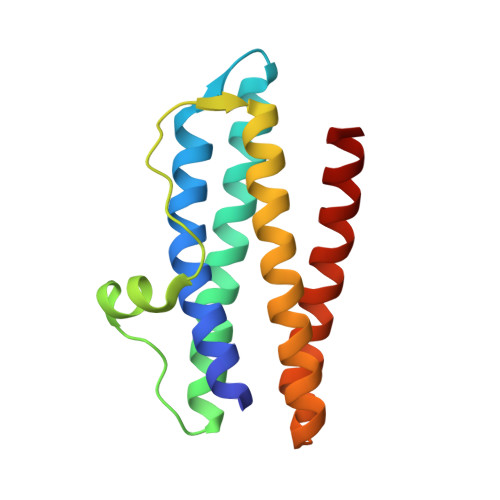
Crystal structure of Helicobacter cinaedi CAIP


Experimental Data Snapshot

  • Method: X-RAY DIFFRACTION
  • Resolution: 2.55 Å
  • R-Value Free: 
    0.248 (Depositor), 0.227 (DCC) 
  • R-Value Work: 
    0.187 (Depositor) 
  • R-Value Observed: 
    0.190 (Depositor) 

Starting Model: experimental
View more details

wwPDB Validation 3D Report Full Report

Validation slider image for 5LBH

This is version 1.1 of the entry. See complete history

Literature

The Helicobacter cinaedi antigen CAIP participates in atherosclerotic inflammation by promoting the differentiation of macrophages in foam cells.

D'Elios, M.M.Vallese, F.Capitani, N.Benagiano, M.Bernardini, M.L.Rossi, M.Rossi, G.P.Ferrari, M.Baldari, C.T.Zanotti, G.de Bernard, M.Codolo, G.

(2017) Sci Rep 7: 40515-40515

  • DOI: https://doi.org/10.1038/srep40515
  • Primary Citation Related Structures: 
    5LBH

  • PubMed Abstract: 

    Recent studies have shown that certain specific microbial infections participate in atherosclerosis by inducing inflammation and immune reactions, but how the pathogens implicated in this pathology trigger the host responses remains unknown. In this study we show that Helicobacter cinaedi (Hc) is a human pathogen linked to atherosclerosis development since at least 27% of sera from atherosclerotic patients specifically recognize a protein of the Hc proteome, that we named Cinaedi Atherosclerosis Inflammatory Protein (CAIP) (n = 71). CAIP appears to be implicated in this pathology because atheromatous plaques isolated from atherosclerotic patients are enriched in CAIP-specific T cells (10%) which, in turn, we show to drive a Th1 inflammation, an immunopathological response typically associated to atherosclerosis. Recombinant CAIP promotes the differentiation and maintenance of the pro-inflammatory profile of human macrophages and triggers the formation of foam cells, which are a hallmark of atherosclerosis. This study identifies CAIP as a relevant factor in atherosclerosis inflammation linked to Hc infection and suggests that preventing and eradicating Hc infection could reduce the incidence of atherosclerosis.


  • Organizational Affiliation
    • Department of Experimental and Clinical Medicine, University of Florence, Florence, Italy.

Macromolecule Content 

  • Total Structure Weight: 198.26 kDa 
  • Atom Count: 14,026 
  • Modeled Residue Count: 1,716 
  • Deposited Residue Count: 1,740 
  • Unique protein chains: 1

Macromolecules

Find similar proteins by:|  3D Structure
Entity ID: 1
MoleculeChains  Sequence LengthOrganismDetailsImage
CAIP
A, B, C, D, E
A, B, C, D, E, F, G, H, I, J, K, L
145Helicobacter cinaediMutation(s): 0 
Gene Names: HCN_0606

Small Molecules

Ligands 1 Unique
IDChains Name / Formula / InChI Key2D Diagram3D Interactions
FE

Query on FE


Download:Ideal Coordinates CCD File
M [auth A]
N [auth B]
O [auth C]
P [auth D]
Q [auth E]
M [auth A],
N [auth B],
O [auth C],
P [auth D],
Q [auth E],
R [auth F],
S [auth G],
T [auth H],
U [auth I],
V [auth J],
W [auth K],
X [auth L]
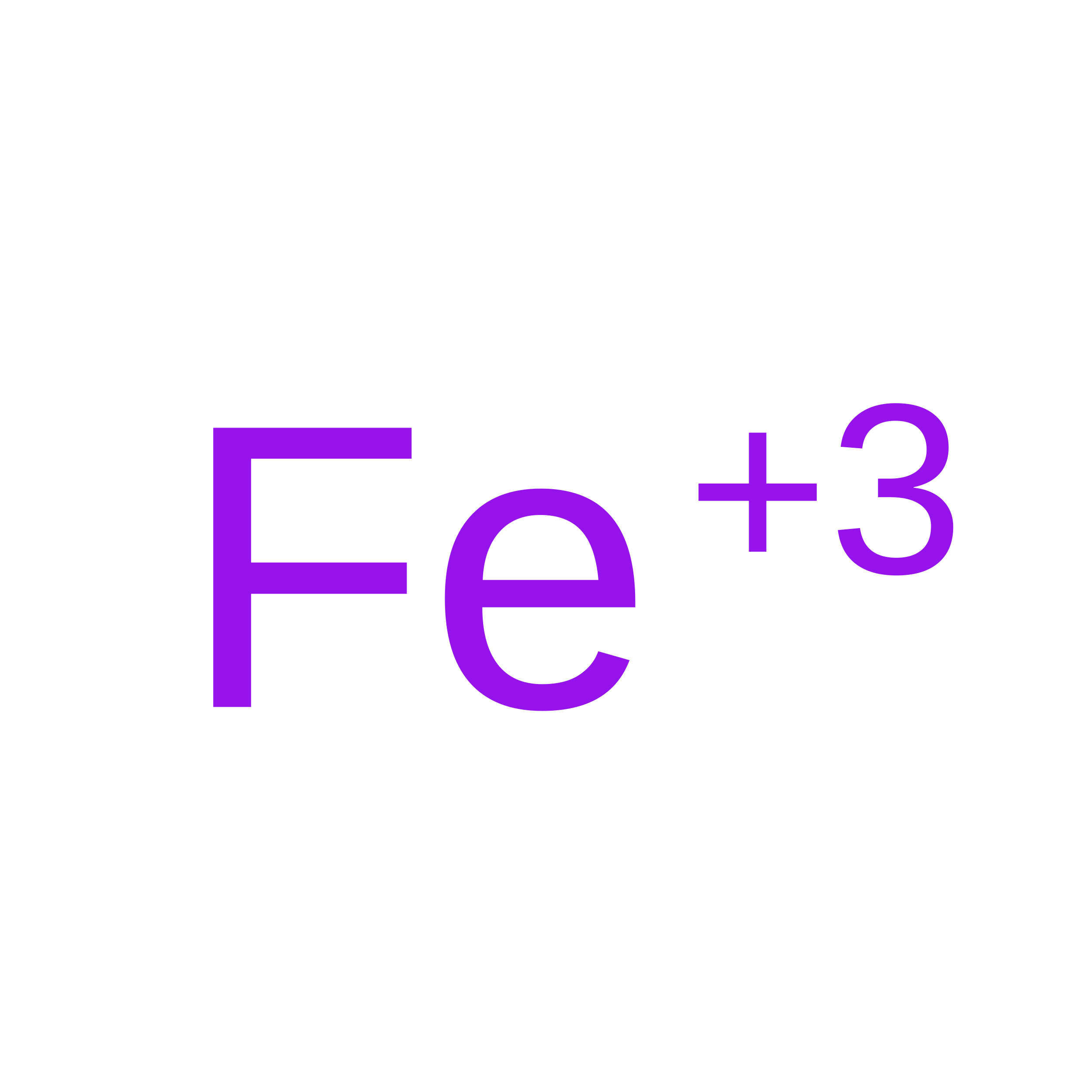
FE (III) ION
Fe
VTLYFUHAOXGGBS-UHFFFAOYSA-N

Experimental Data & Validation

Experimental Data

  • Method: X-RAY DIFFRACTION
  • Resolution: 2.55 Å
  • R-Value Free:  0.248 (Depositor), 0.227 (DCC) 
  • R-Value Work:  0.187 (Depositor) 
  • R-Value Observed: 0.190 (Depositor) 
Space Group: P 1 21 1
Unit Cell:
Length ( Å )Angle ( ˚ )
a = 89.746α = 90
b = 135.918β = 114.5
c = 93.445γ = 90
Software Package:
Software NamePurpose
PHENIXrefinement
XDSdata reduction
SCALAdata scaling
PHASERphasing

Structure Validation

View Full Validation Report


Entry History 

& Funding Information

Deposition Data


Funding OrganizationLocationGrant Number
MIURItalyPRIN 2015KH7Z5K

Revision History  (Full details and data files)

  • Version 1.0: 2017-04-26
    Type: Initial release
  • Version 1.1: 2024-01-10
    Changes: Data collection, Database references, Derived calculations, Refinement description