5L9N | pdb_00005l9n

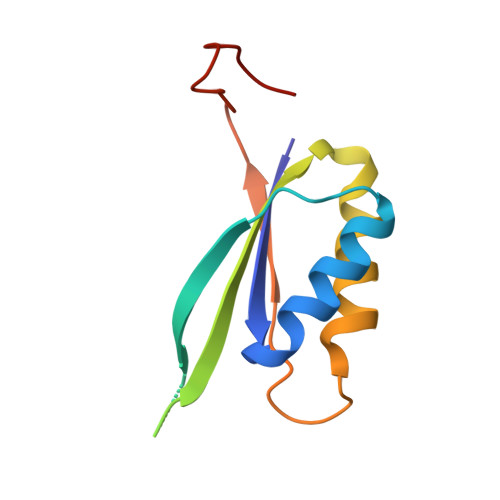
Structure of uridylylated GlnB from Escherichia coli bound to ATP


Experimental Data Snapshot

  • Method: X-RAY DIFFRACTION
  • Resolution: 1.90 Å
  • R-Value Free: 
    0.223 (Depositor), 0.226 (DCC) 
  • R-Value Work: 
    0.184 (Depositor), 0.188 (DCC) 
  • R-Value Observed: 
    0.185 (Depositor) 

Starting Model: experimental
View more details

wwPDB Validation 3D Report Full Report

Validation slider image for 5L9N

Ligand Structure Quality Assessment 


This is version 2.0 of the entry. See complete history

Literature

Effects of T-loop modification on the PII-signalling protein: structure of uridylylated Escherichia coli GlnB bound to ATP.

Palanca, C.Rubio, V.

(2017) Environ Microbiol Rep 9: 290-299

  • DOI: https://doi.org/10.1111/1758-2229.12533
  • Primary Citation Related Structures: 
    5L9N

  • PubMed Abstract: 

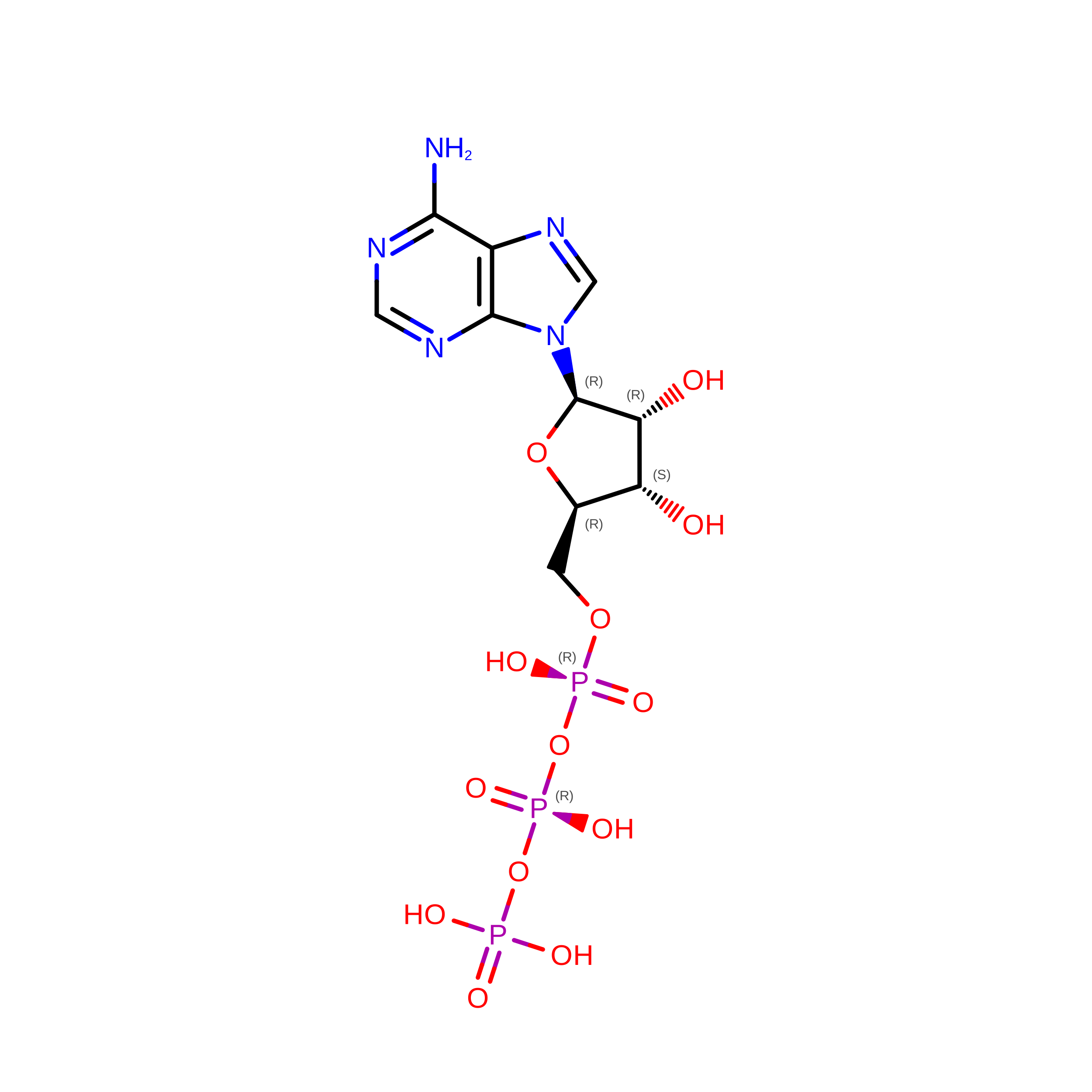
    To adapt to environments with variable nitrogen sources and richness, the widely distributed homotrimeric PII signalling proteins bind their allosteric effectors ADP/ATP/2-oxoglutarate, and experience nitrogen-sensitive uridylylation of their flexible T-loops at Tyr51, regulating their interactions with effector proteins. To clarify whether uridylylation triggers a given T-loop conformation, we determined the crystal structure of the classical paradigm of PII protein, Escherichia coli GlnB (EcGlnB), in fully uridylylated form (EcGlnB-UMP 3 ). This is the first structure of a postranslationally modified PII protein. This required recombinant production and purification of the uridylylating enzyme GlnD and its use for full uridylylation of large amounts of recombinantly produced pure EcGlnB. Unlike crystalline non-uridylylated EcGlnB, in which T-loops are fixed, uridylylation rendered the T-loop highly mobile because of loss of contacts mediated by Tyr51, with concomitant abolition of T-loop anchoring via Arg38 on the ATP site. This site was occupied by ATP, providing the first, long-sought snapshot of the EcGlnB-ATP complex, connecting ATP binding with T-loop changes. Inferences are made on the mechanisms of PII selectivity for ATP and of PII-UMP 3 signalling, proposing a model for the architecture of the complex of EcGlnB-UMP 3 with the uridylylation-sensitive PII target ATase (which adenylylates/deadenylylates glutamine synthetase [GS]) and with GS.


  • Organizational Affiliation
    • Instituto de Biomedicina de Valencia of the CSIC (IBV-CSIC), Spain.

Macromolecule Content 

  • Total Structure Weight: 12.97 kDa 
  • Atom Count: 787 
  • Modeled Residue Count: 92 
  • Deposited Residue Count: 112 
  • Unique protein chains: 1

Macromolecules

Find similar proteins by:|  3D Structure
Entity ID: 1
MoleculeChains  Sequence LengthOrganismDetailsImage
Nitrogen regulatory protein P-II 1112Escherichia coli K-12Mutation(s): 0 
Gene Names: glnBb2553JW2537
UniProt
Find proteins for P0A9Z1 (Escherichia coli (strain K12))
Explore P0A9Z1 
Go to UniProtKB:  P0A9Z1
Entity Groups
Sequence Clusters30% Identity50% Identity70% Identity90% Identity95% Identity100% Identity
UniProt GroupP0A9Z1
Sequence Annotations
Expand
Reference Sequence

Small Molecules

Experimental Data & Validation

Experimental Data

  • Method: X-RAY DIFFRACTION
  • Resolution: 1.90 Å
  • R-Value Free:  0.223 (Depositor), 0.226 (DCC) 
  • R-Value Work:  0.184 (Depositor), 0.188 (DCC) 
  • R-Value Observed: 0.185 (Depositor) 
Space Group: I 21 3
Unit Cell:
Length ( Å )Angle ( ˚ )
a = 88.868α = 90
b = 88.868β = 90
c = 88.868γ = 90
Software Package:
Software NamePurpose
PHENIXrefinement
XDSdata reduction
Aimlessdata scaling
PHASERphasing

Structure Validation

View Full Validation Report


Ligand Structure Quality Assessment 


Entry History 

& Funding Information

Deposition Data


Funding OrganizationLocationGrant Number
Spanish GovernmentSpainBFU2011-30407
Spanish GovernmentSpainBFU2014-58229-P

Revision History  (Full details and data files)

  • Version 1.0: 2017-04-05
    Type: Initial release
  • Version 1.1: 2017-05-10
    Changes: Database references
  • Version 1.2: 2017-05-24
    Changes: Database references
  • Version 2.0: 2024-01-10
    Changes: Atomic model, Data collection, Database references, Derived calculations, Refinement description