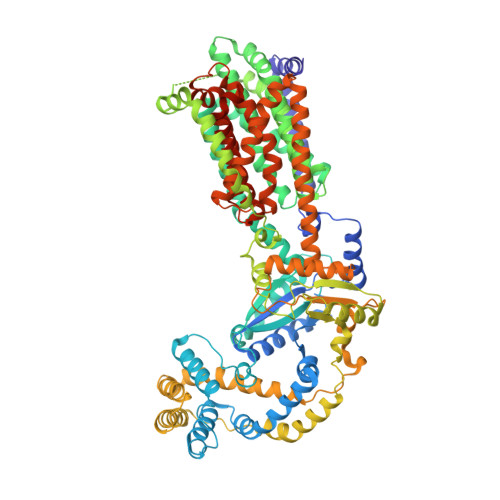
5KHS | pdb_00005khs

Crystal structures of the Burkholderia multivorans hopanoid transporter HpnN


Experimental Data Snapshot

  • Method: X-RAY DIFFRACTION
  • Resolution: 3.76 Å
  • R-Value Free: 
    0.307 (Depositor), 0.311 (DCC) 
  • R-Value Work: 
    0.263 (Depositor), 0.266 (DCC) 
  • R-Value Observed: 
    0.265 (Depositor) 

wwPDB Validation 3D Report Full Report

Validation slider image for 5KHS

This is version 1.3 of the entry. See complete history

Literature

Crystal structures of the Burkholderia multivorans hopanoid transporter HpnN.

Kumar, N.Su, C.C.Chou, T.H.Radhakrishnan, A.Delmar, J.A.Rajashankar, K.R.Yu, E.W.

(2017) Proc Natl Acad Sci U S A 114: 6557-6562

  • DOI: https://doi.org/10.1073/pnas.1619660114
  • Primary Citation Related Structures: 
    5KHN, 5KHS

  • PubMed Abstract: 

    Strains of the Burkholderia cepacia complex (Bcc) are Gram-negative opportunisitic bacteria that are capable of causing serious diseases, mainly in immunocompromised individuals. Bcc pathogens are intrinsically resistant to multiple antibiotics, including β-lactams, aminoglycosides, fluoroquinolones, and polymyxins. They are major pathogens in patients with cystic fibrosis (CF) and can cause severe necrotizing pneumonia, which is often fatal. Hopanoid biosynthesis is one of the major mechanisms involved in multiple antimicrobial resistance of Bcc pathogens. The hpnN gene of B. multivorans encodes an integral membrane protein of the HpnN family of transporters, which is responsible for shuttling hopanoids to the outer membrane. Here, we report crystal structures of B. multivorans HpnN, revealing a dimeric molecule with an overall butterfly shape. Each subunit of the transporter contains 12 transmembrane helices and two periplasmic loops that suggest a plausible pathway for substrate transport. Further analyses indicate that HpnN is capable of shuttling hopanoid virulence factors from the outer leaflet of the inner membrane to the periplasm. Taken together, our data suggest that the HpnN transporter is critical for multidrug resistance and cell wall remodeling in Burkholderia .


  • Organizational Affiliation
    • Department of Chemistry, Iowa State University, Ames, IA 50011.

Macromolecule Content 

  • Total Structure Weight: 187 kDa 
  • Atom Count: 12,679 
  • Modeled Residue Count: 1,705 
  • Deposited Residue Count: 1,766 
  • Unique protein chains: 1

Macromolecules

Find similar proteins by:|  3D Structure
Entity ID: 1
MoleculeChains  Sequence LengthOrganismDetailsImage
Putative RND superfamily efflux pump membrane proteinA [auth B],
B [auth A]
883Burkholderia multivoransMutation(s): 3 
Membrane Entity: Yes 
UniProt
Find proteins for A0A0H3KP92 (Burkholderia multivorans (strain ATCC 17616 / 249))
Explore A0A0H3KP92 
Go to UniProtKB:  A0A0H3KP92
Entity Groups
Sequence Clusters30% Identity50% Identity70% Identity90% Identity95% Identity100% Identity
UniProt GroupA0A0H3KP92
Sequence Annotations
Expand
Reference Sequence

Experimental Data & Validation

Experimental Data

  • Method: X-RAY DIFFRACTION
  • Resolution: 3.76 Å
  • R-Value Free:  0.307 (Depositor), 0.311 (DCC) 
  • R-Value Work:  0.263 (Depositor), 0.266 (DCC) 
  • R-Value Observed: 0.265 (Depositor) 
Space Group: P 1 21 1
Unit Cell:
Length ( Å )Angle ( ˚ )
a = 112.158α = 90
b = 143.374β = 114.1
c = 112.661γ = 90
Software Package:
Software NamePurpose
PHENIXrefinement
SCALEPACKdata scaling
PDB_EXTRACTdata extraction
DENZOdata reduction
PHASERphasing

Structure Validation

View Full Validation Report


Entry History 

Deposition Data

Revision History  (Full details and data files)

  • Version 1.0: 2017-06-14
    Type: Initial release
  • Version 1.1: 2017-06-21
    Changes: Database references
  • Version 1.2: 2017-07-05
    Changes: Database references
  • Version 1.3: 2024-03-06
    Changes: Data collection, Database references