5K6Z | pdb_00005k6z

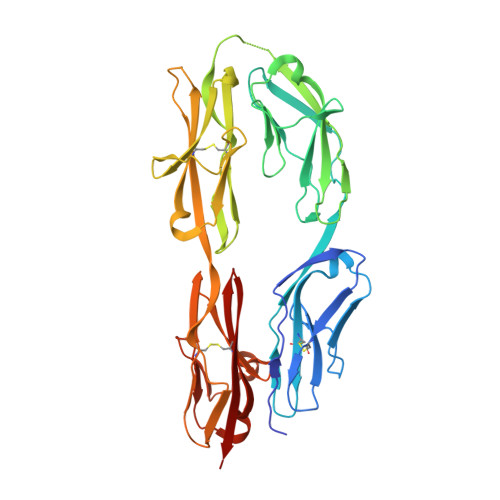
Sidekick chimera containing sidekick-2 immunoglobulin domains 1-2 and sidekick-1 immunoglobulin domains 3-4


Experimental Data Snapshot

  • Method: X-RAY DIFFRACTION
  • Resolution: 2.70 Å
  • R-Value Free: 
    0.233 (Depositor), 0.233 (DCC) 
  • R-Value Work: 
    0.193 (Depositor), 0.193 (DCC) 
  • R-Value Observed: 
    0.195 (Depositor) 

wwPDB Validation 3D Report Full Report

Validation slider image for 5K6Z

Ligand Structure Quality Assessment 


This is version 2.1 of the entry. See complete history

Literature

Molecular basis of sidekick-mediated cell-cell adhesion and specificity.

Goodman, K.M.Yamagata, M.Jin, X.Mannepalli, S.Katsamba, P.S.Ahlsen, G.Sergeeva, A.P.Honig, B.Sanes, J.R.Shapiro, L.

(2016) Elife 5

  • DOI: https://doi.org/10.7554/eLife.19058
  • Primary Citation Related Structures: 
    5K6U, 5K6V, 5K6W, 5K6X, 5K6Y, 5K6Z, 5K70

  • PubMed Abstract: 

    Sidekick (Sdk) 1 and 2 are related immunoglobulin superfamily cell adhesion proteins required for appropriate synaptic connections between specific subtypes of retinal neurons. Sdks mediate cell-cell adhesion with homophilic specificity that underlies their neuronal targeting function. Here we report crystal structures of Sdk1 and Sdk2 ectodomain regions, revealing similar homodimers mediated by the four N-terminal immunoglobulin domains (Ig1-4), arranged in a horseshoe conformation. These Ig1-4 horseshoes interact in a novel back-to-back orientation in both homodimers through Ig1:Ig2, Ig1:Ig1 and Ig3:Ig4 interactions. Structure-guided mutagenesis results show that this canonical dimer is required for both Sdk-mediated cell aggregation (via trans interactions) and Sdk clustering in isolated cells (via cis interactions). Sdk1/Sdk2 recognition specificity is encoded across Ig1-4, with Ig1-2 conferring the majority of binding affinity and differential specificity. We suggest that competition between cis and trans interactions provides a novel mechanism to sharpen the specificity of cell-cell interactions.


  • Organizational Affiliation
    • Department of Biochemistry and Molecular Biophysics, Columbia University, New York, United States.

Macromolecule Content 

  • Total Structure Weight: 86.72 kDa 
  • Atom Count: 5,967 
  • Modeled Residue Count: 753 
  • Deposited Residue Count: 768 
  • Unique protein chains: 1

Macromolecules

Find similar proteins by:|  3D Structure
Entity ID: 1
MoleculeChains  Sequence LengthOrganismDetailsImage
Protein sidekick-2,Protein sidekick-1 chimera
A, B
384Mus musculusMutation(s): 0 
Gene Names: Sdk2Kiaa1514Sdk1
UniProt & NIH Common Fund Data Resources
Find proteins for Q3UH53 (Mus musculus)
Explore Q3UH53 
Go to UniProtKB:  Q3UH53
IMPC:  MGI:2444413
Find proteins for Q6V4S5 (Mus musculus)
Explore Q6V4S5 
Go to UniProtKB:  Q6V4S5
Entity Groups
Sequence Clusters30% Identity50% Identity70% Identity90% Identity95% Identity100% Identity
UniProt GroupsQ3UH53Q6V4S5
Glycosylation
Glycosylation Sites: 1Go to GlyGen: Q3UH53-1Q6V4S5-1
Sequence Annotations
Expand
Reference Sequence

Oligosaccharides

Help  
Entity ID: 2
MoleculeChains Length2D Diagram GlycosylationD Interactions
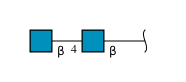
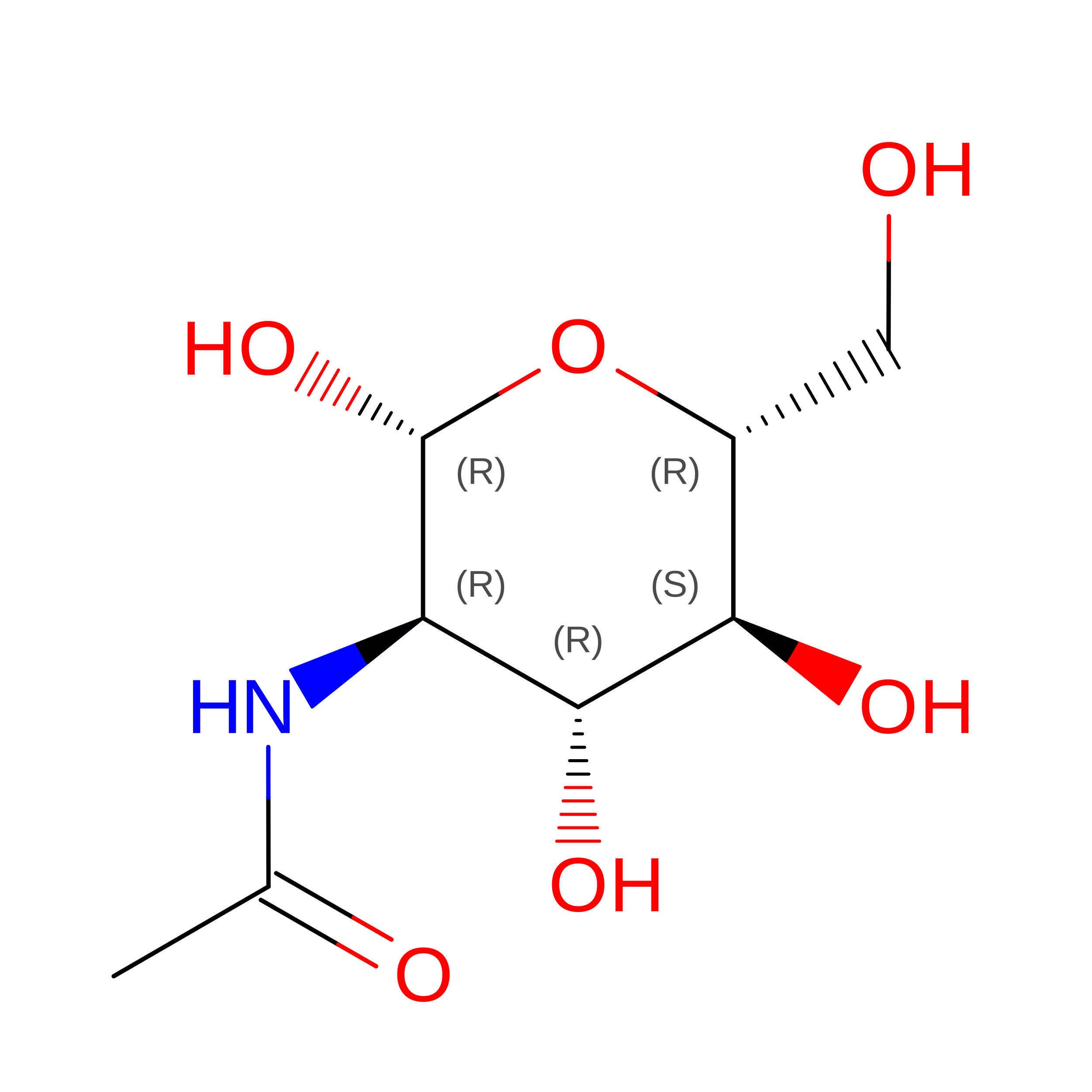
2-acetamido-2-deoxy-beta-D-glucopyranose-(1-4)-2-acetamido-2-deoxy-beta-D-glucopyranose
C
2N-Glycosylation
Glycosylation Resources
GlyTouCan: G42666HT
GlyCosmos: G42666HT
GlyGen: G42666HT

Experimental Data & Validation

Experimental Data

  • Method: X-RAY DIFFRACTION
  • Resolution: 2.70 Å
  • R-Value Free:  0.233 (Depositor), 0.233 (DCC) 
  • R-Value Work:  0.193 (Depositor), 0.193 (DCC) 
  • R-Value Observed: 0.195 (Depositor) 
Space Group: P 2 21 21
Unit Cell:
Length ( Å )Angle ( ˚ )
a = 78.35α = 90
b = 85.73β = 90
c = 146.35γ = 90
Software Package:
Software NamePurpose
PHENIXrefinement
iMOSFLMdata reduction
SCALAdata scaling
PHASERphasing

Structure Validation

View Full Validation Report


Ligand Structure Quality Assessment 


Entry History 

Deposition Data

Revision History  (Full details and data files)

  • Version 1.0: 2016-09-28
    Type: Initial release
  • Version 2.0: 2020-07-29
    Type: Remediation
    Reason: Carbohydrate remediation
    Changes: Atomic model, Data collection, Derived calculations, Structure summary
  • Version 2.1: 2024-11-20
    Changes: Data collection, Database references, Structure summary